25 Best Places to Visit in Karnataka (2026): Beaches, Forts, Hills and Honest Picks
25 best places to visit in Karnataka in 2026 with real timings, costs and what most lists leave out.
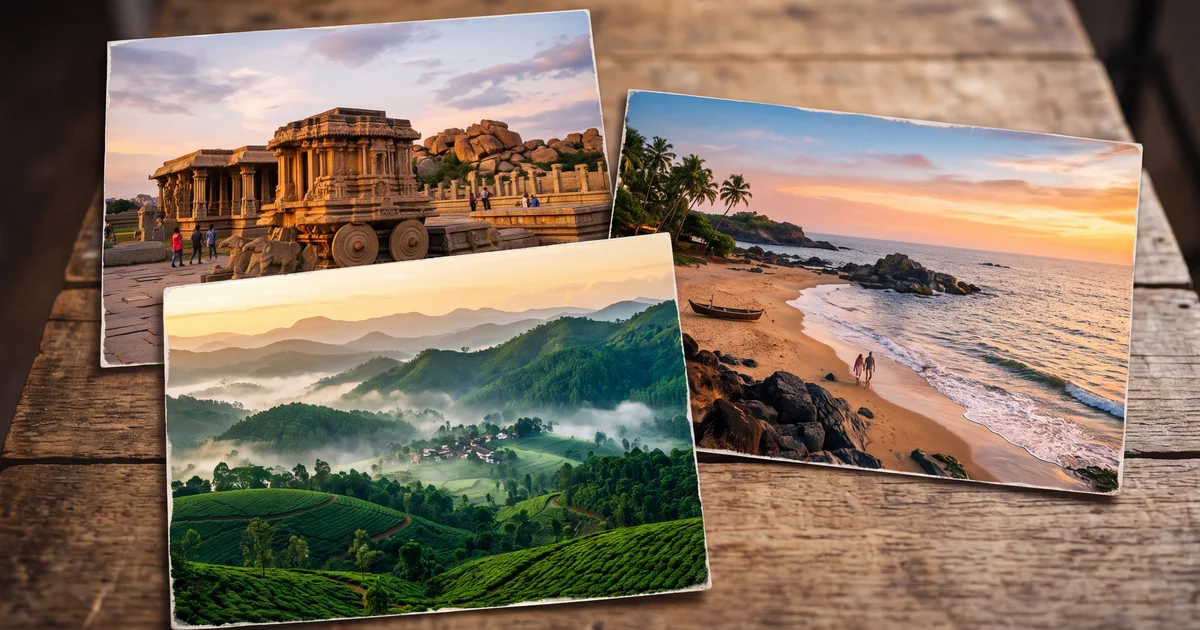
Best places to visit in Karnataka cover about 192,000 square kilometres of coast, highlands, dry plateau and old city ruins. The state runs from the Arabian Sea in the west to the Deccan Plateau in the east, with the Western Ghats drawing a green line through the middle. That geography means you can swim at a beach in Gokarna, drive four hours inland, and be at 1,000 metres elevation in Coorg's coffee country by evening.
Karnataka gets about 300 million domestic tourists a year, according to the state tourism department's 2024 report. Most head to Bangalore or Mysore. Large parts of the state see far fewer visitors than you would expect. Badami's cave temples pull a tenth of the crowd that Hampi gets, even though they are 500 years older.
I have been to 19 of the 25 places on this list. Some through group trips from Bangalore, some on solo road trips, one on a work trip I extended by three days because the coast was too good to leave. This guide is sorted by what worked, what fell short, and where ₹2,000 buys more than it should.
TL;DR
- Coorg, Chikmagalur, Hampi, Gokarna, and Mysore are the five everyone should hit first.
- October to February is ideal for most of the state. Hill stations work through May.
- Budget ₹2,000 to ₹5,000 per person per day depending on whether you stay in hostels or resorts.
- KSRTC buses and trains connect everything. Self drive is comfortable because the highways are decent.
- Do not try to cover the whole state in one trip. Pick a coast and hills combo or a heritage circuit.
What Makes Coorg Worth Multiple Visits?
Coorg (officially Kodagu) sits in the Western Ghats about 250 km southwest of Bangalore. The district produces roughly 30% of India's coffee crop, and in December, the air smells like wet earth and ripe arabica cherries. Rolling green hills, private estates, and plantation homestays fill the district. The families running the homestays usually grew up on the same land.
Abbey Falls is the popular stop, a 21 metre waterfall 8 km from Madikeri town. It gets crowded between 10 AM and 2 PM. Visit before 9 AM. Talakaveri, 48 km from Madikeri, is where the Kaveri River originates. The temple at the summit has views that stretch past the Brahmagiri Range into Kerala on clear mornings.
Raja's Seat in Madikeri is a garden viewpoint that the Kodava kings used for watching sunsets. It is modest but the evening light across the valley is genuine.
The honest caveat: Coorg's roads are narrow two lane through the hills. During monsoon, landslides block sections of the Madikeri to Mangalore highway. Check road conditions if you are driving between June and September.
Stay at a plantation homestay for the real Coorg experience. Rooms run ₹1,500 to ₹4,000 per night with home cooked meals. The pandi curry (pork slow cooked in Coorgi spice paste with kachampuli vinegar) is not optional. You can find it at any local homestay or small restaurant in Madikeri.
Coorg is worth three nights at minimum. Most people do two and leave wanting more time for the lesser visited Nagarhole side.
How Crowded Does Gokarna Actually Get?
Gokarna is a temple town on Karnataka's coast, 490 km from Bangalore. It sits on a peninsula between five beaches: Town Beach, Kudle, Om, Half Moon, and Paradise. Each is separated by a headland you scramble over in 15 to 25 minutes.
The honest answer on crowds: Town Beach and Kudle get busy from December through January, especially on weekends. Om Beach has a steady backpacker population year round. Half Moon and Paradise remain quiet because reaching them requires a 40 minute trail from Om Beach or a boat from the town pier (₹200 to ₹400 per person).
The Mahabaleshwar Temple in the town centre is a 4th century Shiva temple and one of the seven Mukti Sthalas in Hinduism. Most visitors skip it for the beaches. That is a mistake if you have an hour to spare. The temple's carved granite facade and the evening aarti are worth the stop.
Water temperatures hover around 27°C from October to March. Swimming is comfortable at Kudle and Om, but Half Moon has a rocky shelf that makes getting in tricky at low tide. Avoid swimming at Paradise Beach after 3 PM when the current picks up.
Budget travellers stay at shacks on Om Beach for ₹500 to ₹1,000 per night. Namaste Cafe on Om Beach does decent pasta and local fish thali for ₹200 to ₹400. The vibe is barefoot and unhurried. People come for two nights and stay a week. It happens often enough that the shack owners expect it.
For more beach trips from Bangalore, Gokarna is the easiest hit at 8 to 10 hours by overnight KSRTC bus. The bus drops you at the town stand. An auto to Om Beach costs ₹100.
Is Hampi Just for History Buffs?
Hampi is a UNESCO World Heritage Site in northern Karnataka, 340 km from Bangalore. The Vijayanagara Empire ruled from here between 1336 and 1565. What they left behind is 26 square kilometres of granite ruins, boulder fields, and the Tungabhadra River cutting through it all.
You do not need to care about 14th century Deccani history to enjoy Hampi. The landscape alone justifies the trip. Orange boulders the size of houses sit stacked in formations that look engineered but are entirely natural. Sunrise from Matanga Hill (a 30 minute scramble) shows the entire site in one panorama: temples, river, banana plantations, and the boulder valley stretching to the horizon.
That said, the Hampi travel guide covers every temple, climb, and coracle crossing in detail. The short version: Vittala Temple for the musical pillars and stone chariot, Virupaksha Temple for the working shrine, and the Royal Enclosure for the massive stepped tank. Two to three days is right. One day is too rushed.
My opinion: Hampi is the single most visually striking place in Karnataka. I have been twice and neither visit felt repetitive. The north bank (Virupapur Gaddi) is a different world from the temple side. Cross the river by coracle for ₹50.
KSRTC overnight buses from Bangalore to Hospet take 7 to 8 hours (₹600 to ₹1,200). Hospet is 13 km from Hampi.
What Can You Do in Chikmagalur Beyond Coffee Estates?
Chikmagalur is 245 km northwest of Bangalore in the Baba Budan Giri range. It is where coffee arrived in India. A Sufi saint named Baba Budan smuggled seven beans from Yemen in the 17th century and planted them in these hills. The town still runs on coffee estates and the families who manage them.
But the place has more than pour over coffee and estate walks. Mullayanagiri is the highest peak in Karnataka at 1,930 metres. The drive from Chikmagalur town to the base takes 25 minutes. The climb from the parking lot to the summit is about 4 km with 500 stone steps at the end. On clear mornings, the view from the top reaches the coastal plains.
Baba Budangiri, 30 km from town, is a pilgrimage site for both Hindus and Muslims. The dargah/cave temple sits at 1,895 metres. The road up is single lane with tight hairpin turns. Do not attempt it in a sedan during monsoon.
Hebbe Falls is a 168 metre two tiered waterfall in the Bhadra Wildlife Sanctuary. Reaching it requires a jeep ride through a coffee estate (₹3,000 to ₹4,000 per jeep, fits 6 people). The falls are impressive from October through January when the water volume is highest.
The caveat with Chikmagalur: it gets genuinely cold at night from November through February. Temperatures drop below 10°C. Pack layers, especially if you are staying at an estate homestay where the rooms are not always heated.
For detailed coverage, see the Chikmagalur guide. Budget ₹2,000 to ₹4,000 per person per day. Drive or take a KSRTC Volvo from Bangalore (5 hours, ₹500 to ₹900).
Why Do People Rush Through Mysore?
Because most itineraries treat it as a day trip from Bangalore. Mysore is 150 km south, and the expressway puts it within 2.5 hours. That makes it easy to arrive by 10 AM, see the palace, eat lunch, and leave. Easy, but wasteful.
The Amba Vilas Palace (Mysore Palace) is the obvious draw. It is one of the most visited buildings in India after the Taj Mahal. Entry is ₹100 for Indian nationals. The exterior is Indo Saracenic architecture with carved arches, domes, and turrets. Every Sunday and public holiday, the palace is illuminated with 97,000 bulbs at 7 PM. That light show alone justifies staying overnight.
Chamundi Hill, 13 km from the palace, has the Chamundeshwari Temple at the top (1,065 steps or a drive). The 4.9 metre Nandi Bull statue carved from a single boulder sits halfway up the steps. The view of Mysore city from the hilltop is best in the late afternoon when the light softens.
Devaraja Market near the palace is a 130 year old market selling jasmine garlands, sandalwood, kumkum, and produce. The flower section smells incredible at 6 AM when the fresh stock arrives. This is where locals shop. The prices are about a third of what you would pay in the tourist stalls near the palace.
Mysore pak from Guru Sweets near the market is denser and grainier than what gets sold elsewhere. They have been making it since 1935.
Give Mysore two nights. One for the palace, Chamundi Hill, and the market. One for the Brindavan Gardens (18 km away, musical fountain at 6:30 PM) and the walk through Mysore's quieter heritage district around Jayalakshmi Vilas Road.
Where in Karnataka Do the Western Ghats Get Dramatic?
The Western Ghats cross Karnataka from Sakleshpur in the south to Dandeli in the north. The most dramatic sections are around Chikmagalur, Kudremukh, and the rainforests near Agumbe and Shimoga.
Kudremukh National Park (a 3 day trek, permit required from the forest office in Karkala) is one of the best monsoon treks in south India. The grasslands go bright green from July through September. The peak sits at 1,894 metres. The trek crosses streams, leech territory, and shola forests. This is not a casual walk.
Agumbe, 370 km from Bangalore, holds the record for receiving the most rainfall in south India: 7,690 mm in 2014. The village is small, quiet, and surrounded by rainforest. The Agumbe Rainforest Research Station (founded by herpetologist Romulus Whitaker) runs occasional open days. The sunset viewpoint on the main road offers a straight shot to the Arabian Sea horizon on clear days.
Jog Falls near Shimoga is the highest plunge waterfall in India at 253 metres. It is fed by the Sharavati River and best viewed from November through January, when water volumes are still high but the mist clears enough to see all four cascades. Outside monsoon, the falls thin to a trickle by March.
The caveat: roads through the Ghats are narrow, winding, and poorly lit at night. Do not drive these sections after dark. Lorry traffic on the Shiradi Ghat (Bangalore to Mangalore route) makes sections treacherous. Start early, take breaks, and keep your speed under 40 kmph on the hairpins.
What Are the Coastal Towns Beyond Gokarna?
Karnataka's coastline runs 320 km from Mangalore in the south to Karwar in the north. Most travellers only see Gokarna. The rest of the coast is worth exploring.
Mangalore is a city, not a beach town, but its food scene is among the best in south India. Neer dosa with chicken sukka at a local restaurant is a meal that stays with you. Panambur Beach, 10 km from the city centre, is clean and has a surf school that runs beginner lessons (₹1,500 for 90 minutes).
Udupi, 60 km north of Mangalore, is the birthplace of the dosa as most of India knows it. The Krishna Temple in the town centre has been operating since the 13th century. St. Mary's Island, 6 km offshore, has hexagonal basalt columns formed by sub volcanic activity 88 million years ago. Ferry boats run from Malpe Beach (₹300 return, 15 minutes each way).
Karwar sits at the mouth of the Kali River near the Goa border. It is quieter than Gokarna and has decent snorkelling at the offshore islands when the water is clear (November to February). The naval base nearby gives the town a different feel from the backpacker coast further south.
Murudeshwar, between Gokarna and Udupi, has a 37 metre tall Shiva statue visible from the highway. The statue sits on Kanduka Hill overlooking the Arabian Sea. Entry is free. The adjacent Murdeshwar Temple is a functioning shrine. An elevator inside the 20 storey gopuram (₹20) gives panoramic sea views.
Is Badami Worth the Detour?
Badami (Vatapi) sits 500 km north of Bangalore in the dry Deccan Plateau. The Chalukya dynasty made it their capital in the 6th century. The cave temples here are carved into red sandstone cliffs overlooking the Agastya Lake. Four caves, each cut 50 to 80 feet into the cliff face, with carvings of Vishnu, Shiva, Jain tirthankaras, and Buddhist imagery.
Cave 3 is the largest and most ornate. A carving of Vishnu as Trivikrama (cosmic stride) covers the rear wall. The precision on a carving done 1,500 years ago with hand tools is hard to process when you are standing in front of it. Get there before 9 AM to see the morning light hit the sculptures. Photography is allowed without flash.
The Bhutanatha Temples sit at the edge of Agastya Lake, partially submerged during monsoon. The reflection of the red cliffs in the lake water is the signature image of Badami.
My opinion: Badami is the most undervisited major archaeological site in Karnataka. The caves are on par with Ellora in workmanship, smaller in scale but far less crowded. The town itself is quiet, dusty, and has limited accommodation, which keeps the tour groups away.
Budget one full day. Combine with Pattadakal (22 km away, another UNESCO site with Chalukya temples) and Aihole (34 km, often called the cradle of Indian temple architecture). The three together form the Chalukya triangle and need two days total.
Reach Badami by train from Bangalore (8 to 10 hours to Badami station) or drive via Hubli (6 hours from Bangalore, then 2 hours to Badami).
Which Hill Stations Work for Quick Getaways?
Karnataka's hill stations are close enough to Bangalore for a 2 or 3 day trip. The main ones are Coorg (covered above), Chikmagalur (covered above), Sakleshpur, and BR Hills.
Sakleshpur, 220 km from Bangalore, sits between the Shiradi Ghat and the Hassan plateau. The Green Route (an abandoned railway line through 58 tunnels and across valleys) is a popular trek. The 12 km section from Subramanya Road to Donigal takes 5 to 6 hours. It is not official trekking, so go with a local guide who knows the tunnel conditions. Some tunnels are pitch dark for 500 metres.
BR Hills (Biligirirangan Hills) is a wildlife sanctuary 180 km south of Bangalore, at the junction of the Eastern and Western Ghats. It has elephants, leopards, and a significant tiger population, though sightings are rare. The K. Gudi wilderness camp inside the sanctuary runs jeep safaris (₹3,500 per vehicle, morning and evening batches). The camp itself is basic but clean. Book weeks in advance.
Nandi Hills, 60 km from Bangalore, is the closest escape but also the most crowded. On weekends, the parking queue starts at 5:30 AM. Go on a weekday. Tipu Sultan's Summer Palace at the top is a small structure with a big view. Sunrise brings temperatures around 15°C even in October.
For more options near the city, the hill stations near Bangalore guide covers 15 choices sorted by distance and difficulty.
What Heritage Sites Outside Hampi Should You See?
Karnataka has more UNESCO and ASI protected sites than most travellers realise. Beyond Hampi and Badami:
Pattadakal is a UNESCO World Heritage Site 22 km from Badami with 10 temples built between the 7th and 8th centuries. The Virupaksha Temple here (different from the one in Hampi) shows the transition from Dravidian to Nagara architectural styles within a single complex. Entry is ₹40 for Indian nationals.
Belur and Halebidu, near Hassan (200 km from Bangalore), have Hoysala temples from the 12th century. The Chennakeshava Temple in Belur has exterior carvings so detailed that individual jewellery pieces on the sculptures are distinct. Halebidu's Hoysaleshwara Temple, 16 km away, took 190 years to build and was never completed.
Srirangapatna, 15 km from Mysore, is the island fortress where Tipu Sultan made his last stand against the British in 1799. The Gumbaz mausoleum, Tipu's Summer Palace, and the Ranganathaswamy Temple are within walking distance of each other. The entire island takes half a day.
Shravanabelagola, 150 km from Bangalore, has the 17.4 metre monolithic Gommateshwara statue carved in 983 AD. You climb 614 steps to reach it. The statue is visible from the town below. Every 12 years, the Mahamastakabhisheka festival pours milk, saffron, and sandalwood paste over the statue. The next one is in 2030.
How Should You Plan a Karnataka Trip for the First Time?
Start with your interests and available days. Here are three tested routes:
The Heritage Circuit (7 days): Bangalore, Mysore (2 nights), Srirangapatna (day trip from Mysore), Hassan for Belur and Halebidu (1 night), Hampi (2 nights), return via Hospet. This route covers temples, forts, and ruins. Expect 5 to 7 hours of travel between stops.
The Coast and Hills Loop (5 days): Bangalore to Chikmagalur (1 night), Chikmagalur to Udupi via Agumbe (1 night in Udupi), Udupi to Gokarna (2 nights), Gokarna to Bangalore by overnight bus. This is the beach plus coffee estate route. Best between October and February.
The Weekend Dip (2 nights): Bangalore to Coorg (Friday night to Sunday). Or Bangalore to Mysore for the palace on Saturday and Chamundi Hill on Sunday morning. Both work without burning leave days.
For trips from Bangalore with group departures already planned, the routes above are common itineraries offered by most operators. Check departure dates and prices on TripzSearch rather than calling operators individually.
Travel within Karnataka is straightforward. KSRTC buses are reliable and comfortable on the Volvo routes. Train connections work for Mysore, Mangalore, Hospet, and Hubli. Self drive is the most flexible option if you are comfortable with hill roads and two lane highways.
The state is large enough that no single trip covers everything. Come back. There is always another coast, another ruin, another hill that you missed.
Frequently asked questions
- What are the top 5 must visit places in Karnataka?
- Hampi for the Vijayanagara ruins spread across 26 square kilometres, Coorg for the coffee estates and Talakaveri temple, Gokarna for uncrowded beaches within a 30 minute walk of each other, Chikmagalur for Mullayanagiri peak at 1,930 metres, and Mysore for the Amba Vilas Palace lit up every Sunday night. These five cover the range of the state and work as standalone weekend trips.
- What is the best time to visit Karnataka?
- October to February for most of the state. Coastal towns like Gokarna and Mangalore get uncomfortable past March as humidity rises above 80%. Hill stations like Coorg and Chikmagalur are pleasant through May. Monsoon (June to September) turns the Western Ghats green and the waterfalls dramatic, but trails get slippery and some roads flood near Kodagu and Sakleshpur.
- How many days do you need for a Karnataka trip?
- A focused 5 day trip covers one coast town plus one hill station comfortably. A 10 day circuit through Bangalore, Mysore, Coorg, Chikmagalur, Hampi, and Gokarna is the classic loop. Trying to fit everything into less than a week means spending more time on buses than at the places.
- Is Karnataka safe for solo female travellers?
- Bangalore, Mysore, and Coorg are frequently rated among the safer destinations in south India for solo women. Gokarna village is small and well visited. The usual precautions apply: avoid isolated beaches after dark, use registered transport at night, and trust your instincts. Group trips are popular for solo travellers who want company on the road.
- How do I travel within Karnataka?
- KSRTC runs Volvo and sleeper buses between every major town. Bangalore to Mysore costs ₹300 to ₹800 depending on the class. Trains connect Bangalore to Mangalore (7 hours), Hospet for Hampi (8 hours), and Hubli (7 hours). Self drive works well because the state highways are mostly two lane and maintained. Expect 5 to 8 hours of driving for most cross state routes.
- What food should I try in Karnataka?
- Bisi bele bath (a rice and lentil dish with vegetables) is the state staple. Mangalore serves neer dosa with chicken curry that tastes nothing like what you get outside the coast. Coorg has pandi curry (pork in a vinegar and spice gravy) and kadambuttu (rice dumplings). Mysore pak from Guru Sweets in Mysore is the original. Dharwad pedha from Hubli is worth the sugar crash.
- What are some offbeat places in Karnataka?
- Badami for cave temples carved into red sandstone cliffs 1,500 years ago. Dandeli for white water rafting on the Kali River from October to January. Murudeshwar for the 37 metre tall Shiva statue visible from 5 km away. Gokak Falls near Belgaum drops 52 metres and sees a fraction of the tourists that Jog Falls gets.