Best Places to Visit in Hampi (2026): Ruins, Boulders and the Tungabhadra
15 best places to visit in Hampi in 2026, with honest tips on timing, routes and what most travel lists skip.
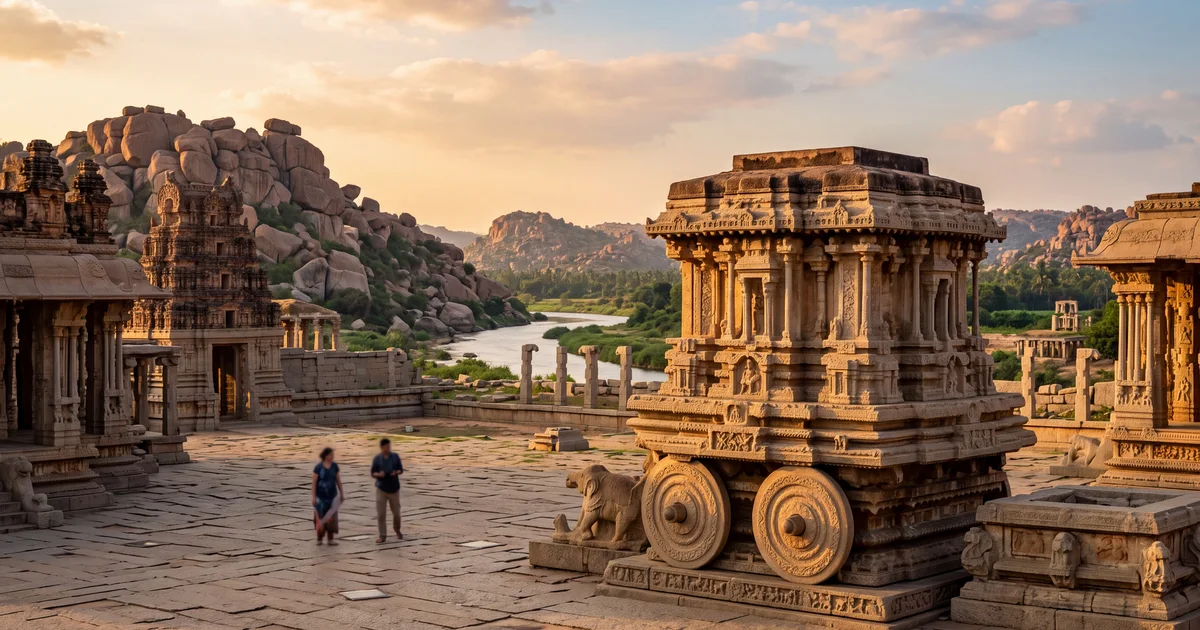
Hampi sits on the south bank of the Tungabhadra River in northern Karnataka, 340 km from Bangalore. It was the capital of the Vijayanagara Empire from 1336 to 1565, a city that housed half a million people and traded diamonds by weight. What remains is 26 square kilometres of granite ruins scattered across a landscape of orange boulders that look like they were placed by a sculptor and then abandoned.
UNESCO listed the site in 1986. The Archaeological Survey of India maintains 56 protected monuments. And despite all the heritage tags, Hampi still feels oddly uncrowded outside December and January. On a Tuesday morning in November, you can walk through the Vittala Temple complex and hear nothing but wind through the stone pillars.
I visited in late October 2025 with two friends on a trip from Bangalore. We spent three days. That was the right amount. Two days would have worked if we had skipped the north bank entirely, but that would have meant missing the best sunset point and the quietest stretch of riverbank.
TL;DR
- Vittala Temple, Virupaksha Temple, Matanga Hill, Hemakuta Hill, and the Royal Enclosure cover the essentials in two days.
- October to February is the window. Anything after March gets genuinely hot (40°C plus).
- Budget ₹1,500 to ₹3,000 per person per day for stays, meals, and bicycle rental.
- Rent a bicycle (₹150 per day) or a moped (₹300 to ₹500 per day). Walking between sites in midday sun is a bad idea.
- The north bank (Virupapur Gaddi) is the quiet side. Cross by coracle for ₹50.
Why Does Everyone Start at Vittala Temple?
Because nothing else in Hampi prepares you for it. The Vittala Temple complex sits 2.5 km northeast of Hampi Bazaar on the south bank. Built between the 14th and 16th centuries, it was never actually consecrated. The deity Vittala (a form of Vishnu) was considered too grand for the temple, according to local lore. Make of that what you will.
The stone chariot in the courtyard is the image everyone recognises. It is a shrine shaped like a temple chariot, carved from granite, sitting on stone wheels that once rotated (the ASI cemented them in place decades ago to prevent damage). The craftsmanship is remarkable. Every wheel has a different spoke pattern.
The musical pillars in the main hall are the other draw. Tap certain pillars and they produce distinct notes. The British reportedly cut one pillar in half to check for hidden resonating chambers. There were none. The sound comes from the stone's mineral composition and the way each pillar was shaped. Some pillars are off limits now, but the guide at the entrance will demonstrate the ones that still ring.
Entry costs ₹40 for Indian nationals, ₹600 for foreign visitors. The complex opens at 6 AM. Get there before 8 AM. By 10 AM, the tour bus groups arrive and the musical pillars are surrounded three deep.
One thing to know: the 2.5 km walk from Hampi Bazaar to Vittala follows a paved path along the riverbank that passes through the old market street. Stone pillars from Vijayanagara era shops line both sides. It is one of the most atmospheric walks in the entire site. Do not take an auto directly to the gate. Walk.
What Can You See from Matanga Hill at Sunrise?
Everything. Matanga Hill is the highest point in Hampi at about 115 metres above the surrounding terrain. The climb starts behind the Achyutaraya Temple on the south bank and takes 20 to 30 minutes depending on your fitness and how many times you stop to photograph the boulders.
The trail is not paved. It is a scramble over granite slabs with some carved steps from the Vijayanagara period. Wear shoes with grip. In the dark before sunrise, a phone torch is enough because the path is well worn and other climbers will be ahead of you.
From the top, the view opens in every direction. Virupaksha Temple's gopuram to the west. The Tungabhadra curving north. Vittala Temple's courtyard to the northeast. The banana plantations of the river valley spread below like a green carpet. On a clear October morning, the sky goes from dark purple to gold in about 20 minutes.
The caveat: there is no railing, no barrier, and no formal path at the summit. The rocks are smooth granite. If it rained the night before, they are slippery. Two tourists were injured in falls here in 2024, both from stepping on wet rock near the edge. Take it seriously.
Start the climb at 5:15 AM in October (sunrise around 6:00 AM) to get a spot. The summit fits maybe 40 people comfortably. On a weekend morning it gets tight.
Is the North Bank Worth Crossing the River For?
The north bank of the Tungabhadra, called Virupapur Gaddi, has a completely different feel from the temple side. Where the south bank is archaeology and tour groups, the north bank is guesthouses, hammocks, rice paddies, and a pace that belongs to a different decade.
Coracle ferries cross the river near Virupaksha Temple. The ride takes 5 minutes and costs ₹50 per person. Coracles are circular wicker boats waterproofed with tar. They spin as they cross, which looks alarming the first time. The service runs from about 7 AM to 5:30 PM and stops during monsoon when the river level rises.
On the north bank, you will find the Anegundi village (one of the oldest continuously inhabited settlements in India, locals claim), the Pampa Sarovar lake mentioned in the Ramayana, and the Anjanadri Hill where Hanuman is said to have been born. The climb up Anjanadri takes 30 to 45 minutes. It is 575 steps. The view at the top covers the entire Tungabhadra valley.
Practically speaking, the north bank is where budget travellers stay. Guesthouses cost ₹500 to ₹1,500 per night. The Laughing Buddha, Mango Tree, and several riverside cafes serve banana pancakes and thalis for ₹100 to ₹200. The vibe leans backpacker. Some people spend three days here and barely cross to the temple side. That is a valid approach if ruins are not your priority.
My take: cross for one afternoon and one sunrise at minimum. Anjanadri Hill at dawn is nearly as good as Matanga, with a quarter of the crowd.
What Is Inside the Royal Enclosure?
The Royal Enclosure is a 59 hectare walled zone on the south bank where the Vijayanagara kings lived. It sits about 2 km south of Virupaksha Temple and contains the most impressive non religious structures in Hampi.
The Mahanavami Dibba is a 12 metre high stone platform where the king watched the nine day Dasara festival. The relief carvings on the platform walls show elephants, horses, wrestlers, dancers, and foreign traders. The detail is sharper here than at most temples because the platform was rebuilt in layers and the inner carvings were protected until excavation.
The stepped tank (Pushkarini) nearby is a geometric marvel. Five tiers of steps descend symmetrically to the water on all four sides. The proportions are perfect enough that it looks computer designed. The water was channelled from the Tungabhadra through an aqueduct system that ran underground for 4 km. Parts of the stone aqueduct are still visible along the walking path.
The Lotus Mahal is the other highlight. It is a two storey pavilion with arched windows and lotus bud domes that blend Hindu and Islamic architectural styles. The Vijayanagara court was syncretic in its architecture. Persian, South Indian, and occasionally Jain influences overlap across the complex. The Lotus Mahal was likely a meeting place for the queen's court.
Next to the Lotus Mahal, the Elephant Stables are a row of 11 domed chambers that once housed the royal elephants. Each dome has a different design. The structure is one of the best preserved in Hampi because its construction used mortar alongside stone, making it more resistant to collapse.
One honest observation: the Royal Enclosure requires walking. It is spread out, mostly open ground with limited shade. In March or later, the heat makes it genuinely unpleasant after 10 AM. Carry 2 litres of water minimum and visit early.
How Should You Plan Two Days in Hampi?
Two days is the minimum to cover both banks without running between sites. Here is a practical split.
Day one starts with a 5:15 AM climb up Matanga Hill for sunrise. Come down by 7:30 AM and walk through Achyutaraya Temple at the hill's base (one of the least visited major temples, beautiful stone carvings, rarely more than 10 people inside). Walk north along the river path to Vittala Temple, arriving by 8:30 AM before the crowds. Spend 90 minutes here.
Walk back along the market street toward Virupaksha Temple. Stop for a late breakfast at one of the Hampi Bazaar restaurants (idli vada and coffee for ₹80 to ₹120). Visit Virupaksha Temple, which is still an active Hindu temple. The 50 metre gopuram at the entrance is the tallest structure in Hampi. The inner sanctum has a Shiva lingam and the temple elephant Lakshmi, who blesses visitors for a ₹10 coin.
Afternoon: cycle or auto to the Royal Enclosure. Cover the stepped tank, Mahanavami Dibba, Lotus Mahal, and Elephant Stables. End the day at Hemakuta Hill (the low hill between Virupaksha and the Krishna Temple) for sunset. Hemakuta has clusters of small Jain and Shaivite temples scattered across the boulders, and the sunset view toward the river is better than Matanga because you are facing west.
Day two is the north bank. Cross by coracle after breakfast. Rent a bicycle on the other side (₹100 per day) and ride to Anjanadri Hill. Climb for the view. Continue to Anegundi village, where the fortified gateway and Ranganatha Temple are worth 30 minutes. Ride through the banana plantations back toward the river, stop at a cafe, and cross back by afternoon.
If you have a third day, use it for the outer sites: Pattabhirama Temple (3 km south, nearly no visitors, excellent sculpture), the Underground Shiva Temple (partially submerged, atmospheric when water levels are low), and the Kadirampura gateway on the eastern edge.
What Do You Actually Spend in Hampi?
Hampi is cheap by Indian travel standards. Guesthouses near the bazaar run ₹800 to ₹2,000 per night for a double room with attached bathroom. On the north bank, ₹500 gets you a basic room with a river view. Air conditioning adds ₹500 to ₹1,000 but is only necessary from March onward.
Meals cost ₹100 to ₹250 at the bazaar restaurants. The Mango Tree restaurant (south bank, by the river) is the most famous. The banana leaf thali is ₹150 and the setting under tamarind trees with boulders behind is the reason people eat there. Arrive before noon. By 1 PM, the wait is 30 minutes.
Bicycle rental is ₹150 per day on the south bank. Mopeds cost ₹300 to ₹500 per day and are the better choice if you want to cover the Royal Enclosure and Kamalapuram without exhausting yourself. Autos charge ₹200 to ₹300 for short hops.
The ASI entry ticket for Vittala Temple and the Royal Enclosure is ₹40 for Indians, ₹600 for foreign nationals (combined ticket). Virupaksha Temple entry is a ₹2 donation. Everything else is free to walk into.
Total budget for two nights and two full days: ₹3,000 to ₹6,000 per person including accommodation, meals, transport, and entry fees. Hampi is not a place where money buys a significantly better experience. The ruins are the same whether you spend ₹1,500 or ₹5,000 a day.
How Do You Reach Hampi from Bangalore?
The most common route is the overnight KSRTC bus from Bangalore (Kempegowda Bus Station) to Hospet. Buses depart between 8 PM and 11 PM and arrive by 6 to 7 AM. Airavat Club Class costs ₹1,200, Rajahamsa ₹800, ordinary ₹600. Book on the KSRTC website or at the counter. The Club Class buses have reclining seats that make the 7 hour ride tolerable.
From Hospet, local buses to Hampi run every 30 minutes (₹25, 30 minutes). Autos charge ₹200 to ₹300 for the 13 km trip.
The Hampi Express (Train 16592) runs from Bangalore to Hospet on Tuesdays, Thursdays, and Saturdays, departing at 10 PM and arriving at 7:30 AM. Sleeper class costs around ₹350.
If you drive, the NH48 to Chitradurga and then NH50 to Hospet covers 340 km in about 6 hours. The road is four lane until Chitradurga and decent two lane afterward. There is a toll of approximately ₹300 total.
Group trips from Bangalore typically handle transport, stays, and a guided tour for ₹4,000 to ₹8,000 per person for a 2 night itinerary. Compare options on TripzSearch to find departures that match your dates.
What Most Guides Leave Out About Hampi
The Tungabhadra Dam is 15 km upstream from Hampi. It was built in 1953 and the reservoir supplies irrigation water to the rice paddies that surround the ruins. The dam's musical fountain show runs on weekday evenings (₹20 entry) but it is not worth the trip unless you happen to be passing. The dam viewpoint itself is fine for 15 minutes.
The boulder landscape continues for kilometres beyond the protected area. Climbers come to Hampi specifically for the granite bouldering. Routes range from V0 to V10 on the bouldering scale. The area around Kadirampura and the reservoir rim has the best problems. You will see chalk marks on boulders if you know where to look. No formal climbing gym exists. Bring your own gear or rent from a shop on the north bank.
Hampi Utsav, the annual cultural festival, usually runs in January or February. Three days of classical dance, music performances, and a sound and light show at the Vittala Temple. The crowd triples during the festival. If you want the experience, book accommodation two months ahead.
The coracle ferry is an experience in itself. The circular boats have been used on the Tungabhadra for centuries. The boatmen spin the coracle as they paddle, which feels chaotic but is actually the most efficient way to cross a current in a round vessel. The 5 minute crossing costs ₹50. In monsoon, the same crossing is impossible, and the nearest bridge is in Hospet.
If you only have one day, this is the order: Matanga Hill sunrise, Achyutaraya Temple, Vittala Temple, river walk back to Virupaksha, lunch at the bazaar, Royal Enclosure by auto, Hemakuta Hill sunset. It is a 12 hour day. You will be tired. But you will have seen Hampi's core.
For group trips to Hampi from Bangalore, check dates and operator reviews on TripzSearch to find a departure that fits your weekend.
Frequently asked questions
- What are the top 5 must visit places in Hampi?
- Vittala Temple for the stone chariot and musical pillars, Virupaksha Temple for the oldest working temple in the complex, Matanga Hill for the sunrise view across the entire boulder valley, Hemakuta Hill for sunset with ruined temples in every direction, and the riverside ruins around Achyutaraya Temple. These five give you the range of Hampi in two days without exhausting yourself.
- How many days are enough for Hampi?
- Two full days cover the major sites on both sides of the river. Add a third if you want the outer ruins like Anegundi fort and the Pampa Sarovar lake. Most group trips from Bangalore run 2 night, 3 day itineraries. One day is too rushed because the sites are spread across 26 square kilometres.
- What is the best time to visit Hampi?
- October to February, when daytime temperatures sit between 20°C and 32°C. March through May sends the thermometer past 40°C by noon, which makes walking between ruins miserable. Monsoon (June to September) brings green landscapes but some riverside paths flood and coracle crossings stop.
- How do I reach Hampi from Bangalore?
- Overnight KSRTC buses from Bangalore to Hospet take 7 to 8 hours and cost ₹600 to ₹1,200 depending on the class. Hospet is 13 km from Hampi. The Hampi Express train from Bangalore runs three times a week, reaching Hospet by early morning. Driving takes about 6 hours via NH48 and NH50, roughly 340 km.
- Is Hampi worth visiting in monsoon?
- The boulders and ruins look dramatic against overcast skies, and the crowds drop to almost nothing. But coracle ferries across the Tungabhadra stop when water levels rise, cutting off the Hippie Island side. Some trails near the river get slippery. If you stay on the south bank (temple side), monsoon visits work fine.
- What should I skip in Hampi?
- The Archaeological Museum in Kamalapuram has a decent model of the city but the artefact collection is thin. Skip it if you have only two days. The elephant stables get overcrowded between 10 AM and 1 PM because every tour bus stops there first. Go before 8:30 AM or after 3 PM. Lotus Mahal is beautiful but small, five minutes total.
- Is Hampi safe for solo female travellers?
- Hampi village and the temple complex are well visited and considered safe during the day. The north bank (Virupapur Gaddi) has a more backpacker feel and is also generally safe, though it gets very quiet after dark. Stick to guesthouses with reviews, avoid isolated trails at night, and the standard precautions apply. Many solo women travellers rate Hampi as one of the most comfortable destinations in Karnataka.