Best Places to Visit in Gokarna (2026): Beaches, Temples and the Trek Between
12 best places to visit in Gokarna in 2026, with honest tips on beaches, the half day trek and what to skip.
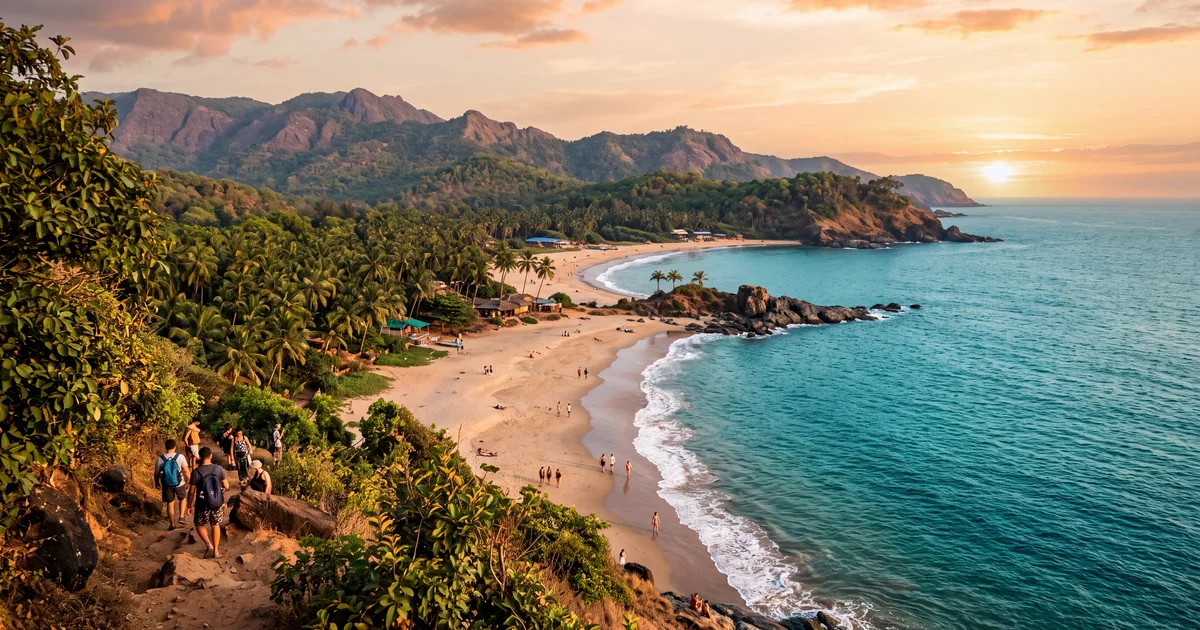
Gokarna sits on the Karnataka coast, 480 km northwest of Bangalore and 230 km south of Goa. It is a temple town that happens to have some of the best beaches on India's western coastline. The Mahabaleshwar Temple here predates most of what you see in Goa by centuries. The beaches south of town, connected by a cliff trail, feel like they belong to a different era of Indian tourism, one where you walked to the beach instead of driving.
The town has roughly 25,000 permanent residents. In December, that number swells noticeably. Kudle Beach and Om Beach fill with travellers, shack restaurants extend their seating, and the half day beach trek gets crowded enough that you will encounter someone every five minutes. In October or February, you can walk for 20 minutes on Half Moon Beach without seeing another person.
I visited twice: once in November 2024 with a group trip from Bangalore, and once solo in February 2025. The November trip was the better one. The water was clearer, the shacks were open but not packed, and the cliff trail was dry enough to walk comfortably in sandals.
TL;DR
- Five beaches: Gokarna Main Beach, Kudle, Om, Half Moon, and Paradise. The southern four are connected by a 6 km cliff trek.
- October to March is the season. December and January are peak (and priced accordingly).
- Budget ₹1,200 to ₹3,000 per person per day for stays, meals, and the essentials.
- The beach trek from Kudle to Paradise takes 3 to 4 hours one way. Carry water. Wear shoes, not flip flops.
- Mahabaleshwar Temple is worth an hour even if temples are not your thing.
What Makes the Beach Trek Gokarna's Best Experience?
The trail connects Kudle Beach to Paradise Beach, passing through Om Beach and Half Moon Beach along the way. Total distance is roughly 6 km. The terrain alternates between sandy paths, rocky scrambles over headlands, and stretches through low scrub forest with sea views.
Start from the southern end of Kudle Beach. The trail climbs a headland (about 80 metres elevation gain) before dropping to Om Beach's northern cove. The first section takes 30 to 40 minutes. The view from the top of the headland, where the trail passes through a gap in the rocks, shows both Kudle and Om beaches simultaneously. This is the most photographed point on the trek.
From Om Beach to Half Moon Beach is the rockiest section. The trail crosses a headland with loose laterite rock and some steep sections where you need to use your hands. It takes about 45 minutes. The path is marked by painted arrows on rocks, though some have faded. In a group, someone will know the way. Solo, pay attention at forks and keep the sea to your right.
Half Moon Beach to Paradise Beach is the shortest section, about 20 minutes. Paradise Beach is the smallest of the four. A few semi permanent shacks sell water and snacks during season (October to February). Outside season, it is empty.
The caveat: this trek is not dangerous, but it is not a paved coastal promenade either. Two sections require climbing over boulders. In the rain, the laterite becomes genuinely slippery. One traveller broke an ankle on the Om to Half Moon section in July 2024, during a monsoon attempt. Stick to dry months and wear proper shoes. Sandals and flip flops are a bad idea on the rocky sections.
Carry at least 1.5 litres of water per person. There are shacks at Om Beach and sometimes at Half Moon Beach, but nothing is guaranteed. Sun protection matters because the trail is exposed for long stretches.
If you only want to do part of the trek, the Kudle to Om section is the most rewarding per kilometre. You get the best viewpoint, avoid the rockiest sections, and can return by auto from Om Beach (₹100 to ₹150 back to town).
Is Om Beach Really Shaped Like Om?
From above, yes. The beach has two coves separated by a rocky headland, and the curve of the sand traces something close to the Devanagari ॐ symbol. You can see this clearly from the cliff trail approaching from Kudle, or from the rocky headland that divides the two coves.
The southern cove (closer to Half Moon Beach) is the quieter one. It has a few fishermen's huts and limited shack infrastructure. The northern cove has the establishments: Namaste Cafe, a handful of guesthouses, and boat services. The beach is about 500 metres long across both coves.
Swimming is reasonable in the northern cove between October and March. The waves are moderate. Lifeguards are occasionally present during peak season but do not rely on them. The southern cove has stronger currents near the rocks.
Namaste Cafe sits on the cliff between the two coves. The food is average tourist fare (pasta, thali, pancakes) at ₹150 to ₹300. The view is the reason to eat there. A table on the terrace at sunset, with the Arabian Sea below and fishing boats returning, is one of the better dining views in coastal Karnataka.
Boat rides from Om Beach to Half Moon (₹150) or Paradise Beach (₹300) are an alternative to the trek. The boats run during the day in season and take 10 to 15 minutes. The ride gives a perspective on the coastline you do not get from the trail.
My take: Om Beach is the best beach in Gokarna for spending an afternoon. Kudle is better for swimming. Half Moon is better for solitude. But Om Beach combines the setting, the infrastructure, and the cliff views in a way the others do not match.
What Is at Kudle Beach That Keeps People Coming Back?
Kudle is a 500 metre crescent of sand backed by palm trees and low cliffs, about 1.5 km south of Gokarna town. You reach it by walking down a steep path from the main road (5 minutes) or by auto rickshaw to the top of the access path.
The beach faces west, which means unobstructed sunsets over the Arabian Sea. Between October and February, the sun sets directly ahead. The sand is wide enough at low tide that a hundred people spread out without crowding each other.
The water is the calmest of the Gokarna beaches for swimming. Waves break gently and the seabed is sandy without rocks. Local fishermen know the currents. If they tell you not to swim past a certain point, listen.
Shacks line the back of the beach. Cafe 1987, Sunset Point, and several others serve seafood, thalis, and the usual traveller menu. A fish thali with rice costs ₹200 to ₹350 depending on the catch. The beer is available. A Kingfisher runs ₹150 to ₹200 at beach shacks.
Budget stays are behind the tree line. Rooms start at ₹600 for a basic double with shared bathroom. With attached bathroom and a fan, ₹1,000 to ₹1,500. A few properties like Kudle Beach View Resort charge ₹3,000 to ₹5,000 and have the cliff top view. For most travellers, the ₹1,000 range gets you what you need because you will spend the day on the sand, not in the room.
The honest caveat: Kudle gets crowded in December and January. Weekends bring groups from Bangalore and Mangalore. If you want the quiet Kudle experience, come on a weekday in November or February. The difference is dramatic. A Tuesday in November, the beach has maybe 30 people total.
Why Should You Visit Mahabaleshwar Temple?
Because Gokarna was a pilgrimage town for centuries before anyone came for the beaches. The Mahabaleshwar Temple sits in the centre of Gokarna's old town and houses what Hindu tradition calls the original Atma Linga, a Shiva lingam said to have been given directly by Shiva to Ravana. The story from the Puranas involves Ganesha tricking Ravana into placing the linga on the ground at this spot, where it became permanently fixed.
The temple is old. Epigraphic evidence dates the structure to at least the 4th century CE, with renovations and expansions through the 12th century. The granite tower and the surrounding Prakara (walled courtyard) are Dravidian in style. The inner sanctum is dark, lamp lit, and smells of centuries of ghee and camphor.
Non Hindu visitors can enter the outer courtyard and see the tower but cannot enter the inner sanctum. The temple is free. Shoes must be removed at the entrance. The temple is most active during Shivaratri (February or March) and during the Rath Yatra in February, when a chariot procession runs through the town streets.
The surrounding streets of Gokarna town are narrow, with Agrahara houses (traditional Brahmin homes) and small temples at every turn. A 30 minute walk through the old town covers the Maha Ganapati Temple, Tamra Gauri Temple, and the tank (Koti Tirtha) with stepped ghats. This walk is best in early morning when the street is quiet and the light is low.
One real opinion: even if you have zero interest in Hindu temples, the Mahabaleshwar Temple and the old town walk are worth an hour. The architecture alone justifies it. This is a living temple in a 2,000 year old town. Gokarna is not a manufactured beach destination. The beaches came second.
What Does Half Moon Beach Have That Others Do Not?
Solitude. Half Moon Beach is a 150 metre curve of sand between two rocky headlands, reachable only by the cliff trek from Om Beach (45 minutes) or by boat. There is no road access. No auto will bring you here.
During season (November to February), a couple of shack operators set up tents and basic shelters. You can camp for ₹500 to ₹800 per night including a tent and meals. The food is simple: rice, dal, fish curry, chai. Do not expect menus or choices. What they cooked is what you eat.
The beach is small enough that 15 tents start to feel full. On a December Saturday night, all spots may be taken. On a weekday, you might share the beach with four other groups.
The swimming is fine close to shore but the undertow picks up near the headlands. There are no lifeguards. After dark, the only light is from cooking fires and phone torches. Stars are exceptional on a clear night because there is zero light pollution from the coast.
The caveat is real: no electricity (some shacks have small solar panels for phone charging), no running water (they carry it in), and no mobile signal on most networks. Jio gets intermittent 4G sometimes. If connectivity matters, this is not your beach.
For trips that include Gokarna, the beach trek and an overnight at Half Moon or Paradise beach is the experience that separates Gokarna from any other coastal destination within a day's travel from Bangalore.
How Should You Plan Two Days in Gokarna?
Two days cover the essentials. Here is a practical approach.
Day one is the beach trek day. Start from Kudle Beach by 8 AM. Walk south to Om Beach (40 minutes), stop for chai at a shack, continue to Half Moon Beach (45 minutes), and reach Paradise Beach by 11:30 AM or noon. Spend an hour at Paradise, swim if conditions allow, eat at a shack if one is open.
Return options: boat from Paradise to Om Beach (₹300, 15 minutes) or retrace the trek. If your legs are up for it, the return trek goes faster because you know the path. Total return time is about 2.5 hours. The alternative is to take a boat to Om Beach and an auto from there back to town (₹150).
Evening: sunset at Kudle Beach. The western facing orientation makes it the best sunset spot of the five beaches. Dinner at one of the Kudle shacks or back in Gokarna town.
Day two is the town and water day. Start with a morning walk through Gokarna's old town streets. Visit Mahabaleshwar Temple by 8 AM (least crowded). Walk to Koti Tirtha tank and loop through the Agrahara lanes. Breakfast in town (South Indian meals, dosa and filter coffee for ₹60 to ₹100 at the local restaurants near the bus stand).
Late morning: head to Om Beach. Spend the afternoon swimming in the northern cove, reading at Namaste Cafe, or renting a body board (₹200 per hour at some shacks). If you did not get enough of the cliff views on day one, walk to the headland between the two Om Beach coves for a closer look.
If you have a third day, spend it at Half Moon Beach. Camp overnight. It is a different Gokarna from the one visible at Kudle or Om, and it is the memory most people carry home.
What Do You Actually Spend in Gokarna?
Gokarna is budget friendly. A room in Gokarna town costs ₹500 to ₹1,500 for a double with attached bathroom. On Kudle Beach, the range is ₹800 to ₹2,000. Om Beach has a wider range from ₹600 basic rooms to ₹4,000 for a cliff view property. Half Moon Beach camping is ₹500 to ₹800 per night with meals.
Meals in town are the cheapest. A thali at a local restaurant costs ₹80 to ₹120. Beach shack meals run ₹150 to ₹350. Seafood (grilled fish, prawns) goes higher at ₹250 to ₹500 per plate.
Auto rickshaws within Gokarna town and to the beach access points charge ₹50 to ₹200 depending on distance. The bus from Gokarna to Kudle Beach top is ₹10 if you catch a local bus, but they are infrequent. Most people walk (15 minutes) or auto.
Two days and one night in Gokarna: ₹2,400 to ₹6,000 per person total, depending on whether you stay in town or at a beach property and whether you eat at local restaurants or beach shacks.
What Do Most Guides Skip About Gokarna?
Gokarna Main Beach is the one most travel guides photograph but few recommend for spending time. It is a long, wide beach stretching from the town to the south headland. The northern end near the temple has strong currents and rough surf. The southern end is calmer but has less character than Kudle or Om. Fishermen use the central section. It is worth a walk but not an afternoon.
Mirjan Fort is 12 km north of Gokarna. This 16th century coastal fort was built by the Nawabs of Savanur and later fell to the Portuguese. The laterite walls are partially covered in vegetation, giving it an atmospheric ruin quality. Entry is free. Few tourists visit because getting there requires an auto (₹250 one way) or a rented scooter. If you have a third day, this is a worthwhile morning trip.
Yana Rocks are 50 km east of Gokarna in the Western Ghats. Two massive black rock formations (Bhairaveshwara Shikhara at 120 metres and Mohini Shikhara at 90 metres) rise from a dense forest. A 2 km forest trail from the parking area leads to the base of the rocks. It is a half day trip by rental scooter or hired car (₹1,500 to ₹2,000 return). The formations are genuinely impressive. Not widely known among beach tourists.
The local toddy shops in Gokarna town sell palm toddy (fresh tapped sap) in the morning hours. It is mildly alcoholic, slightly sweet, and costs ₹20 to ₹30 per glass. After noon, fermentation makes it stronger and more sour. This is a local experience that no beach shack replicates.
One final note: Gokarna is 230 km south of Goa. If your plan includes both, the bus between them takes 5 to 6 hours via Karwar. The Konkan Railway is faster (3 hours, Gokarna Road to Margao). Some travellers combine a weekend in Gokarna with a few days in south Goa. That is a good combination because the two places offer completely different things.
For group trips to Gokarna from Bangalore, browse dates and reviews on TripzSearch to find one that fits your schedule.
Frequently asked questions
- What are the top 5 must visit places in Gokarna?
- Om Beach for its distinctive shape and cliff views, Kudle Beach for swimming and sunset, Half Moon Beach for quiet camping, Mahabaleshwar Temple for the ancient Atma Linga, and the beach trek trail connecting all four southern beaches. These five give you the full Gokarna experience in two days.
- How many days are enough for Gokarna?
- Two days cover the main beaches and the temple comfortably. Add a third if you want to camp at Half Moon or Paradise Beach overnight. Most weekend trips from Bangalore use a Friday night departure and Sunday return, giving two full days. One day is possible but means choosing between the beach trek and the town.
- What is the best time to visit Gokarna?
- October to March, when the weather is dry and temperatures sit between 22°C and 32°C. December and January are peak season with higher prices and crowded beaches. April and May get hot (35°C plus). Monsoon from June to September brings heavy rain and rough seas, but the town is green and dramatically empty.
- How do I reach Gokarna from Bangalore?
- Overnight KSRTC buses from Bangalore to Gokarna take 9 to 10 hours and cost ₹700 to ₹1,400 depending on class. The Gokarna Road railway station is 10 km from town, served by the Konkan Railway with trains from Bangalore, Mumbai, and Mangalore. Driving takes about 8 hours via NH48, roughly 480 km.
- Is Gokarna safe for solo female travellers?
- The main town and Kudle Beach area are well visited and considered safe. Om Beach has more permanent establishments and regular foot traffic. Half Moon and Paradise beaches get very quiet after dark, so solo women usually prefer to camp there in groups. The beach trek is busy enough during the day that isolation is not a concern between October and February.
- What is the difference between Gokarna and Goa?
- Gokarna has five main beaches compared to Goa's forty plus. There are no beach clubs, no trance parties, and very few resorts above ₹5,000 per night. Gokarna is a temple town first and a beach destination second. The pace is slower, the crowds are smaller (outside December), and alcohol is available but not the main attraction. If you want quiet sand and a cliff trek, Gokarna. If you want nightlife and variety, Goa.
- Can you swim at Gokarna beaches?
- Kudle Beach and the southern end of Om Beach are the safest for swimming. The water is generally calm between October and March. Gokarna Main Beach has strong undertow near the temple end. Half Moon and Paradise beaches are swimmable but have no lifeguards. During monsoon, all beaches have dangerous currents and swimming is not advisable.