14 Best Places to Visit in Dalhousie (2026): Khajjiar, Colonial Trails and Himalayan Quiet
Practical guide to the best places to visit in Dalhousie in 2026 with Khajjiar, churches, treks and what to skip.
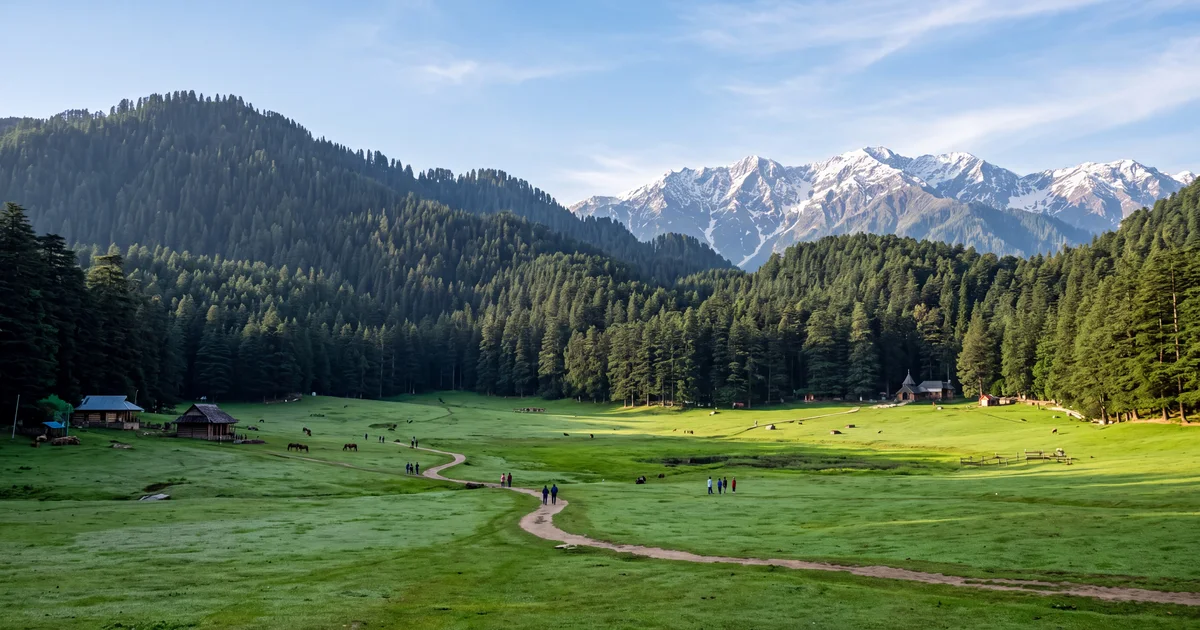
Dalhousie sits between 1,525 and 2,378 metres in the Chamba district of Himachal Pradesh, spread across five hills: Kathlog, Potreyn, Tehra, Bakrota and Balun. The British built it as a sanatorium and summer retreat in the 1850s, and some of that character survives in the stone churches, pine lined walks, and the general absence of the commercial frenzy you get in Shimla or Manali.
The places to visit in Dalhousie fall into three groups: the colonial era town itself (churches, Mall Road, old bungalows), the day trips out to Khajjiar and Chamba, and the treks that start right from town (Dainkund Peak, Kalatop). Most visitors come for Khajjiar, stay two nights, and leave. That is enough, but the town rewards a slightly longer stay if you like walking and quiet.
This guide covers what is worth your time and what is not, with real costs and practical notes.
TL;DR
- Khajjiar meadow, Kalatop Wildlife Sanctuary, and the Dainkund Peak trek are the highlights.
- Mall Road and the churches are pleasant half day walks but not destination worthy on their own.
- Best time: March to June for warm days. October to November for autumn colours. December to February for snow (roads may close).
- Getting there from Delhi: 10 to 12 hours by road via Pathankot, or overnight bus.
- Budget: 1,500 to 3,500 per person per day depending on stay and transport.
What Are the Must See Places in Dalhousie Town?
The town centre is small enough to walk end to end in 40 minutes. That is part of its appeal.
Mall Road connects Subhash Chowk to Gandhi Chowk across the ridge, about 1.5 km. The walk takes 30 minutes at a casual pace and passes colonial era buildings, a post office that has been operating since 1867, and a scattering of shops selling Himachali shawls and wooden handicrafts. It is not a shopping destination (the selection is limited), but the walk itself, with deodar trees on both sides and glimpses of the Pir Panjal range between the branches, is the point.
St. John's Church was built in 1863 and is one of the best preserved colonial churches in Himachal Pradesh. The stone exterior with stained glass windows sits in a quiet clearing off the main road. It still holds services on Sundays. The interior is simple: wooden pews, a small altar, and plaques commemorating British officers from the 1800s. Five minutes of your time, but it adds context to the town.
St. Francis Church near Subhash Chowk is the other notable church, built in 1894 in a different style with a distinctive bell tower. The two churches together give you a quick sense of the town's colonial past without needing a museum.
Subhash Baoli is a natural spring 1 km from Subhash Chowk, named after Subhash Chandra Bose who stayed in Dalhousie during the 1930s. The spring itself is unremarkable, but the short walk through deodar forest to reach it is pleasant. Go in the morning.
One caveat: Dalhousie town is not photogenic in the way Shimla's Ridge or Manali's Old Town is. The architecture is understated, the streets are narrow, and the "views" from town require you to look between buildings. The town's value is in its pace. If you want postcard scenes, head to Khajjiar or Dainkund.
Is Khajjiar Worth the Day Trip?
Yes, but calibrate your expectations.
Khajjiar is 22 km from Dalhousie, about 45 minutes by car on a winding hill road through deodar and pine forest. The meadow itself is a flat, saucer shaped clearing roughly 1 km in diameter at an altitude of 1,951 metres. A small lake sits in the middle (more of a marshy pond by October), surrounded by grass and ringed by tall deodar trees. On a clear day, the Pir Panjal range fills the backdrop.
The "Mini Switzerland" tag was given by a visiting Swiss dignitary in 1992 who placed a signboard at the meadow. It has stuck in every tourism brochure since. The comparison sets unrealistic expectations. Khajjiar is a pretty meadow. That is all. No alpine villages, no glacier fed lakes, no cable cars.
What makes it worth the trip is the setting. The combination of the flat green ground, the dense forest edge, and the mountain backdrop creates a genuinely peaceful scene, especially on weekday mornings before the paragliding operators set up. On weekends during peak season (May and June), the meadow fills with 200+ day trippers, horses, and food stalls that clutter the edges. Tuesday or Wednesday visits are a different experience entirely.
Paragliding costs 2,000 to 3,500 rupees for a 10 to 15 minute flight. Zorbing and horse riding are available but feel like filler. The Khajjiar temple (12th century, dedicated to Khajji Nag) at the meadow's edge is small but worth the 5 minute stop.
My take: Khajjiar is one of those places that photographs better than it delivers in peak season and delivers better than it photographs on a quiet weekday. Time your visit accordingly.
What Are the Best Treks from Dalhousie?
Dalhousie's treks are short, accessible, and start from town or nearby. No permits required for any of these.
Dainkund Peak is the highest point in Dalhousie at 2,755 metres, about 10 km from the town centre. You can drive to Ahla Cantonment (about 5 km up) and then trek the remaining 3 km to the summit. The trail passes through deodar forest and opens up to a 360 degree panorama at the top: the Pir Panjal range to the north, the Chamba Valley to the east, and the Ravi River winding below. The Pholani Devi temple sits near the summit. Total trek time from the road head is about 90 minutes one way. The trail is moderately steep but manageable for anyone with basic fitness.
Best time to go: early morning, preferably before 8 AM. The summit clouds over by noon most days between May and September. In winter (December to February), the trail gets icy above 2,400 metres and you will need proper shoes.
Kalatop Wildlife Sanctuary is 8 km from Dalhousie, and the trek through it is one of the best half day walks in the region. The sanctuary covers 31 square kilometres of dense deodar and oak forest. The main trail (about 5 km one way, relatively flat) passes through sections where the canopy blocks most sunlight, giving the forest a distinctly different feel from the open meadows of Khajjiar. Black bears, leopards, and barking deer live here, though sightings are uncommon. What you will see: Himalayan langurs, woodpeckers, and (if you are quiet and lucky) the Cheer pheasant.
The forest rest house at Kalatop serves as a checkpoint. Entry is free but you need to register at the forest office in Dalhousie. The trail is well marked. Carry water and a light jacket because the forest is 3 to 5 degrees cooler than the town.
Bakrota Hills circuit is a 5 km walk that loops around one of Dalhousie's five hills. The path starts near the Dalhousie Public School and passes through pine forest with views of the Ravi River valley. It is flat enough for casual walkers and takes about 2 hours at a relaxed pace. This is the option when you want fresh air without exertion.
A real limitation: the trails have minimal infrastructure. No water points, no washrooms, no cafes along the route. The mobile signal drops in the forested sections of Kalatop.
How Do You Reach Dalhousie from Delhi?
The journey is long regardless of how you do it. Plan for a full day of travel or an overnight leg.
By road from Delhi, the route covers about 560 km via Chandigarh, Pathankot, and the Dalhousie ghat road. Driving takes 10 to 12 hours with stops. The Chandigarh to Pathankot stretch (270 km) is highway; the Pathankot to Dalhousie leg (80 km) is ghat road with hairpin bends and takes about 2.5 hours. HRTC and private operators (RedBus has options) run overnight Volvo and semi sleeper buses from Delhi ISBT Kashmere Gate. Fare: 800 to 1,500 rupees depending on the operator and bus type.
By train, take a train from Delhi to Pathankot Junction (the fastest is about 8 hours overnight). From Pathankot, shared taxis and HRTC buses connect to Dalhousie (80 km, 2.5 to 3 hours). A private taxi from Pathankot costs 1,500 to 2,000 rupees.
By air, the nearest airport with regular flights is Gaggal (Kangra Airport), 180 km from Dalhousie. SpiceJet and Air India operate flights from Delhi. From Gaggal, the drive to Dalhousie via Nurpur takes about 5 hours. This option costs more and the road journey from the airport is still substantial, so most people skip it.
If you are combining Dalhousie with Dharamshala, you can route through Kangra: Delhi to Gaggal by air, Dharamshala for 2 days, then Dalhousie (120 km, 4 hours by road) for 2 days, and return via Pathankot.
What Is the Chamba Valley and Should You Visit?
Chamba town is 56 km from Dalhousie, about 2 hours by road, sitting on the bank of the Ravi River at 996 metres. It is significantly lower and warmer than Dalhousie. The town is one of the oldest in Himachal Pradesh, with a history going back to the 6th century.
The Chaugan is the town's central green, a long, flat maidan used for the annual Minjar Fair in July and August. The fair, a week long celebration with a river procession on the final day, is genuinely interesting if your timing aligns. Outside fair season, the Chaugan is just a pleasant open space.
Lakshmi Narayan Temple Complex dates to the 10th century and is the most architecturally significant site in Chamba. Six shikhara style temples in a walled compound, with carved stone reliefs on the exterior that show Vishnu, Shiva, and various mythological scenes. The craftsmanship stands out from the roadside temples you see elsewhere in Himachal.
Bhuri Singh Museum has a small but well curated collection of Pahari miniature paintings, inscriptions, and Chamba rumals (embroidered cloth). The Pahari paintings, done in the Kangra and Basholi schools, are the highlight. Entry is 10 rupees.
Worth the detour? If you have a third day in the area and care about temple architecture or Pahari art, yes. If you are short on time, Khajjiar and Kalatop are better uses of a day.
Where Should You Stay in Dalhousie?
Dalhousie's accommodation clusters around Gandhi Chowk and Subhash Chowk, with a few properties scattered along the Bakrota ridge.
For mid range stays, budget 1,500 to 3,000 per night. Several older hotels along the Mall Road have been renovated with valley facing rooms. The Bakrota ridge road has a few properties with unobstructed views of the Pir Panjal range from the balcony. These are the ones worth seeking out.
Budget options (600 to 1,200 per night) are available near the bus stand and around Subhash Chowk. They are functional, close to transport, but rarely scenic. Air conditioning is unnecessary; Dalhousie stays below 25°C even in peak summer.
Homestays are growing in number but not as established as in places like Shimla. A few families in the Potreyn area rent rooms with home cooked meals (Himachali rajma chawal, siddu, and the occasional mutton curry). Ask locally rather than relying on booking apps; not all are listed online.
One thing to know: Dalhousie's restaurant scene is limited. The dhabas near Gandhi Chowk serve reliable North Indian food, and a couple of cafes on Mall Road do decent coffee and momos. But this is not McLeodganj or Kasol; there are no backpacker cafes or "artisan" bakeries. Eat at your hotel for dinner unless you enjoy walking dark, hilly roads with a flashlight.
Dalhousie Trip Budget for 2026
For a couple travelling from Delhi on a moderate budget, here is a typical 3 night, 4 day breakdown.
Transport: 1,500 to 2,500 per person by overnight bus (round trip). Khajjiar day trip taxi: 1,500 to 2,000 for the car. Dainkund taxi to road head: 600 to 800 return. Chamba day trip (if taken): 2,000 to 2,500.
Stay: 1,500 to 3,000 per night for a decent mid range hotel with breakfast.
Food: 400 to 800 per person per day. Simple North Indian meals, momos, and chai.
Entry fees: negligible. Most sites are free or under 50 rupees.
Total: roughly 5,000 to 10,000 per person for a 3 night trip from Delhi, depending on transport and accommodation choices. For packaged options that bundle transport and stays, check current listings on TripzSearch.
Frequently asked questions
- How many days are enough for Dalhousie?
- Two to three days covers Dalhousie and Khajjiar comfortably. Day one for the town walks (Mall Road, churches, Panchpula). Day two for Khajjiar and Kalatop Wildlife Sanctuary. A third day lets you add Dainkund Peak or Chamba. Less than two days means skipping either Khajjiar or the treks, and both are highlights.
- What is the best time to visit Dalhousie?
- March to June for pleasant weather between 15°C and 30°C and clear views. October to November for post monsoon colours with fewer tourists. December to February brings snowfall and temperatures between minus 2°C and 10°C, which is appealing if you want snow but the roads to Khajjiar can get blocked. July to September is monsoon season with frequent landslides on the Pathankot road.
- Is Khajjiar really the Mini Switzerland of India?
- Khajjiar is a flat, saucer shaped meadow surrounded by deodar forests with a small lake in the middle. It is pretty, especially on a clear morning when the Pir Panjal range is visible behind the trees. But calling it Switzerland sets expectations the place cannot meet. It is a 1 km wide meadow, not the Alps. Go without the comparison in your head and you will enjoy it more.
- How do you reach Dalhousie from Delhi?
- By road from Delhi, it is about 560 km via Chandigarh and Pathankot, taking 10 to 12 hours by car or overnight Volvo bus. HRTC and private operators run overnight buses from Delhi ISBT to Dalhousie. The nearest railhead is Pathankot (80 km, 2.5 hours by taxi). The nearest airport is Gaggal in Kangra (180 km, about 5 hours), which has limited flights from Delhi.
- Is Dalhousie safe for solo travellers and families?
- Dalhousie is one of the quieter hill stations in Himachal, with a small town feel and low crime rates. Solo travellers, including women, generally feel comfortable walking around even after dark on the main roads. Families with young children will find the flat walks around Mall Road and Subhash Baoli easier than the steep trails at places like Manali or Shimla.