Leh Ladakh Bike Trip (2026): Routes, Costs and Group Rides Worth Joining
Plan your Leh Ladakh bike trip with routes, costs, permits, best months and group ride options for 2026. Covers Manali and Srinagar routes.
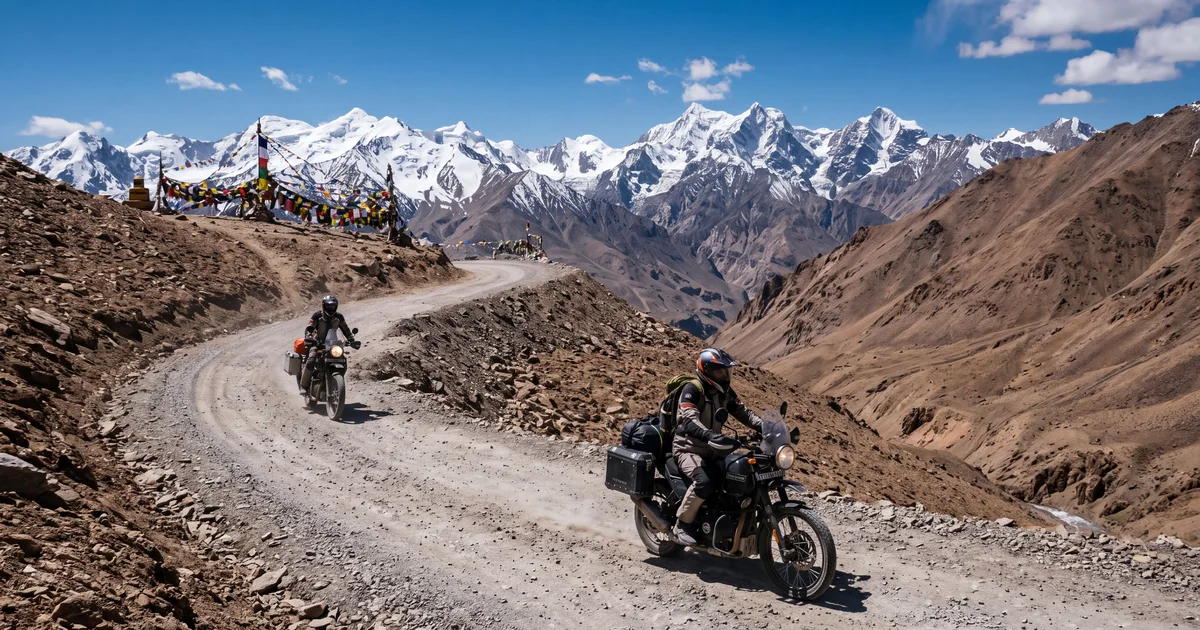
The Leh Ladakh bike trip sits at the top of every Indian rider's bucket list. It has for two decades now. And unlike most bucket list things, this one delivers. You ride through terrain that looks like another planet, cross passes above 5,000 metres, and spend nights in places where the nearest town is 6 hours away.
About 45,000 riders attempt the Manali to Leh route every season between June and September. Not all of them finish. The altitude is punishing, the roads between Darcha and Pang are dangerous in heavy rain, and mechanical breakdowns happen to the best prepared bikes. None of that should scare you off. It should make you plan properly.
This is what you need to know before booking or riding out.
TL;DR
- Two main routes: Manali to Leh (474 km, 2 days minimum, multiple passes above 4,800m) and Srinagar to Leh (434 km, better roads, lower passes).
- Best window: mid June to mid September. July is peak season with the most riders and the most water crossings.
- Budget 25,000 to 45,000 self-ride or 18,000 to 35,000 for a group departure with rented bike and backup.
- You need an ILP for Nubra, Pangong, Tso Moriri. Get it in Leh or online.
- Group rides make sense for first timers. A sweep vehicle with a mechanic eliminates 80% of what goes wrong.
Which Route Should You Take to Leh?
Two highways connect the Indian plains to Leh. They feel like different countries.
Manali to Leh (NH3, 474 km): This is the iconic one. You cross Rohtang Pass (3,978m), Baralacha La (4,890m), Nakee La (4,739m), Lachalung La (5,059m), and Tanglang La (5,328m) in roughly 48 hours of riding spread over 2 to 3 days. The stretch between Darcha and Pang has no fuel station, no mobile signal, and roads that turn into rivers in July. BRO maintains it, but "maintained" is relative when you are fording knee-deep water at 4,500 metres.
The reward: those surreal high-altitude plains near Pang, the Gata Loops (21 hairpin bends climbing to Nakee La), and the feeling that you earned Leh.
Srinagar to Leh (NH1, 434 km): Better tarmac, lower maximum altitude (Zoji La at 3,528m is the only real pass), and fuel stops every 60 to 80 km. You ride through the Kashmir Valley, cross into Ladakh at Drass, and follow the Indus to Leh. The scenery is green on the Kashmir side and turns brown after Kargil. Two days of comfortable riding with a night in Kargil or Drass.
If you are doing this for the first time and riding solo, start with the Srinagar route. Save Manali for the return when your body has acclimatized.
How Many Days Do You Need for the Full Circuit?
The minimum circuit (Manali in, Srinagar out, or reverse) with Nubra and Pangong takes 11 days. Here is how that breaks down:
Day 1 to 2: Manali to Jispa, Jispa to Leh (long, brutal, beautiful). Day 3: Rest in Leh. Your body needs this. Skipping the rest day at 3,500m is how people end up in the hospital with pulmonary edema. Day 4 to 5: Leh to Nubra Valley via Khardung La (5,359m) and back. Day 6 to 7: Leh to Pangong Tso via Chang La (5,360m), night at Pangong, return. Day 8: Buffer day or Tso Moriri detour (adds 2 days if you take it). Day 9 to 11: Leh to Srinagar over 2 days with a halt in Kargil.
Compress this to 8 days and you will feel it in your knees, your back, and your oxygen-starved brain. Thirteen days is more comfortable and lets you add Tso Moriri or Hanle.
What Does a Ladakh Bike Trip Cost in 2026?
Costs split into two categories: riding your own bike versus renting one from a group operator.
Self-ride (own bike, own planning): Fuel from Manali to Leh and back to Srinagar runs 5,000 to 8,000 depending on your bike's consumption. Guesthouses along the route charge 800 to 2,500 per night. Food at dhabas averages 300 to 500 per meal. Add 2,000 for the ILP, emergency medical kit, and Rohtang Atal Tunnel fee. Total: 25,000 to 45,000 per person for 10 to 12 days, depending on how spartan you are willing to go.
Group departure (rented bike, support vehicle, planned stays): Operators offer packages from 18,000 to 35,000 per person. The lower end gets you a shared tent at campsites and a Royal Enfield Classic 350 with basic maintenance included. The upper end gives guesthouse stays, a Himalayan 450, all meals, and a mechanic riding sweep. Fuel is sometimes included, sometimes not. Check before booking.
For current group departures and price comparisons, see options on /trips.
What Can Go Wrong (and How Groups Handle It)
Three things consistently catch riders off guard.
Altitude sickness: Above 4,500 metres, your body produces fewer red blood cells than it needs. Symptoms start mild (headache, nausea) and can escalate to pulmonary or cerebral edema within hours. The fix is descent. Group rides carry portable oxygen and have a vehicle that can evacuate you to a lower altitude while the rest of the group continues. Solo, you are relying on passing trucks.
Mechanical failure: A Royal Enfield on bad roads at altitude throws up problems. Chain snaps, punctures from sharp gravel, fuel filter clogs from dirty petrol at highway-side pumps. Between Darcha and Pang there is no mechanic for 150 km. Group rides travel with a dedicated mechanic and spare parts. That is not luxury; it is insurance.
Weather changes: The forecast says clear. Then at 14:00, a cloud bank rolls over Baralacha La and drops hail the size of marbles. Visibility goes to 10 metres. Water crossings that were ankle deep at 09:00 are now knee deep and moving fast. Groups have radio communication between the lead and sweep riders and know when to stop versus push through. Solo riders make that call alone.
Do You Need Riding Experience Before Attempting This?
Yes. But how much depends on your route.
For the Srinagar route: 6 months of regular riding, comfort on two-lane highways with truck traffic, and experience riding for 5 to 6 hours continuously. The road surface is mostly good. The challenge is distance and mental fatigue, not technical skill.
For the Manali route: you want at least a year of riding experience including some off-road or mountain riding. Water crossings require throttle control in first gear with your feet on the pegs. Gravel descents at 4,800m need confidence with rear brake modulation. The Gata Loops test your cornering on loose surfaces at altitude where your reaction time is slower than at sea level.
If you have never ridden above 3,000 metres, be honest with yourself. The group ride with a backup vehicle is not a compromise. It is the smart play.
Which Bike Works Best at Altitude?
The Royal Enfield Himalayan 450 (2024 model onward) is the current top choice. The 452cc liquid-cooled engine loses less power at altitude than the older air-cooled 411. Ground clearance is 200mm. The seat height works for most Indian riders at 825mm. And Enfield service centres in Leh and Manali stock parts for it.
The Classic 350 and Bullet 350 still work. Thousands of riders prove it every year. But they struggle above 5,000m with loaded luggage, and the drum brakes on older models are terrifying on wet descents. If you rent, ask specifically for a 2023 or newer model with disc brakes on both wheels.
Bikes under 350cc (the Honda CB200X, KTM 200 Duke) technically work on the Srinagar route where passes are lower. On the Manali route, they do not have the torque for loaded water crossings or the highway stability for 150 km stretches at 80 km/h with crosswinds.
What Permits Do You Need?
Indian nationals need an Inner Line Permit for:
- Nubra Valley (via Khardung La)
- Pangong Tso
- Tso Moriri
- Hanle (for the observatory side trip)
Apply online through the Ladakh UT administration portal or at the DC office in Leh. Processing takes 1 to 2 hours in person. You need your ID proof, 4 passport photos, and a vehicle registration copy. The permit costs approximately 600 per person and is valid for 7 days. If your itinerary is longer, get a 14 day permit.
Foreign nationals need the ILP for all restricted areas and must travel in a group of minimum 2 with a registered tour operator. Solo foreign riders technically cannot get the permit, though many operators provide the paperwork for a fee.
The Rohtang Pass and Atal Tunnel require a separate permit booked online at least 24 hours in advance (free for bikes, but you need the slot).
Is a Group Bike Ride Worth It?
If you have done this before, own your bike, and have a riding buddy: probably not. You know the roads, you carry your spares, and you want the freedom to stop wherever.
If this is your first Ladakh trip, you are renting a bike, or you are riding solo: yes. Here is what a group gives you that money cannot easily buy on your own.
A mechanic who has seen every Enfield problem that exists on these roads. A support vehicle carrying your heavy luggage so your bike handles better on bad stretches. Route knowledge from a leader who has ridden this 15 to 20 times and knows which water crossings are safe at what hour. And other riders who become friends over 10 days of shared suffering and beauty.
The trade-off is fixed schedules and group pace. If you ride fast, you will wait. If you are slow, you will feel pressure. Most groups manage this well, but ask about group size before booking. Eight to ten bikes is comfortable. Fifteen to twenty is a convoy, and convoys are loud, slow, and attract police attention at checkpoints.
Browse group rides with verified operators on /trips.
Packing for a Ladakh Bike Trip: What Matters
Skip the gear listicles with 50 items. Here is what matters at altitude.
Riding gear: A proper helmet (full-face, not the open-face ones sold at Manali shops), riding jacket with armour (it gets below 5°C on passes even in July), waterproof gloves, and knee guards. Heated grips are a luxury that becomes a necessity on early morning starts above Baralacha La.
Against the cold: Temperatures on passes drop to minus 5°C at night in September. Thermal base layers, a down jacket for camp stops, and a balaclava for riding above 5,000m. The wind chill on a bike at 60 km/h makes 5°C feel like minus 10°C.
Medical: Diamox (consult your doctor before the trip), basic painkillers, ORS packets, sunscreen SPF 50 (the UV at 5,000m is aggressive), and lip balm. Portable oxygen cans are available in Leh for 400 to 600 each; buy 2 before heading to Khardung La.
Bike spares: Clutch cable, accelerator cable, spare tubes (2 minimum), tyre levers, chain links, and a basic toolkit. Even if you cannot fix everything yourself, a passing mechanic on a truck can use your spares to get you moving.
Planning Your Itinerary from Delhi
Most riders start from Delhi because the trains and flights connect easily. Two options:
Option 1 (via Manali): Delhi to Manali by overnight Volvo bus (12 to 14 hours, 1,200 to 1,800). Pick up your rental bike in Manali and acclimatize for a day. Then ride out via Rohtang.
Option 2 (via Srinagar): Fly Delhi to Srinagar (1.5 hours, 4,000 to 8,000). Pick up your rental from an operator in Srinagar, ride to Leh over 2 days. This saves your body the Manali altitude shock.
The best circuit: Srinagar in, Manali out. You acclimatize gradually on the gentler Srinagar route, reach Leh at a comfortable pace, do Nubra and Pangong, then ride out via the Manali highway having already adjusted to altitude. Drop the bike in Manali, bus back to Delhi.
Find group departures from Delhi that handle the logistics, bike rental, and route planning.
When to Book (and When to Avoid)
Book early if riding in July: Peak season means rental bikes run out. Operators fill group slots 6 to 8 weeks ahead. Guesthouses in Pangong have maybe 15 rooms total; they book out by May for July slots.
Avoid mid-July to early August if you dislike crowds and water crossings at their worst. The Manali route sees its highest water levels and most traffic in this window.
September is underrated: Fewer riders, no rain, crystal visibility, and the landscape turns gold at lower altitudes. Nights are colder (below minus 5°C at Pangong), but the riding conditions are the best of the season. The Manali route typically stays open until early October.
Check current Ladakh trip options for dates and availability.
Fuel Stops and Planning Around Them
The Manali route has exactly 3 fuel stations between Manali and Leh: Tandi (the last reliable one before the high passes), Keylong, and Karu (just before Leh). The gap between Tandi and Karu is roughly 365 km. A Royal Enfield Himalayan with a 15 litre tank gets 30 to 35 km/l at altitude, giving you around 450 km range. Tight, but enough if you fill to the brim at Tandi.
Carry a 5 litre jerry can anyway. One wrong turn, one detour for a blocked road, and your margins disappear. Some riders carry 10 litres extra and never use it. Better than being stranded at Pang with no phone signal and the next fuel 130 km away.
The Srinagar route has fuel every 60 to 80 km. No jerry can needed. Fill at Drass and Kargil; you will reach Leh with half a tank to spare.
The Honest Downsides Nobody Puts in the Brochure
The toilets between Darcha and Pang are holes in the ground behind tents, when they exist at all. Phone signal vanishes for 6 to 8 hour stretches. Your back will hurt by Day 3 regardless of your bike or posture. The altitude headache is a dull, persistent companion above 4,500m even with Diamox. And Leh's guesthouse prices in peak July are 3x what they are in September.
None of this should stop you. All of it should set your expectations. The riders who enjoy this trip the most are the ones who expected discomfort and found it manageable rather than the ones who expected a highway cruise and found it grueling.
Ride prepared, ride with people you trust (or who have done it before), and do not skip the rest day in Leh. The mountains will still be there on Day 4.
Frequently asked questions
- How much does a Leh Ladakh bike trip cost in 2026?
- A self-planned ride runs 25,000 to 45,000 per person for 10 to 12 days, covering fuel, food, stays, and permits. Group departures with a rented Royal Enfield and backup vehicle cost 18,000 to 35,000 depending on the operator, duration, and whether you camp or stay in guesthouses. Fuel alone eats 5,000 to 8,000 on the Manali route.
- What is the best time for a Ladakh bike trip?
- June to mid September. The Manali to Leh highway opens by late June after BRO clears the snow on Baralacha La and Tanglang La. July brings some rain on the approach but Ladakh itself stays dry. September gives you clear skies and thinner crowds, though nights drop below 0°C at Pangong.
- Is the Manali to Leh route safe for solo riders?
- Experienced riders manage it solo every season, but the risk is real. Between Darcha and Pang there is no phone signal for roughly 150 km, water crossings flood without warning in July, and altitude sickness hits hard above Baralacha La at 4,890 metres. First timers should ride in a group with a support vehicle carrying spares and oxygen.
- Do you need a permit for Ladakh bike trip?
- Indian nationals need an Inner Line Permit for Nubra Valley, Pangong Tso, Tso Moriri, and the Hanle area. You can get it online through the Leh DC office website or at the DC office in Leh within a day. Carry 4 passport size photos. Foreign nationals need ILP for all restricted areas and cannot ride the Manali to Leh route without one.
- Which bike is best for Leh Ladakh trip?
- The Royal Enfield Himalayan 450 is the current favourite for its ground clearance, low seat height, and torque at altitude. The Classic 350 and Meteor 350 work fine on the Srinagar route where roads are better. Avoid bikes under 350cc as they struggle above 4,000 metres with thin air and loaded panniers.
- Can beginners do the Ladakh bike trip?
- The Srinagar route is manageable for someone with 6 months of riding experience and comfort on highways. The Manali route with its unpaved stretches, water crossings, and high altitude passes is not a learner's road. If you are new to long-distance riding, join a group departure with a mechanic and sweep vehicle. That changes the risk entirely.