Chadar Trek (2026): Walking the Frozen Zanskar River in Ladakh
Everything you need for the Chadar trek in 2026: route on the frozen Zanskar river, best dates, fitness requirements and group departures from Leh.
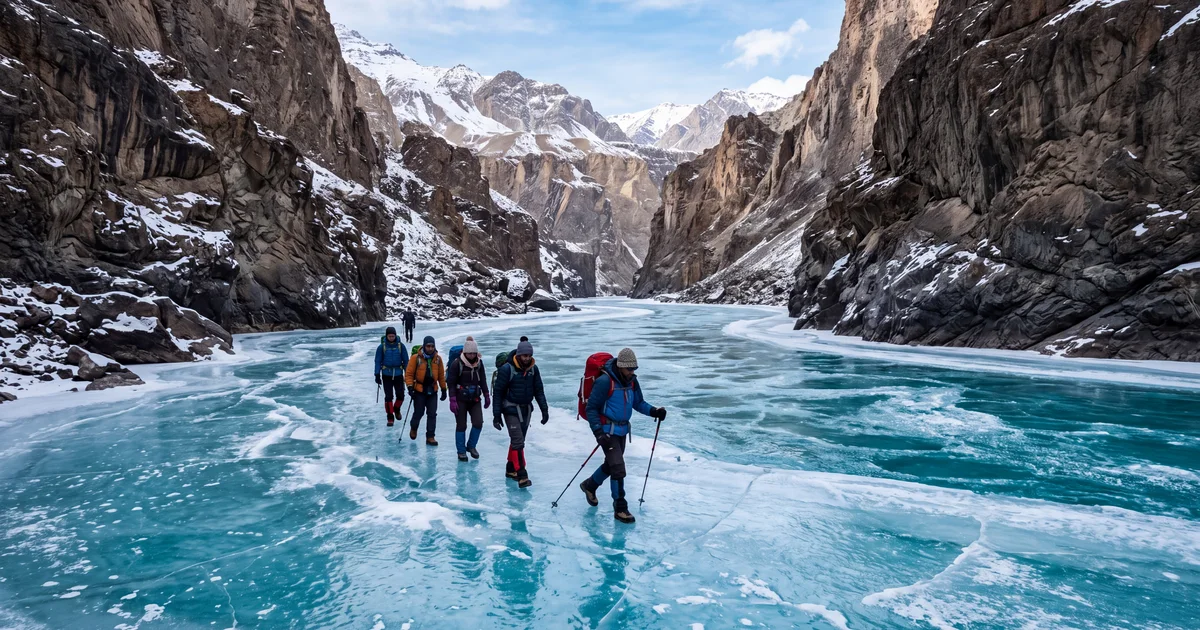
The Chadar trek is not a trek in the traditional sense. You walk on a frozen river. The Zanskar river in Ladakh freezes into a sheet of ice every January, and for a few weeks each winter, this ice becomes the only route between the Zanskar valley and Leh. Locals have used it for centuries. Trekkers discovered it about two decades ago. Now roughly 3,000 people attempt it every season.
The word "chadar" means blanket in Hindi, referring to the white ice sheet that covers the river. Walking on it is exactly as strange as it sounds. The ice is rarely flat. It buckles, cracks, turns blue in places and milky white in others. Some sections are smooth enough to slide on. Others are rubble fields of broken ice chunks refrozen at odd angles. The canyon walls rise 100 to 200 metres on both sides, blocking sunlight for most of the day.
This is not a casual adventure. Temperatures on the Chadar drop to minus 25°C during the day and minus 35°C at night. You sleep in caves cut into the canyon walls or in tents pitched on the ice itself. The trek covers about 62 km over 5 to 6 walking days, and every step depends on whether the ice beneath you is thick enough to hold.
TL;DR
- The Chadar trek walks 62 km on the frozen Zanskar river over 5 to 6 days. Season: mid January to mid February.
- Difficulty: Hard. Prior high altitude trekking experience required. Minus 25 to minus 35°C throughout.
- Cost: 25,000 to 45,000 rupees for group packages from Leh. Add flights and 2 days acclimatization.
- Permits required: Inner Line Permit plus Chadar trek permit (operators handle both).
- Browse group departures on TripzSearch for confirmed January and February batches.
Why Do People Do the Chadar Trek?
The honest answer varies by person, but most come back talking about the same three things.
First, the landscape. The Zanskar gorge in winter is visually unlike anywhere else in India. Frozen waterfalls hang from the canyon walls in 30 metre columns of turquoise ice. The river itself shifts colour from white to deep blue depending on ice thickness and air trapped beneath. On clear nights, the stars through the narrow canyon opening are undiluted by any light pollution within 100 km.
Second, the difficulty. This is one of the hardest treks commercially available in India. People who have done Kedarkantha, Roopkund, and Stok Kangri still describe the Chadar as a different category. The cold tests you constantly. There is nowhere to warm up during the walking day. Your water bottle freezes within 20 minutes of leaving your sleeping bag. The sense of accomplishment at the turnaround point (Nerak waterfall, usually) is genuine because the suffering was genuine.
Third, cultural encounter. Zanskari families still use the Chadar in winter to travel between villages when the road over Pensi La is buried under 20 ft of snow. You meet them on the ice, sometimes with children, sometimes with livestock. That context, walking a route that is someone's actual highway, gives the trek a weight that manufactured adventure experiences lack.
The caveat: the Chadar's window is shrinking. Climate data from the Indian Meteorological Department shows the Zanskar freeze period has shortened by roughly 10 days over the past two decades. Some years (2023 was one), the trek opens late and closes early, giving only a 2 week window. This is not a trek you can postpone indefinitely.
What Does the Chadar Trek Route Look Like?
The standard itinerary runs 7 to 9 days total including travel and acclimatization:
Day 1 to 2: Arrive in Leh, acclimatize. Leh sits at 11,500 ft. You need a minimum of 2 full days here before starting the trek. Spend them walking around town slowly, drinking water, and sleeping. Do not take Diamox unless a doctor prescribed it; it masks symptoms you need to feel. Most operators include a short acclimatization walk to Shanti Stupa or Leh Palace.
Day 3: Leh to Chilling (drive), Chilling to Tilad Do (walk, 7 km). The drive to Chilling takes about 2.5 hours on the Leh to Srinagar highway, then a turn off toward the Zanskar. At Chilling, you step onto the frozen river for the first time. The first day's walk is short, 7 km to a cave campsite at Tilad Do. This is deliberate: your body needs to adjust to walking on ice.
Day 4: Tilad Do to Shingra Koma (16 km). The first full day. The gorge narrows, the canyon walls close in, and you settle into the rhythm of Chadar walking: short steps, wide stance, constant assessment of the surface. Some sections require scrambling over rocks on the river bank where ice has melted or broken. Camp in caves.
Day 5: Shingra Koma to Tibb Cave (15 km). More of the same, but the scenery intensifies. Frozen waterfalls become more frequent. The canyon is narrow enough in places that sunlight reaches the river for only 2 hours per day. Tibb Cave is one of the larger camping caves, big enough for 20 people.
Day 6: Tibb Cave to Nerak (14 km). The turnaround point for most commercial treks. Nerak is a small Zanskari settlement at the confluence of two rivers. The frozen waterfall at Nerak is the iconic Chadar photo: a 30 metre cascade of blue ice pouring from the canyon wall. You camp near the waterfall.
Day 7 to 8: Nerak back to Chilling (return, 2 days). You walk back the same route. The return is usually faster because you know the terrain and the ice has had more days to solidify. Some operators push the return in 2 long days; others take 3 comfortable ones.
Day 9: Drive Chilling to Leh. Back to hot showers and phone signal.
Total walking distance: about 62 km. Daily distances of 14 to 18 km sound modest, but walking on uneven ice at minus 20°C with a daypack is slower than you expect. Plan for 6 to 8 hours of walking each day.
How Difficult Is the Chadar Trek Really?
Let me be specific about what makes it hard, because "difficult" means different things to different people.
The cold. Daytime temperatures range from minus 10 to minus 25°C. Night temperatures hit minus 30 to minus 35°C. Your sleeping bag must be rated to minus 40°C to be safe. Even with proper gear, the cold seeps in. Pulling your hands out of gloves for 30 seconds to adjust a strap leaves your fingers numb. Eating requires speed because food freezes on the plate within minutes.
The ice surface. You are not walking on a skating rink. The ice is irregular: smooth patches give way to boulder fields of refrozen chunks, water seeping over the surface in some spots (called "overflow"), and thin sections near rapids where the current weakens the freeze. You wear microspikes or crampons over insulated boots. Falls happen to everyone; the question is how you fall, not whether.
The sleeping conditions. Caves are smoky from cooking fires and cramped. Tents on ice are cold: your body heat melts the ice beneath you slightly, then it refreezes, sticking your sleeping pad to the ground. You sleep in all your layers. Getting up to use the "bathroom" (an open spot behind a rock) at 3 AM in minus 30°C requires serious willpower.
The altitude. The trek stays between 10,500 and 11,500 ft. This is not extreme altitude by Himalayan standards, but combined with the cold, dehydration (you cannot drink enough when all water must be melted from ice), and exertion, altitude symptoms hit harder than they would at the same elevation in summer.
What it does not require: technical climbing skills, ropes, or mountaineering experience. The walking itself is flat. There are no passes to cross, no scrambles above grade 1, and no exposure. Fitness for walking 15 to 18 km per day at altitude in extreme cold is the baseline. That means cardiovascular endurance over raw strength.
My recommendation: if you have not done at least one winter trek in the Himalayas (Kedarkantha, Brahmatal, or similar), do that first. Not because those treks are similar to the Chadar, but because they teach you how your body reacts to cold and altitude simultaneously. Arriving on the Chadar without that baseline knowledge is risky.
What Does the Chadar Trek Cost in 2026?
The Chadar is one of the more expensive treks in India, driven by logistics (everything goes in on the ice or by helicopter), the short season, and permit fees.
Group trek packages from Leh (7 to 9 days): 25,000 to 45,000 rupees per person. The price spread is wide because inclusions vary. Cheaper packages may use shared tents, fewer porters, and basic meals. Premium ones include a dedicated cook, 4 season tents, satellite phone, and smaller group sizes (8 to 10 people vs. 20+).
What the package typically includes: camping gear (tent, sleeping bag, mat), all meals on the trek, porters to carry group equipment, a certified guide, trek permit fees, transport from Leh to Chilling and back.
What you add separately:
- Flights to Leh: 5,000 to 12,000 rupees one way from Delhi depending on season and booking time
- Leh accommodation for acclimatization: 1,500 to 3,000 rupees per night
- Personal gear (if you do not own it): renting a minus 40°C sleeping bag and insulated boots in Leh costs about 2,000 to 3,500 rupees for the trek duration
- Personal insurance with high altitude and evacuation coverage: 2,000 to 5,000 rupees for a short term policy
Total realistic budget: 35,000 to 60,000 rupees for the complete trip from Delhi and back.
Do not underestimate gear costs. You need: minus 40°C sleeping bag, 4 layer clothing system (base, mid, insulation, shell), insulated boots rated to minus 30°C, gaiters, down mittens plus liner gloves, balaclava, ski goggles for wind days, and microspikes or crampons. If you own none of this, renting in Leh is feasible but buying outright for future use runs 15,000 to 30,000 rupees at Indian outdoor stores.
For current group departure dates and operator pricing, check TripzSearch.
Is the Chadar Trek Getting Harder to Do?
Yes, and for reasons beyond your control.
The Zanskar river freeze depends on sustained temperatures below minus 15°C for several consecutive weeks. Climate data shows winters in Ladakh warming at roughly 0.3°C per decade. The practical effect: the Chadar window was reliably 4 to 5 weeks in the early 2000s. Now it averages 2 to 3 weeks in most years.
In 2023, the trek opened on January 25 and had to close on February 9 after ice thinned dangerously at multiple points. Operators refunded or rescheduled hundreds of bookings. In 2024, the window was slightly longer (January 18 to February 14), but multiple groups reported unsafe sections near Shingra Koma requiring land bypasses.
The Indian government is building the Nimmu to Padum highway, a year round road that will connect Zanskar to Leh without relying on the frozen river. When completed (estimated 2027 to 2028), the Chadar's cultural significance changes: locals will no longer need it. Whether it remains open for trekking is uncertain; environmental regulations may close it.
If the Chadar trek is on your list, the next 2 to 3 seasons may be the window. Not because the ice will disappear entirely (it probably will not for another decade), but because the combination of regulatory, climate, and infrastructure changes makes the future unpredictable.
How to Prepare for the Chadar Trek
Start 3 to 4 months before your departure date.
Cardiovascular fitness: You need the stamina to walk 15 to 18 km per day for 5 to 6 consecutive days. Running 5 km in under 30 minutes, or brisk walking 10 km with a 10 kg pack on hilly terrain, is the minimum baseline. Build up to longer distances. The Chadar does not have steep ascents, so raw uphill power matters less than sustained endurance.
Cold tolerance: Take cold showers. Sleep without heating for a few weeks. These sound silly but they teach your body not to panic in cold. The mental component of handling minus 30°C is as important as the physical: people who have never experienced sustained cold underestimate how much it drains your motivation and decision making.
Prior altitude experience: At minimum, do one trek above 12,000 ft before the Chadar. Kedarkantha (12,500 ft, winter), Brahmatal (12,250 ft, winter), or Kuari Pass (12,516 ft) are appropriate warm ups. You need to know how your body handles altitude: do you get headaches? At what elevation? How much water do you need?
Gear testing: Do not wear new boots on the Chadar. Break in your insulated boots on at least 3 multi hour walks before the trek. Test your layering system in the coldest conditions you can access (a night camping in Uttarakhand in January, or even a cold storage facility walk through). Discover what fails before you are 30 km into a canyon with no exit.
Medical clearance: Get a basic fitness certificate from your doctor. Operators require it. If you have Raynaud's disease, asthma triggered by cold air, or cardiac conditions, consult a specialist specifically about sustained cold exposure at altitude.
Picking an Operator for the Chadar Trek
This is one trek where the operator genuinely matters for safety. Here is what to evaluate:
Leh presence. Your operator should have a physical office in Leh and staff who have run the Chadar multiple times. Avoid operators who subcontract the entire trek to a Leh based team without oversight. Ask who the lead guide is and how many Chadars they have done.
Group size. Smaller is better. Groups above 15 create bottlenecks at narrow ice sections and overcrowd cave campsites. Groups of 8 to 12 allow the guide to monitor each person's condition individually.
Safety gear. They should carry: a satellite phone (Thuraya or Iridium, not just a Jio phone), a throw rope for ice rescue, a pulse oximeter for altitude checks, and a basic medical kit with frostbite treatment supplies. Ask specifically about evacuation protocol: how do they get someone out from Tibb Cave (30 km from the road)?
Cancellation policy. Because the Chadar depends on ice conditions, cancellations happen. A responsible operator will offer: full refund if the trek does not open, partial refund or date change if it opens but conditions deteriorate mid trek, and clear communication 48 hours before departure about ice status.
Compare options on TripzSearch where you can filter for Chadar departures with verified operator details.
Frequently asked questions
- When is the Chadar trek open?
- The Chadar trek runs from mid January to mid February in most years. The exact window depends on when the Zanskar river freezes solid enough to walk on. Operators typically announce confirmed departures 2 to 3 weeks before the start date based on ice reports from Leh. Some years the window shrinks to just 3 weeks if winter is mild.
- How difficult is the Chadar trek?
- The Chadar trek is classified as difficult to extreme. The walking itself is moderate (flat river ice, 15 to 18 km per day), but the conditions make it hard: temperatures drop to minus 25 to minus 35°C at night, you sleep in caves or tents on ice, and the river surface is unpredictable. Prior Himalayan trekking experience above 12,000 ft is strongly recommended.
- How much does the Chadar trek cost in 2026?
- Group packages from Leh cost 25,000 to 45,000 rupees per person for a 7 to 9 day itinerary. This covers camping gear, food, porters, a guide, and the trek permit. Add your flight to Leh (5,000 to 12,000 rupees from Delhi) and 1 to 2 days acclimatization in Leh. Total budget for a Chadar trek is roughly 35,000 to 60,000 rupees all in.
- Do I need a permit for the Chadar trek?
- Yes. You need an Inner Line Permit (ILP) for the Zanskar region plus a specific Chadar trek permit from the Leh district administration. Most operators handle both permits as part of the package fee. Indian nationals can get the ILP online. Foreign nationals need to apply through a registered tour operator in Leh.
- Can beginners do the Chadar trek?
- The Chadar trek is not suitable for first time trekkers. You need prior experience walking at altitude (at least one trek above 12,000 ft), cold weather camping tolerance, and strong cardiovascular fitness. The cold alone disqualifies most casual trekkers: if you have not camped below minus 10°C before, the minus 30°C nights on the Chadar will be a shock.
- Is the Chadar trek safe?
- Risk is real but managed by experienced operators. The main dangers are: ice breaking (operators test thickness at every campsite and reroute if needed), hypothermia (proper layering and sleeping bags rated to minus 40°C mitigate this), and altitude sickness (you acclimatize in Leh for 2 days before starting). Evacuations happen every season, usually for frostbite or AMS. Pick an operator with a Leh base, satellite phone, and documented rescue protocol.