Valley of Flowers Trek 2026: Best Time, Itinerary & Group Treks That Handle Everything
Plan your Valley of Flowers trek: best bloom dates, how to get there from Bangalore, trail difficulty, and group trek options for 2026.
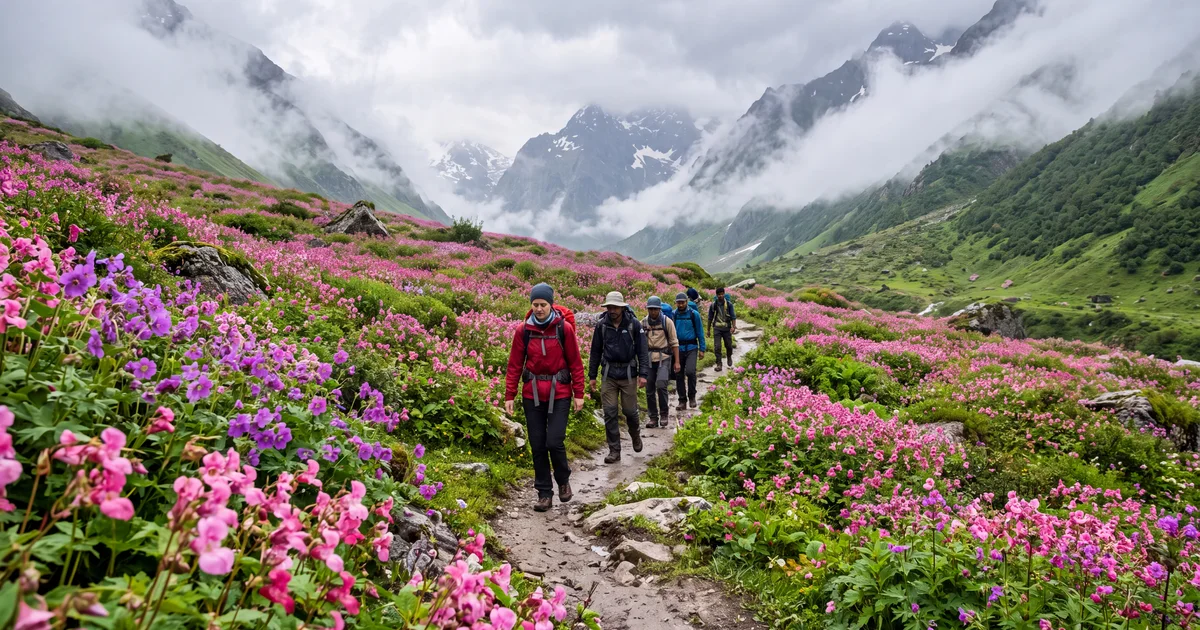
The Valley of Flowers trek is one of India's most searched treks for a reason: the photos show an entire alpine valley buried under hundreds of species of blooming flowers, and the photos are telling the truth. The valley sits at 3,658 metres in Chamoli district, Uttarakhand, inside a UNESCO World Heritage Site, and roughly 520 species of alpine flora bloom here between mid-July and late August. The colour changes week to week across the season.
It is not a quick trip. From Bangalore, you need at least 6 days to do it properly: two days of travel each way, an acclimatisation day, and two days on the trails. This guide covers what the route involves, when to go, and how to find a group trek that handles the logistics.
TL;DR
- Best bloom window: late July to late August; peak colour runs roughly 25 July to 20 August
- Trek difficulty: moderate; altitude at base camp (3,050 m) is the main challenge, not the gradient
- Getting there from Bangalore: fly to Dehradun, then 295 km by road to Govindghat (7 to 8 hours)
- Group trek duration: 6 to 8 days including travel from Dehradun
- The national park closes October 31; no winter access
When is the best time to do the Valley of Flowers trek?
The valley blooms in monsoon. This surprises most people who have been told to avoid the Himalayas in July. For Valley of Flowers, monsoon is not an obstacle. It is the whole point.
Glacial melt and steady rainfall together trigger the bloom. Before mid-July, much of the upper trail is still under snow and the flowers have not opened. After mid-September, the petals drop and the valley begins to look wintry. The park closes October 31 each year, and there is no winter access.
Within the season, the flower composition changes significantly. Mid-July brings the first wave: Himalayan blue poppies in cobalt clusters, white and purple anemones, early primulas along the stream margins. By late July, brahmakamal comes in at higher elevations. The first week of August is typically the peak, when the valley floor is so densely covered that the separate species become hard to distinguish. After 20 August, variety narrows, though the trails are noticeably quieter.
If you can only go once, target late July. The 25 July to 10 August window gives you peak colour in the valley and the Hemkund Sahib wildflowers above 4,000 metres in their best condition simultaneously.
One honest thing about the weather: monsoon means rain, leeches on the lower trail between Govindghat and Ghangaria, and cold evenings at base. The leeches are manageable with salt. The rain usually comes in short bursts, not all-day downpours. But pack a proper rain jacket with a hood that covers your pack, and accept that your shoes will be wet by day two.
How difficult is the Valley of Flowers trek?
The gradient is mild inside the national park. From Ghangaria at 3,050 metres to the valley floor at 3,658 metres is 400 metres of elevation over 3.5 km. An easy half-day walk for anyone in moderate fitness.
The approach is harder. From Govindghat to Ghangaria covers 13 km and roughly 1,000 metres of gain. The path is mostly paved with concrete steps and stone slabs, but it is a sustained climb over 4 to 5 hours. Ponies are available from Pulna village, 4 km from Govindghat, for those who need them.
Altitude is the real challenge. Arriving at Ghangaria from Bangalore and heading directly into the valley is the single most common mistake on this trek. At 3,050 metres, some people feel the thinning air as a dull headache and unusual fatigue. Most adjust within 12 to 18 hours. Take a rest day at Ghangaria before entering the national park. It is boring advice. It is correct advice. Skipping it causes at least one person in most groups to turn back early.
This trek is frequently labelled as extreme Himalayan adventure in marketing. It is not. Fit adults with no altitude-related health conditions complete it comfortably. The legitimate risk is remoteness: if someone falls seriously ill at Ghangaria, evacuation takes hours. Know your group's health before you go, and ask any operator about their emergency protocol before you book.
How to reach Valley of Flowers from Bangalore
By air to Dehradun: Fly from Kempegowda International (BLR) to Jolly Grant Airport in Dehradun (DED). Direct flights take around 2.5 hours. From Dehradun, the road to Govindghat covers roughly 295 km via Rishikesh and Joshimath. Budget 7 to 8 hours for the drive in normal conditions; during peak monsoon, the Rishikesh to Joshimath section can add 1 to 2 hours for landslide checks and single-lane stretches.
Via Delhi: If your Bangalore connection goes through Delhi, overnight AC buses run from Kashmere Gate ISBT to Haridwar or Rishikesh. From Haridwar, shared taxis to Govindghat take another 7 to 8 hours. Slower overall, but considerably cheaper than a separate Dehradun flight. Most solo trekkers from South India use this route.
For group departures from Bangalore, most operators include shared transport from Dehradun as part of the package. Check what is included before booking, since some list the Bangalore to Dehradun flight as a separate cost. Browse current departures on TripzSearch or the Himalayan treks collection.
Joshimath, 19 km before Govindghat, is a practical overnight stop if you arrive in Dehradun late in the day. Several guesthouses here, and breaking the drive means you reach Govindghat rested. Solo trekkers should plan this stop; some group itineraries include it.
The Valley of Flowers trail: what to expect day by day
Most organised itineraries run 6 to 8 days. The core structure looks like this:
Day 1: Fly to Dehradun, begin the road to Haridwar or Joshimath. Overnight en route.
Day 2: Continue driving to Govindghat. Begin the 13 km climb to Ghangaria on a paved trail. Arrive by afternoon. Ghangaria has guesthouses, small restaurants, and intermittent mobile signal. Overnight at Ghangaria.
Day 3: Acclimatisation. Stay in Ghangaria, walk around the village, eat well, drink water, sleep early. Most altitude headaches resolve with 12 to 18 hours of rest and fluids. Do not skip this day.
Day 4: Valley of Flowers. Enter at the national park gate with your permit, walk 3.5 km to the valley floor, spend 4 to 6 hours inside. The gate closes at 5 PM; plan your exit accordingly. This is the day everything else was for.
Day 5: Hemkund Sahib. The gurudwara at 4,329 metres sits beside a glacial lake and is one of the highest Sikh shrines in the world. The climb from Ghangaria is steep and takes 3 to 4 hours each way. If altitude affected you noticeably on day 3, skip this one. The return effort above 4,000 metres is not something to push through if you are still symptomatic.
Day 6: Descend to Govindghat. Drive toward Dehradun or Rishikesh for the return journey.
Do not book a Bangalore flight on the same day you descend from Govindghat unless your Dehradun flight is in the late evening. The road has landslide-prone stretches in monsoon and delays of 2 to 3 hours are common. A buffer night in Rishikesh removes a lot of anxiety from the return.
What flowers bloom in Valley of Flowers?
Around 520 documented species, which is why the valley earned UNESCO World Heritage status in 1988. What you see depends on when you arrive.
Mid-July brings Himalayan blue poppies (Meconopsis aculeata) in vivid cobalt clusters, various anemone species, and the first primulas along water channels. This is the quieter end of the season with fewer trekkers and a lower accommodation crunch.
Late July into early August adds brahmakamal (Saussurea obvallata), the state flower of Uttarakhand, in waxy white clusters that grow above 3,500 metres. Geraniums, potentillas, and multiple yellow composite species carpet the lower sections. Kobressia forms dense meadow patches near the stream network.
By late August, variety narrows but some species are still in full bloom: late-season asters, lingering cobalt poppies at elevation, and ground-cover plants that persist into September.
A word on expectations: the valley covers 87 square kilometres and you walk through a section of it on a defined trail. Bloom density varies across the floor. Some zones look extraordinary. Others are patchier. The overall effect at peak is unlike anything most Indian trekkers have seen, but it is a natural alpine meadow, not a curated garden, and its appeal is partly that it looks genuinely wild.
Group treks vs. going independently
Both are viable. They suit different kinds of trekkers.
Going independently gives full flexibility on timing and pace. You book your own guesthouse in Ghangaria (limited capacity; book 3 to 4 weeks ahead for the late July peak), buy your national park entry permit at the gate, and arrange your own transport from Govindghat. Porters are available at Govindghat. This works well for experienced Himalayan trekkers who have navigated remote trails before.
A group trek handles the logistics and removes most of the pre-trip work: shared transport from Dehradun, group-rate guesthouses, a local guide, and an itinerary that already builds in the acclimatisation day. The right group also means an emergency protocol and, for any operator worth booking, an oxygen cylinder and an evacuation plan. Ask specifically about these before committing. Any operator who cannot answer the altitude sickness question clearly is not the right operator for a trek that tops 4,300 metres.
Browse current group departures on TripzSearch or the Himalayan treks collection. Trekkers starting from Bangalore can check group trips leaving Bangalore for packages that already include Dehradun transport.
Before you pack
A short list of what this trek requires that standard packing guides miss:
A waterproof jacket (not just a poncho): it needs a hood that covers your pack and should be a proper rain shell, not a light windbreaker. Trekking shoes with grip on wet stone, since the trail from Govindghat to Ghangaria is paved but slick in rain. A fleece or mid-layer for evenings at Ghangaria, where temperatures drop to 5 to 8 degrees Celsius at night in July. Rehydration salts. A headlamp if you plan an early valley entry.
Mobile signal exists in Ghangaria and drops to nothing inside the national park. Carry offline maps.
If you are arriving from Bangalore in 30-degree July heat and packing accordingly, you will regret leaving the fleece behind by the second evening at Ghangaria. The altitude does the work quickly.
Frequently asked questions
- When is the best time to do the Valley of Flowers trek?
- The bloom window runs mid-July to mid-September, but peak colour is late July to late August. Plan to be in the valley between 25 July and 20 August for the most flowers. Before mid-July, the trail still has snow cover in sections; after September, the flowers fade and the national park closes October 31.
- Is Valley of Flowers trek suitable for beginners?
- Yes, with one caveat on altitude. The gradient inside the national park is gentle, around 400 metres over 3.5 km. The real challenge is acclimatising to 3,050 metres at Ghangaria. Take one rest day at Ghangaria before entering the valley, hydrate well, and go slow on arrival day. Anyone in reasonable fitness with no heart or respiratory conditions can complete this trek.
- How do I reach Valley of Flowers from Bangalore?
- Fly from Bangalore (BLR) to Dehradun (DED); direct flights take around 2.5 hours. From Dehradun, it is a 7 to 8 hour drive to Govindghat covering roughly 295 km via Rishikesh and Joshimath. Most group treks include shared transport from Dehradun. Solo trekkers can take overnight buses from Delhi to Haridwar and then shared taxis to Govindghat.
- What flowers bloom in Valley of Flowers?
- The valley has around 520 documented species of alpine flora. Mid-July brings Himalayan blue poppy, anemones, and early primulas. Late July sees brahmakamal and dense geranium patches at higher elevations. The composition shifts week to week within the season, so two visits a fortnight apart will look quite different.
- What is the difference between Valley of Flowers and Hemkund Sahib?
- Both are accessed from the same base at Ghangaria (3,050 m). Valley of Flowers is a national park with a gentle gradient, visited for its alpine meadow blooms. Hemkund Sahib is a Sikh pilgrimage site and glacial lake at 4,329 metres, with a steep 6 km climb from Ghangaria. Most group itineraries include both on separate days.