Best Treks from Mumbai (2026): Weekend Sahyadri Trails Worth the Drive
12 treks from Mumbai for weekends in the Sahyadris, with difficulty ratings, best months, group options, and what each trail actually demands.
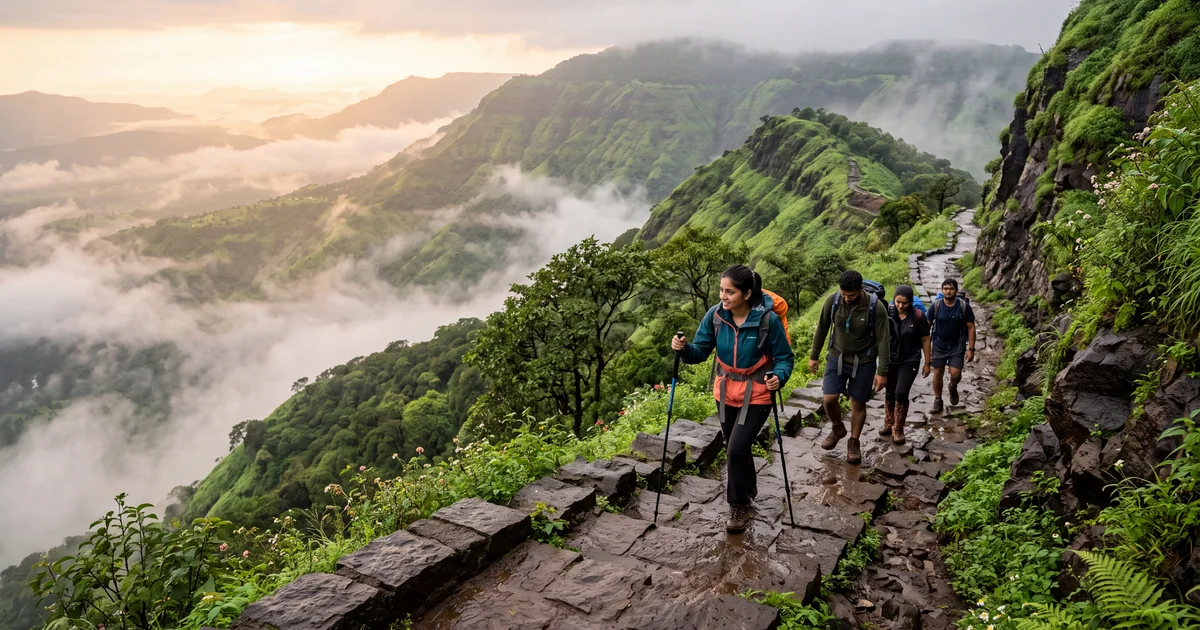
Mumbai sits within striking distance of the Western Ghats, and by striking distance I mean 60 to 150 km depending on whether you are counting from Borivali or from Panvel. That proximity is the reason weekend trekking has become something close to a default activity for anyone in the city who owns a pair of shoes with grip.
The Sahyadris running parallel to the coast are old mountains. Flat-topped forts, basalt cliffs, seasonal waterfalls that appear in June and vanish by November. The treks are mostly short (3 to 6 hours up) but steep enough that you feel them the next day.
This is organized by what the trail demands from you, not by some artificial ranking. A 4 km walk up stone steps to Lohagad and a 4 km scramble up Nalichi Vaat are two entirely different experiences.
TL;DR
- Lohagad, Karnala, and Tikona are the simplest options and work year round.
- Monsoon (July to September) is the best season for Sahyadri treks. The landscape transforms completely.
- Harishchandragad, Sandhan Valley, and Kalsubai are the big ones. Budget a full day or overnight.
- Most base villages connect via MSRTC buses from Kalyan or Karjat. A car saves 2 hours each way.
- Group treks from Mumbai start at 800 to 1,500 per person for day trips, 2,500 to 5,000 for overnighters.
What Are the Best Easy Treks from Mumbai for a First Timer?
If you have never trekked the Sahyadris, these three will show you what the range is about without punishing your knees.
Lohagad Fort (65 km from Mumbai, 2 hours up). Stone-cut steps all the way. The fort at the top has walls, gates, and a view of Pawna Lake that earns its reputation. The monsoon version is the one to do: clouds roll through the ramparts and visibility drops to 10 metres, then clears in seconds. Catch the 6:15 AM Lonavala local from Dadar, auto to Malavli base. You can be back in the city by 4 PM.
Karnala Fort (55 km, 90 minutes up). Inside the Karnala Bird Sanctuary, so the approach is a proper forest trail. The trek is easy until the last 200m, where you scramble over exposed rock to reach the bastion. Skip this section if it is wet and you are alone. Best between October and February when the birding is good.
Tikona Fort (110 km, 2 hours up). The name means triangle, which describes the shape of the hill. Steeper than Lohagad but still manageable. Pawna Lake lies below, and most trekkers combine this with lakeside camping on Friday night. The stone steps are original Maratha construction. One honest caveat: the last 15 minutes are a near-vertical rock patch that feels exposed. People with genuine vertigo should know this in advance.
Which Treks from Mumbai Work Best in Monsoon?
Monsoon in the Sahyadris is not just tolerable. It is the point. The plateaus flower, valleys fill with mist, and waterfalls that do not exist for 8 months suddenly drop 300 metres off cliff edges.
Rajmachi Fort (via Udhewadi, 70 km from Mumbai). Two forts (Shrivardhan and Manaranjan) on a plateau above Lonavala. The trek from Udhewadi village is 5 km through dense fog in monsoon. Villagers run homestays and serve hot misal. This is the trek Mumbaikars default to when they want something easy but atmospheric.
Visapur Fort (65 km, 3 hours up). Lohagad's neighbour, but wilder and less crowded. The trail passes multiple waterfalls in monsoon, and the fort itself has a larger plateau with cisterns full of rainwater. You can combine Lohagad and Visapur in a single long day if you start at 6 AM.
Andharban (80 km, descent trek, 5 to 6 hours). The name means "dark forest," and that is accurate. You start at Pimpri Dam near Tamhini Ghat and descend 13 km through dense canopy, crossing streams and scrambling over roots. This is a one-way trek (you come out at Bhira Dam). The lack of markers means you need a guide or a group who knows the route. One of the best monsoon experiences within 100 km of Mumbai.
Devkund Waterfall (100 km, 4 hours return). Not a summit trek but a forest walk to a waterfall pool. The trail follows a river through the Tamhini region. Knee-deep crossings in August. The waterfall is about 25 metres high with a swimmable pool at the base. Weekends get crowded by 10 AM; start early or go midweek.
How Difficult Is Harishchandragad from Mumbai?
Harishchandragad is the trek that separates casual weekenders from committed trekkers. The mountain (1,424m) has four routes, and the difficulty ranges from moderate to genuinely dangerous depending on which one you pick.
Khireshwar route (moderate, 4 to 5 hours up). The standard approach. A mix of forest trail and rock steps. Suitable for anyone with reasonable fitness. This is what most group operators use.
Pachnai route (moderate, 3 to 4 hours). Shorter but steeper. Less crowded than Khireshwar. The trail is straightforward until the final ascent to the temple.
Nalichi Vaat (difficult, 5 to 6 hours). A cliff route with exposed rock traverses and sections where you use fixed ropes. Falls have happened here. Do not attempt without a guide, and skip it entirely if the rock is wet. This is not beginner territory.
Junnar Darwaja (moderate to difficult, 5 hours). The historical main entrance. Parts of the rock-cut staircase have crumbled, making it more scramble than stairs.
The summit plateau has Kedareshwar cave (a Shiva linga surrounded by waist-deep water), the Saptateertha pushkarni (a stepped pool), and Kokan Kada, a concave cliff face that drops 400 metres straight down. Kokan Kada at sunrise during monsoon is the most dramatic viewpoint in the entire Western Ghats range. I realize that sounds like exaggeration. It is not.
Most trekkers camp overnight on the plateau. Water is available at the temple and pushkarni. Carry a tent in monsoon because the caves get crowded on weekends. From Mumbai, budget 3.5 hours of driving to Khireshwar village.
Is Kalsubai Worth the Effort for a Day Trip from Mumbai?
Kalsubai is Maharashtra's highest peak at 1,646m. The standard route from Bari village takes 3 to 4 hours up via a well-maintained trail with iron ladders bolted into the steeper sections.
The honest answer: Kalsubai is worth it once. The climb is relentless (1,000m of elevation gain in 5 km) and the trail itself is more stairmaster than scenic. But the summit view on a clear day shows Bhandardara dam, the Sahyadri ridgeline, and on very clear winter mornings, you can make out peaks 60 km away.
The better version of a Kalsubai trip: drive up on Saturday, camp at the base in Bari, summit for sunrise, descend by 9 AM, and visit Bhandardara lake and Randha falls on the way back. Trying to do it as a Sunday morning dash from Mumbai (3.5 hour drive, 3.5 hour climb, 3.5 hour drive back) is possible but exhausting.
Group trips from Mumbai operators typically include transport, guide, and sometimes dinner the night before. Expect 1,500 to 3,000 per person.
What About Sandhan Valley from Mumbai?
Sandhan Valley (the "Valley of Shadows") is a canyon trek in the Sahyadris, about 150 km from Mumbai. The valley is a 200-metre-deep gorge with sections as narrow as 2 metres. You rappel, wade through waist-deep pools, and chimney-climb between rock walls.
This is not a walk. It is a canyoneering route. The full descent takes 5 to 7 hours and requires basic rappelling. Most groups do it as an overnight: camp at the canyon rim Saturday evening, descend Sunday morning.
When to go: post-monsoon (October to December) is ideal. The pools are full but not flooded. In monsoon, flash flood risk makes the canyon genuinely unsafe. Summer dries the pools but the heat at the canyon floor (no shade, no wind) becomes oppressive.
You cannot do Sandhan without ropes and someone who knows the anchor points. Join a group trip or hire a local guide from Samrad village. The rappel sections are 30 to 50 feet. Falls here are not theoretical.
Browse weekend group treks from Mumbai or check the monsoon Western Ghats collection for fixed departures that include gear and guides.
Quick Reference: Distance and Time from Mumbai
Lohagad: 65 km, 1.5 hours drive, 2 hours up. Karnala: 55 km, 1 hour drive, 90 minutes up. Tikona: 110 km, 2.5 hours drive, 2 hours up. Rajmachi: 70 km, 2 hours drive, 2.5 hours trek. Visapur: 65 km, 1.5 hours drive, 3 hours up. Andharban: 80 km, 2.5 hours drive, 5 hours descent. Harishchandragad: 170 km, 3.5 hours drive, 4 to 6 hours up. Kalsubai: 155 km, 3.5 hours drive, 3.5 hours up. Sandhan Valley: 150 km, 3.5 hours drive, 5 to 7 hours canyon.
All distances measured from Dadar, central Mumbai. Add 20 to 30 km if starting from Andheri or Borivali for northern routes, subtract for eastern-corridor treks (Karjat side).
How to Get to Trek Bases Without a Car
Owning a car in Mumbai is optional. Most of these treks are reachable by train and bus.
Take the Central Railway local to Karjat (for Matheran, Peth, and routes south of the railway line) or the Lonavala fast local from Dadar (for Lohagad, Visapur, Rajmachi). Both cost under 50 rupees and take 90 to 120 minutes.
From Karjat or Lonavala, MSRTC buses and shared Sumo/Tata Magic vehicles connect to base villages. The last mile is where you lose time: 30 to 60 minutes on dirt tracks that only run when enough passengers gather. Leave Mumbai by 5:30 AM to reach most trailheads by 8 AM.
For distant treks (Harishchandragad, Kalsubai, Sandhan), a group trip with included transport saves you the logistics headache entirely. Most operators pick up from Dadar or Thane between 10 PM Friday and midnight, drive overnight, and reach the base by 4 to 5 AM Saturday.
Compare group departures on TripzSearch to find operators running your target trail this weekend.
The Sahyadris reward repetition more than variety. The same trail in October and July is two different treks. People who trek regularly from Mumbai tend to cycle through 4 or 5 favourites rather than checking off a long list, and they are not wrong.
Frequently asked questions
- Which is the easiest trek from Mumbai for beginners?
- Lohagad Fort is the simplest. It is 60 km from Mumbai, takes about 2 hours to climb, and has well-cut stone steps for most of the ascent. Karnala Fort is even closer (55 km) with a gentle trail through the bird sanctuary, though the final rock patch near the bastion needs basic fitness.
- Are monsoon treks from Mumbai safe?
- Most Sahyadri treks are best during monsoon (July to September), but safety depends on the specific trail. Routes like Harishchandragad via Nalichi Vaat and Ratangad become genuinely dangerous when wet. Stick to fort treks with stone steps (Lohagad, Rajmachi, Tikona) if you are new to monsoon hiking. Always check rain forecasts and avoid valleys prone to flash floods.
- How far in advance should I book a weekend trek from Mumbai?
- For popular group treks during monsoon weekends, book 5 to 7 days ahead. Operators cap batches at 20 to 30 people, and Saturday departures fill first. Winter season (October to February) is less crowded but long weekends still sell out.
- Can I do a trek from Mumbai without a group or guide?
- Yes, for well-marked trails like Lohagad, Visapur, Karnala, and Matheran. For routes like Harishchandragad (Nalichi Vaat), Sandhan Valley, and Kalsubai via the west face, a local guide is strongly recommended. The trails are unmarked, forks are confusing, and phone signal drops entirely on most Sahyadri ridges.
- What is the best season for trekking near Mumbai?
- Monsoon (July to September) is peak season. The waterfalls run, the plateaus turn green, and temperatures stay around 22 to 26 degrees. October and November offer clearer views with some green still left. Winter (December to February) is dry and cool but the landscape turns brown. Summer (March to May) is too hot for most trails below 1,000m.
- How do I reach trek base villages from Mumbai without a car?
- State transport (MSRTC) buses connect Kalyan, Karjat, and Lonavala to most base villages. Local trains to Karjat or Lonavala are the cheapest start. From there, share autos or jeeps run to trailheads like Baje (for Lohagad), Khireshwar (for Harishchandragad), or Bhandardara (for Kalsubai). Expect 30 to 60 minutes on last-mile dirt roads.