Rajmachi Fort Trek (2026): Route from Lonavala, Camping and Monsoon Guide
Rajmachi trek guide for 2026 with routes from Lonavala and Karjat, camping spots, monsoon tips and group departures from Pune.
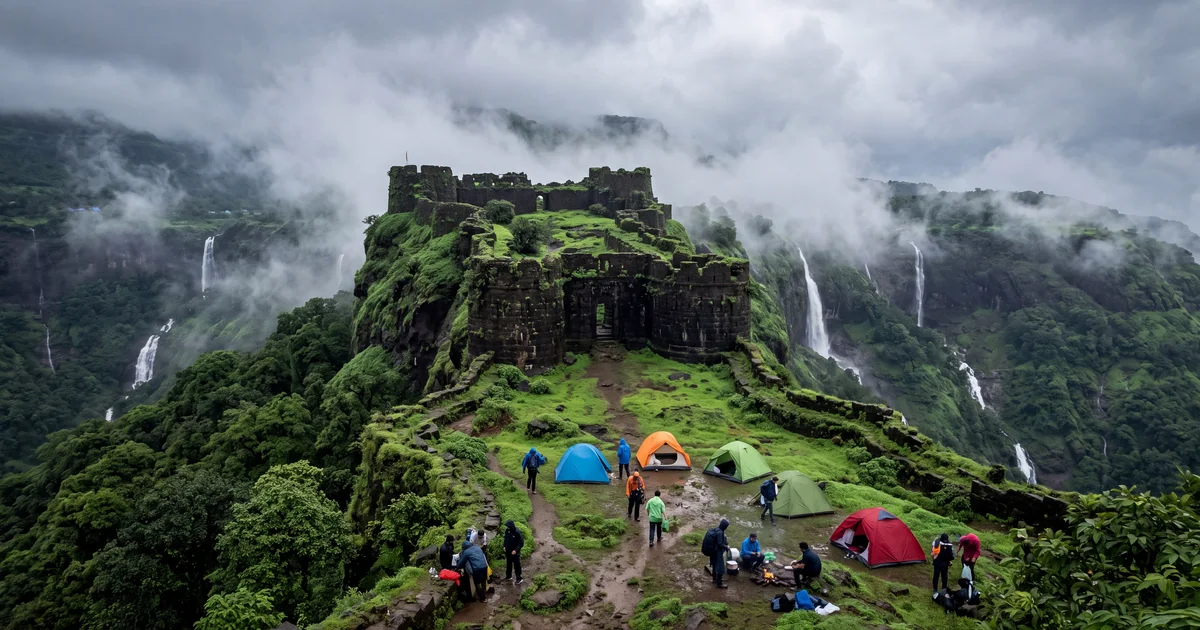
Rajmachi sits on the edge of the Sahyadri escarpment between Lonavala and Karjat, 67 km from Pune. Two Maratha bastions, Shrivardhan and Manaranjan, guard the old trade route that connected the Konkan coast to the Deccan plateau. The fort pulls trekkers year round, but monsoon is when it earns its reputation.
Between June and September, the approach from Lonavala passes five waterfalls you will not find on any map. The valley below the fort fills with cloud. And in late May through early June, the forest floor near Udhewadi lights up with bioluminescent fireflies after dark.
The rajmachi trek is not hard. It is long enough to tire you out and scenic enough to keep you moving. Two routes lead to the same place, one forgiving and one steep. This guide covers both.
TL;DR
- Two routes: Lonavala (15 km, easy, jeep track) or Karjat (7 km, steep, forest trail)
- Elevation: 920 metres at the fort. Gain from Lonavala side is about 600 metres.
- Best months: June to September for waterfalls, late May for fireflies
- Camping available at Udhewadi village below the fort
- Group departures run every weekend in monsoon from Pune and Mumbai
Which Rajmachi route should you take: Lonavala or Karjat?
The Lonavala route is 7.5 km one way along a wide jeep track. The gradient is gentle, the path is obvious, and you could do it in chappals in dry weather (do not try this in monsoon). It starts near the old Mumbai Pune highway, past Della Resorts, and follows a laterite road through open grassland before entering a forested stretch that leads to Udhewadi village.
The Karjat route is 3.5 km from Kondivade village. Shorter, yes. Also steeper, narrower, and significantly harder to navigate in rain. The trail gains 600 metres in under 4 km through dense forest with exposed rock steps. Stream crossings on this side become impassable during heavy rainfall.
Pick Lonavala if you want a relaxed walk with a group, plan to camp overnight, or have beginners in your team. Pick Karjat if you want intensity, a shorter day, and decent fitness. Most people in monsoon pick Lonavala. There is a reason for that.
One caveat: the Lonavala jeep track is boring for the first 3 km. Flat, straight, no shade. Once you cross the tree line at the 4 km mark, the landscape shifts completely.
What is the best month for the Rajmachi trek?
Monsoon owns this fort. The Western Ghats receive 3,000 to 5,000 mm rainfall between June and September in this belt, and Rajmachi sits right on the watershed where clouds from the Arabian Sea hit the Sahyadri wall.
June: The rains arrive by the second week. Waterfalls start by late June. The trail is green but not yet waterlogged. This is the sweet spot if you hate crowds.
July and August: Peak monsoon. Every gully becomes a waterfall. Cloud cover is thick. Visibility on the fort can drop to 20 metres on active rain days. The trail from Lonavala gets muddy but remains passable. The Karjat route becomes risky.
September: Rains taper. Waterfalls are still running. Green is at its deepest. The trail is at its muddiest because four months of foot traffic have churned the earth.
October: Post monsoon clarity. The valley views open up. Greenery is still lush but the waterfalls are drying. Good for photography.
Late May to early June: Firefly season. The pre-monsoon humidity triggers bioluminescence in the Udhewadi forest. Night treks during this window are popular with groups from Pune and Mumbai.
Skip November to April unless you specifically want the fort history and dry views. The landscape is brown, the waterfalls are gone, and the heat makes the exposed Lonavala jeep track unpleasant after 9am.
How to reach Rajmachi from Pune
Lonavala route (most common):
Drive the Pune Mumbai Expressway to Lonavala (67 km, 90 minutes). Exit at Lonavala and head toward the old highway. The trek starting point is a dirt road turnoff near the Della Resorts access road. Parking is available at the trailhead. From there, it is 7.5 km on foot to Udhewadi.
If you do not have a car, take any Lonavala bound bus from Swargate or Shivajinagar (₹120 to ₹180 depending on AC/non-AC). Ask for the "Rajmachi jeep track" stop. Alternatively, the Lonavala railway station is 3 km from the trailhead.
Karjat route:
Take the Pune to Karjat local train (2 hours) or drive via Tamhini Ghat to Kondivade village. The trail begins at the village edge. This side does not have vehicle access beyond Kondivade.
Drive times from other cities:
Mumbai to Lonavala trailhead: 85 km, about 2 hours via the Expressway. Nashik: 190 km, about 3.5 hours. For groups coming from either Pune or Mumbai, check available group departures from Pune which include transport.
What to expect on the Lonavala route (step by step)
The first 3 km are flat laterite road. You walk past scrubland with Lonavala's urban sprawl still visible behind you. Not inspiring. Keep moving.
At the 3.5 km mark, you enter a tree canopy. The road narrows slightly but remains a jeep track. In monsoon, this section has standing water puddles that reach ankle height.
Around the 5 km mark, the first waterfall crosses the path. It is not dramatic. It is a sheet of water flowing over the road surface. Two more appear in the next kilometre during active rain.
At 6 km, you reach a clearing with views of the Konkan plain below. On clear monsoon mornings (they happen), you can see the coastline 40 km away. On most days, you see cloud.
Udhewadi village appears at 7 km. Small settlement, 15 to 20 houses. Locals offer food (poha, maggi, tea) and camping space. The fort is a 30 minute climb above the village.
The fort itself has two bastions: Shrivardhan (higher, better views) and Manaranjan (lower, more intact walls). Both are worth exploring. Budget 45 minutes for both.
Camping at Rajmachi: what you get and what you carry
Udhewadi is the camping base. You have two options:
Village homestay camping: Local families have set up tent pitches on their land. ₹500 to ₹800 per person typically includes a tent, dinner (usually rice, dal, bhaji), and morning tea with breakfast. You carry nothing except your daypack.
Self camping: Flat ground is available near the village temple. Carry your own tent, sleeping bag, and food. Water is available from a village tap (bring purification tablets in monsoon; the runoff mixes into open sources).
Toilets are basic. Expect pit latrines at the homestays. There are no facilities between the trailhead and Udhewadi on the Lonavala route.
A word of honesty: Rajmachi camping is not wilderness camping. On any monsoon weekend, 50 to 100 people camp at Udhewadi. If you want solitude, go midweek or pick a less popular fort.
Is the Rajmachi trek good for beginners?
The Lonavala route is one of the best beginner treks in the Sahyadris. No rock climbing, no rappelling, no route finding. The entire path is a defined jeep track. You need only fitness for a 15 km walk with moderate elevation gain.
That said, beginners make common mistakes here:
They underestimate the distance. 7.5 km one way sounds easy. In monsoon mud with a loaded backpack, it takes 2.5 to 3 hours each way, not the 1.5 hours they expect.
They skip rain gear. You will get wet. A poncho or rain jacket is essential June through September. Wet cotton against skin for 6 hours causes chafing and chills.
They wear the wrong shoes. Sports shoes with smooth soles are dangerous on wet laterite. Shoes with deep lugs (trekking shoes or even gumboots) are what regulars use here.
If you are in a group of mixed fitness levels, the Lonavala route accommodates everyone. The fittest walk ahead, the slower ones follow at their pace, and everyone meets at Udhewadi.
Rajmachi fireflies: when and where
Late May to early June (sometimes extending to mid-June if the pre-monsoon humidity arrives early) brings bioluminescent fireflies to the forest between the 4 km and 6 km marks on the Lonavala trail.
The window is narrow: about 2 to 3 weeks. The fireflies appear after sunset, peak between 8pm and 10pm, and need darkness to be visible. Any torchlight or phone flashlight kills the effect for everyone around you.
Night treks specifically for fireflies are popular. Groups typically leave Lonavala trailhead at 5pm, reach Udhewadi by 8pm, and walk back through the firefly zone after dinner.
One limitation: you cannot photograph them on a phone. The exposure time needed is 10 to 30 seconds with a tripod and a camera with manual controls. If you just want to experience them, leave the phone in your bag.
What to pack for a monsoon Rajmachi trek
Keep it minimal. You are walking 15 km, not mountaineering.
Shoes with deep tread (most important item). Rain jacket or full poncho. Two litres of water minimum. Snacks for 6 hours (chikki, dry fruit, glucose biscuits). Headlamp if you are camping or doing a night trek. Extra dry clothes in a waterproof bag if camping. Sunscreen for the exposed first 3 km. Cash (₹500 to ₹1000; no UPI or card at Udhewadi).
Do not carry: heavy dSLR unless you are serious about the firefly window, cotton jeans (they absorb water and weigh you down), leather shoes.
Group treks to Rajmachi: what operators offer
Multiple operators run fixed departure Rajmachi treks from Pune and Mumbai every weekend during monsoon. A typical package includes:
Transport from a pickup point (Swargate in Pune or Dadar in Mumbai), a guide, tent stay at Udhewadi, dinner and breakfast, and the return drop. Prices range from ₹1,200 to ₹2,500 per person depending on group size and inclusions.
Batch sizes range from 15 to 40 people. Most depart Saturday evening and return Sunday afternoon. Some operators offer a shorter day trek option (Saturday morning departure, same day return) without camping.
For available weekend departures, check group treks from Pune or browse monsoon Western Ghats trips on TripzSearch. You can filter by date and compare prices across operators.
My opinion: for a first-time Rajmachi visit in monsoon, the overnight group trek is worth it. The sunset from Shrivardhan bastion and the morning cloud-in-the-valley view are both better than any midday visit.
Shrivardhan and Manaranjan bastions: what to see at the top
Rajmachi is not one fort. It is a fortified settlement with two elevated bastions on either end.
Shrivardhan (north bastion): Higher of the two. The climb from Udhewadi takes 20 minutes up a rocky path. At the top, you get a 270 degree view of the Sahyadri escarpment. On clear days, you can spot Lohagad, Visapur, and the Duke's Nose from here. The walls are partially intact with carved bastions. A small temple sits inside.
Manaranjan (south bastion): Lower and more intact structurally. The approach is slightly easier. The fortification walls here are better preserved, and you can walk along the ramparts for 200 metres. Views face south toward Karjat and the Konkan.
Between the two, a flat saddle holds the ruins of old granaries and water cisterns (still functional in monsoon). The entire fort exploration takes 45 minutes to an hour if you visit both bastions.
History note: Rajmachi controlled the Bor Ghat trade route that connected the Konkan ports to the Deccan markets. The fort changed hands between Marathas, Mughals, and the British multiple times between the 1600s and 1818. The strategic value was the view: anyone moving through the pass below was visible from the twin bastions.
Mistakes people make on the Rajmachi trek
Starting too late. In monsoon, heavy rain typically arrives by 2pm to 4pm. If you start the Lonavala route after 10am, you will catch the worst downpour on the exposed initial stretch. Leave by 6am for a day trek, 4pm to 5pm for an overnight with fireflies.
Ignoring the Karjat route conditions. Every monsoon, rescue teams evacuate trekkers stuck on the Karjat side during flash floods. The streams on that route can go from knee to chest height in 30 minutes during a cloudburst. If you insist on the Karjat route, check weather radars before descending.
No waterproof bag for electronics. Everything in your bag will get wet. Your phone, wallet, and dry clothes need a dry bag or at minimum a sealed zip-lock inside your main pack.
Expecting phone signal. Coverage is patchy past the 3 km mark and nonexistent at Udhewadi. Tell someone your plan before you leave.
Nearby treks if you want to combine
Rajmachi pairs well with other Sahyadri forts for a long weekend. Within 20 km:
Lohagad and Visapur: Twin forts near Malavli station. Easy to moderate. You can do Rajmachi Saturday and Lohagad Sunday if camping overnight at Udhewadi.
Duke's Nose: A short, steep scramble near Lonavala. 2 hours round trip. Good warmup before the Rajmachi walk.
Tung Fort (Tikona): 40 km from Lonavala near Pawna Lake. Moderate difficulty with ladder-like rock patches near the top. Popular with camping groups.
For more options, browse trips from Pune where you can filter treks by difficulty and duration.
Frequently asked questions
- How difficult is the Rajmachi trek from Lonavala?
- The Lonavala route via Udhewadi is about 15 km round trip with 600 metres elevation gain. It follows a jeep track with no technical climbing. Fit beginners can complete it in 5 to 6 hours. The route gets muddy and slippery in peak monsoon, so grip shoes are essential.
- Can I camp at Rajmachi fort?
- Yes. The Udhewadi village below the fort has flat ground suitable for camping, and a few local homes offer tent stays with dinner and breakfast included. There are no facilities on the fort itself, so carry water if you plan to stay on top after dark.
- What is the best time to visit Rajmachi?
- June to September is peak season when waterfalls surround the fort and the entire valley turns green. October brings clear views with residual greenery. May and early June are popular for fireflies near the Udhewadi trail. Avoid December to February unless you want a dry, exposed walk.
- Is the Rajmachi trek safe during monsoon?
- The Lonavala route is relatively safe even in heavy rain because it follows a wide jeep track. The Karjat route has steep sections and stream crossings that become dangerous during downpours. Check IMD Pune warnings before starting, and avoid the Karjat route on orange or red alert days.
- How do I reach Rajmachi from Pune?
- Drive to Lonavala (67 km, about 90 minutes via the Expressway) and take the jeep track from the Della Resorts side road near the old Mumbai Pune highway. Alternatively, catch a Karjat local train from Pune Junction and start the trek from Kondivade village. Both routes converge at Udhewadi.
- Are there group treks to Rajmachi available on weekends?
- Multiple operators run fixed departure group treks to Rajmachi every weekend between June and October, with transport from Pune or Mumbai. Batch sizes range from 15 to 40 people with guides. You can browse available group departures on TripzSearch at /from/pune.