15 Best Places to Visit in Varkala (2026): Cliff Beach, Temples and Hidden Coves
15 best places to visit in Varkala in 2026 with cliff walk timings, temple rules, and beach picks beyond the tourist stretch.
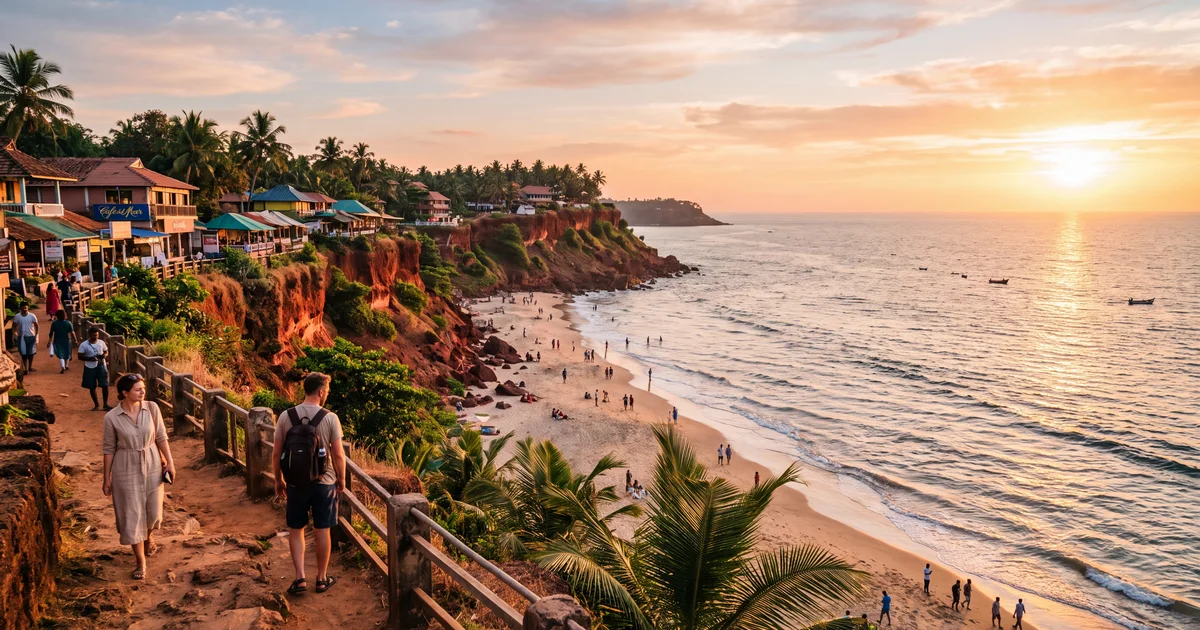
Varkala is a 15 km stretch of coastline in southern Kerala where red laterite cliffs rise 30 metres straight out of the Arabian Sea. The town sits 50 km north of Trivandrum and has one main claim: the North Cliff, a walking path along the cliff edge lined with restaurants, yoga studios, and guesthouses on one side and a sheer drop to the ocean on the other. Below the cliff, Papanasam Beach curves along the base, and the Janardhana Swamy Temple (one of the 108 Divya Desams of Vaishnavism) sits at its southern end.
Places to visit in Varkala split into three zones. The cliff and Papanasam Beach cover the tourist core, walkable in half a day. Varkala town, 2 km inland, has the train station, markets, and the Sivagiri Mutt. The northern coast from Odayam Beach to Kappil Lake holds the quieter stretches that most visitors skip. Two days cover all three zones well. Three days let you add the Anjengo Fort day trip and a backwater canoe ride.
The population is around 40,000. The place gets roughly 300,000 domestic and 50,000 international tourists per year, most of them between November and February. Varkala Sivagiri railway station connects to Trivandrum (1 hour), Kochi (3.5 hours), and Bangalore (11 to 14 hours) by direct trains.
TL;DR
- The North Cliff walk is the main draw. Go at 5 PM for sunset, eat at a cliff restaurant, and walk back after dark.
- Papanasam Beach below the cliff has lifeguards October to March. Swim only in flagged zones.
- October to March is best. December and January are packed. November and February offer the same weather with fewer crowds.
- Budget ₹1,200 to ₹2,500 per person per day covering stays, food, and transport.
- Eat on the cliff for the view, but eat in town for the value. A banana leaf meal costs ₹150 in Varkala town.
What Makes the North Cliff Walk Worth Doing?
The North Cliff is Varkala's postcard. A narrow path runs along the cliff edge for about 1.5 km, starting from the helipad at the north end and ending near the Janardhana Swamy Temple steps at the south. On the landward side, restaurants, cafes, shops, and guesthouses have been built right up to the edge. On the seaward side, the cliff drops 25 to 30 metres to the rocks and surf below. There are no guardrails for most of the stretch.
The walk itself takes 20 to 30 minutes if you do not stop. But stopping is the point. The cliff restaurants serve everything from Kerala fish curry to Israeli shakshuka (Varkala has had a steady Israeli backpacker community since the early 2000s). Prices are 2x to 3x what you would pay in Varkala town. A kingfish fry that costs ₹180 in town costs ₹450 on the cliff. The markup buys you a table 3 metres from a cliff edge overlooking the Arabian Sea at golden hour.
The best time to walk is between 4:30 PM and 6:30 PM. The sun sets directly over the water between October and March, and the laterite cliffs turn deep orange in the last light. By 7 PM, the fairy lights on the restaurants switch on and the path gets a different character entirely.
One thing to know: the cliff is eroding. Sections of the path have collapsed in past monsoons, and the Kerala government periodically announces building restrictions that are inconsistently enforced. The north end near the helipad is more stable. The southern end near the temple has narrower patches where the path is barely a metre wide. Walk carefully after rain.
How Is Papanasam Beach Different from Other Kerala Beaches?
Papanasam Beach sits directly below the North Cliff, accessible by a long staircase cut into the rock face (about 150 steps). The name translates to "destroyer of sins," and Hindus consider a dip here to have purifying properties. You will see families performing rituals at the southern end near the temple steps, especially during Ashtami and other festival days.
The beach is roughly 800 metres long, curved, and backed by the cliff face. The sand is dark brown, coarser than Goa's white sand. Swimming conditions vary by season. October to March brings calmer seas and lifeguards patrol the beach from 7 AM to 6 PM. The designated swimming area is marked by flags roughly 200 metres north of the temple steps. Stay within those flags. The currents off Varkala are strong even in calm season, and riptides pull out at unpredictable spots.
Monsoon transforms this beach. Waves hit the cliff base directly, the sand narrows to almost nothing at high tide, and red flags go up most days. The beach shacks close. The few that stay open serve to locals, not tourists.
The honest take on Papanasam: it is not a lounging beach. The sand is too coarse and the cliff shadow hits the southern half by 3 PM. What makes it worthwhile is the setting. A beach at the base of a red cliff with a 2,000 year old temple at one end and a row of surf hitting the rocks at the other. You come for the 2 hours of swimming and the walk, not for a full day with a book.
What Is Special About Janardhana Swamy Temple?
The Janardhana Swamy Temple sits at the southern end of the cliff, right where the cliff path meets the beach staircase. It is dedicated to Vishnu and is one of the 108 Divya Desams, the Vaishnavite pilgrimage sites celebrated in the Naalayira Divya Prabandham (the Tamil hymns composed by the Alvars between the 6th and 9th centuries).
The temple dates back over 2,000 years by tradition, though the current structures are medieval. A large banyan tree in the courtyard provides shade for an area that can feel brutally hot between 11 AM and 3 PM (temperatures hit 35°C in the courtyard by noon during March and April). The temple bell, said to be brought from a shipwrecked Dutch vessel, hangs in the entrance.
Non Hindus are generally not permitted inside the inner sanctum. You can enter the outer courtyard and see the gopuram (tower gate), the banyan tree, and the temple tank. Dress modestly: covered shoulders and knees. The temple is busiest during the 10 day Arattu festival (March to April), when a procession carries the deity to Papanasam Beach.
The thing most visitors miss: the temple tank, a stepped pond 50 metres behind the main shrine. It is quieter than the beach, used by locals for bathing, and has a calm, almost private atmosphere even during peak season. Worth the detour if you are walking past.
Where Are the Beaches That Tourists Usually Skip?
Varkala has 5 named beaches stretched along 10 km of coast. Most visitors see only Papanasam and the small Black Beach. The others are worth the effort, and a scooter (₹350 to ₹400 per day from Varkala town) lets you cover all three in a single morning along the flat coastal road.
Odayam Beach is the closest, 600 metres north of the helipad past the cliff path. A short trail (no proper stairs, slightly scramble-y) drops you into a 300 metre cove backed by coconut palms. A handful of guesthouses sit here but no restaurants on the beach. The swimming is better than Papanasam for experienced swimmers because the beach is wider and the wave break more gradual. No lifeguards, though.
Edava Beach starts about 3 km north. Take an auto from Varkala town (₹100) or cycle. The beach runs 2 km and sits deserted on most weekdays. What makes Edava different is the Nadayara lagoon behind it. In December and January, the sandbar between the sea and the lagoon narrows to 10 metres. Bring water. There are no facilities.
Kappil Beach, 6 km north, is where the Kappil Lake (a backwater lagoon) opens into the Arabian Sea. Broad, flat, almost empty outside weekends. The lagoon side has canoe operators who paddle you through the mangroves for ₹300 to ₹500 per hour. Sea on one side, still backwater on the other, separated by a 20 metre strip of sand. Few places on the Kerala coast offer that.
What Can You Do at Sivagiri Mutt?
The Sivagiri Mutt is the ashram and final resting place of Sree Narayana Guru, the social reformer who challenged caste discrimination in Kerala in the late 1800s and early 1900s. The mutt sits on Sivagiri Hill, 2 km east of the cliff, overlooking Varkala town.
Sree Narayana Guru changed Kerala. His famous dictum, "One Caste, One Religion, One God for Man," drove the temple entry movements and social reforms that transformed the state. He established temples open to all castes at a time when lower caste Hindus were barred from entering them. The Sivagiri Pilgrimage in late December and early January draws tens of thousands.
The ashram grounds are well maintained. The samadhi (memorial) is a white building with a gold dome. Photography is allowed outside but not inside the samadhi chamber. The hilltop gives a view of Varkala's coconut groves and, on a clear day, a sliver of the sea. Morning visits (before 10 AM) are best. The grounds empty out by lunchtime.
This is not a tourist sight in the usual sense. There are no entry fees, no guides, no souvenir shops. It is a pilgrimage site and a place of quiet. Visit it if you are interested in Kerala's social history. Skip it if you are looking for beach vibes.
Is the Varkala Tunnel Worth a Side Trip?
The Varkala Tunnel (also called the Tunnel of Naya) is a 924 foot (282 metre) railway tunnel built by the British in the 1860s as part of the Trivandrum to Quilon (Kollam) rail line. It runs through the laterite rock roughly 1 km east of the main cliff.
For a long time, the tunnel was accessible by walking along the disused sections of the old rail alignment. The current route is a short walk from Varkala town: head east from the railway station for about 800 metres. The tunnel itself is straight, so you can see light at the other end, and the laterite walls have a reddish colour that photographs well. A torch on your phone is enough.
Honestly, the tunnel is 5 minutes of walking through and 2 minutes of photographs. It is not a destination on its own. But if you are cycling around Varkala or walking to Sivagiri Mutt, it makes a worthwhile 15 minute stop. The colonial engineering is interesting if you are into railway history.
The caveat: access has been restricted at various times. Check locally before heading out. Some visitors report gates on both ends. Others walk through without issue.
How Do the Varkala Backwaters Compare to Alleppey?
The Varkala backwaters are centered around Kappil Lake and the network of canals that feed into it. They are a fraction of the size of the Alleppey to Kumarakom system, but that is their advantage. No houseboats jam the canals here. The experience is smaller, quieter, and cheaper.
Canoe trips start from Kappil Beach (the lake side) or from operators in Varkala town who will drive you to the launch point. A 2 hour canoe ride through the mangroves and coconut waterways costs ₹600 to ₹800 for a small canoe (2 to 3 people). The boatman paddles manually. You see kingfishers, egrets, the occasional monitor lizard, and the backs of houses where people wash clothes and fish from their back steps.
For comparison, a half day canoe in Alleppey costs ₹1,500 to ₹2,500 and covers a bigger network. The Alleppey backwaters have more birdlife, more canals, and the scale feels different. But if you are already in Varkala and want a backwater experience without the 3 hour drive north to Alleppey, the Kappil canoe ride is 80% of the atmosphere at a third of the price and time.
The best time for the canoe is early morning (6:30 AM to 8:30 AM) or late afternoon (3:30 PM to 5:30 PM). Midday is hot and the birds are less active. Wear sunscreen regardless. The open sections of the lagoon have no shade.
What Is There to See at Anjengo Fort?
Anjengo (Anchuthengu) Fort sits 12 km south of Varkala on a narrow peninsula between the sea and a backwater lake. The British East India Company established a trading post here in 1684, making it one of their earliest settlements on the Malabar Coast. The fort was a key point in the pepper and cinnamon trade.
What remains today: a low laterite wall enclosing a small compound, a cemetery with 18th century British graves, and a lighthouse. The fort wall is barely 2 metres high in most places. This was never a large military installation. Its importance was commercial.
The lighthouse (still operational) stands near the fort and you can climb it for a view of the coastline and the backwater. Entry is ₹25. The cemetery has about 20 graves, some with readable inscriptions from the 1700s. A few mention causes of death (disease, mostly) and give you a snapshot of what life was like for Company employees posted to a remote trading outpost in tropical India.
Getting there from Varkala: auto for ₹250 to ₹300 one way, or scooter along the coast road. The fort takes 30 to 45 minutes to see. Combine it with Edava Beach on the way back for a solid half day trip.
Where Should You Eat on and off the Cliff?
The cliff restaurants in Varkala serve to the view. The food ranges from decent Kerala fish curry to Italian pasta to Middle Eastern meze. The quality is uneven and the prices are consistently high for Kerala standards. But the setting, tables on the cliff edge, candles, the sound of waves below, makes at least one dinner here non negotiable.
For actual Kerala food at Kerala prices, go to Varkala town. The vegetarian meals (banana leaf with rice, sambar, rasam, avial, thoran, and payasam) cost ₹100 to ₹150 at any of the "hotels" (restaurants) near the bus stand. Non vegetarian meals with fish curry and rice run ₹150 to ₹250. The fish here is the same fish served on the cliff, bought from the same market, cooked in the same style, minus the view and the markup.
Three specific spots worth knowing. Oottupura on Temple Junction Road does an unlimited sadya lunch for ₹130 that draws locals. The fish stalls near the Papanasam beach steps grill fresh catch in the morning. And any of the toddy shops along the Kappil road serve the most honest Kerala meal: karimeen fry, tapioca, and beef fry if you eat meat, with fresh toddy for ₹30 a glass.
Skip the cliff restaurants for lunch. The midday heat makes the walk uncomfortable, and you lose the sunset atmosphere that justifies the premium. Save the cliff for the 5 PM to 8 PM window.
What Is the Cheapest Way to Get Around Varkala?
Varkala is compact enough that you can walk between the cliff, the town, and the main beaches. The cliff to the town centre is a 20 minute walk. The cliff to Odayam Beach is 10 minutes on foot.
For anything further, autos are the default. Varkala to Kappil Beach: ₹150 to ₹200. Varkala to Anjengo Fort: ₹250 to ₹300. Town to railway station: ₹50. Negotiate before you get in. Ola and Uber have patchy coverage here; do not rely on them.
Scooter rental changes the equation. A Honda Activa or similar costs ₹350 to ₹400 per day from shops on the road connecting the cliff to the town. Fuel is cheap (the distances are short), and it lets you hit Kappil, Edava, and Anjengo in a single morning. Carry your driving licence. Police occasionally check at the junction near the railway station.
Bicycles are available at a few guesthouses for ₹150 to ₹200 per day. The terrain is mostly flat along the coast, but the climb up to the cliff from Papanasam Beach will test you in the afternoon heat. Cycling works best for the northern beaches on the coastal road.
The train is useful for arrivals and departures but not for getting around Varkala itself. Varkala Sivagiri station is 2 km from the cliff. One train stop north takes you to Edava, but the frequency is low (2 to 3 trains per day stop there).
How Do You Plan 2 Days in Varkala?
A realistic two day plan that covers the essentials without rushing.
Day 1 is the cliff and Papanasam. Arrive in the morning. Drop bags at your stay (cliff area or Odayam Beach for quieter options). Walk the North Cliff path from the helipad to the temple. Descend the steps to Papanasam Beach. Swim in the flagged zone. Visit the Janardhana Swamy Temple (30 minutes). Walk back up. Lunch at a cliff restaurant or in town. Rest during the 1 PM to 4 PM heat. Return to the cliff for sunset. Dinner on the cliff edge.
Day 2 is the north beaches and backwaters. Rent a scooter (₹350 to ₹400). Ride to Kappil Beach (6 km, 15 minutes). Walk the sandbar between the lake and the sea. Take a 2 hour canoe ride on Kappil Lake (₹600 to ₹800). Ride to Edava Beach on the way back. Stop at the Varkala Tunnel if time allows. Afternoon: Sivagiri Mutt (1 hour). Evening: fish curry dinner in Varkala town.
If you have a third day, ride south to Anjengo Fort in the morning (12 km, 25 minutes). See the fort and lighthouse. Swim at a quieter section of coast on the way back. Spend the afternoon at Odayam Beach. Catch the sunset from a different section of the cliff.
This plan works for solo travellers and groups heading to Kerala. Varkala is one of the calmer stops on the Kerala coast, especially compared to the pace of Kochi or the resort density of Kovalam. If you are coming from Bangalore or Chennai, it pairs well with an Alleppey backwater stay for a 5 day trip that covers cliffs, beaches, and backwaters.
Frequently asked questions
- What are the top 5 must visit places in Varkala?
- Varkala Cliff (North Cliff) for the walk along the red laterite edge above the sea, Papanasam Beach directly below for swimming, Janardhana Swamy Temple for the 2,000 year old Vishnu shrine, Kappil Beach at the backwater lagoon mouth 6 km north, and Edava Beach for a quiet stretch with almost no tourists. These five give you Varkala's cliffs, temples, and empty coastline in two days.
- How many days are enough for Varkala?
- Two full days cover the cliff, both main beaches, the temple, and a backwater canoe trip comfortably. Add a third day for Kappil Beach, Edava, and a day trip to Anjengo Fort 12 km south. Most travellers from Bangalore or Kochi come for a long weekend and leave feeling they saw enough without rushing.
- What is the best time to visit Varkala?
- October to March gives you dry weather between 25°C and 32°C. December and January are peak season with the highest hotel rates and crowded cliff restaurants. November and February offer the same weather with fewer people. Monsoon from June to August closes most cliff path restaurants and makes swimming dangerous due to strong currents and red flag warnings on the beach.
- Is Varkala better than Kovalam?
- Varkala has the cliff, which Kovalam does not. The cliff walk with restaurants on one side and a 30 metre drop to the sea on the other is what sets Varkala apart. Kovalam has a more developed lighthouse beach and is closer to Trivandrum airport by 20 minutes. For backpackers and people who want fewer resorts and more character, Varkala wins. For a polished beach resort stay, Kovalam is more convenient.
- How do I reach Varkala from Bangalore?
- The fastest route is a flight to Trivandrum (TRV), then a 1 hour drive or train north to Varkala. Direct trains from Bangalore City Junction to Varkala Sivagiri run daily and take 11 to 14 hours. The Kerala Express and Kanyakumari Express both stop at Varkala. Alternatively, fly to Kochi (COK) and take a 4 hour train or drive south. Book train tickets 60 days ahead during peak season.
- Is it safe to swim at Varkala Beach?
- Papanasam Beach below the cliff has lifeguards during the tourist season (October to March) and designated swimming zones marked by flags. The currents here are unpredictable, so swim only in the flagged areas. Black Beach north of the helipad has no lifeguards and stronger rip currents. During monsoon, red flags go up frequently and swimming is not advisable anywhere along the coast.
- What food should I try in Varkala?
- Kerala fish curry with red rice at any cliff restaurant. Fresh grilled kingfish or red snapper at the beach shacks below the cliff. Banana leaf meals (sadya style) at local restaurants in Varkala town for ₹120 to ₹200. The cliff restaurants are marked up 2x to 3x for the view, so eat the sunset meal there and do lunch in town. Tibetan momos and hummus plates cater to the backpacker crowd but are not the local food.