Best Places to Visit in Tamil Nadu (2026): Temples, Hills and Coastal Towns
Best places to visit in Tamil Nadu in 2026: Madurai's Meenakshi temple, Ooty's Nilgiris, Mahabalipuram's shore temple and the southern tip at Kanyakumari.
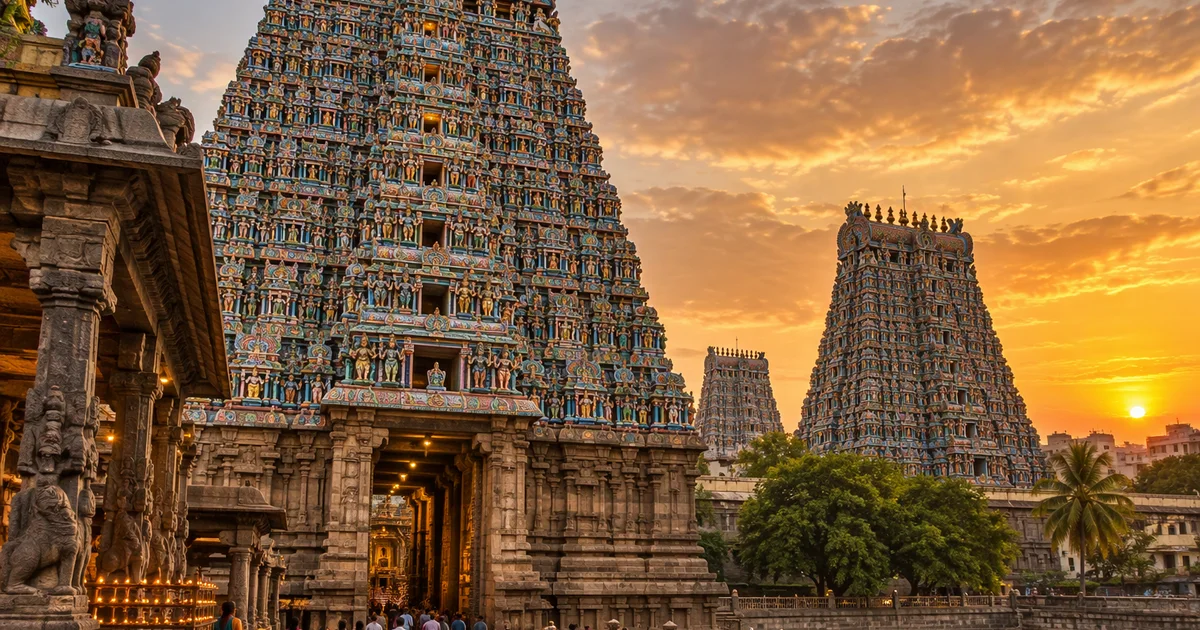
Tamil Nadu has more variety than its standard itineraries suggest. The best places to visit in Tamil Nadu span 65-metre granite temple towers in the south, Nilgiris tea estates where the temperature drops below 10°C at night, and a Coromandel coastline with an 8th-century shore temple that sits close enough to the sea to hear the surf from the sanctum.
If you have flown into Chennai and are still mapping your route, this guide covers what is worth the journey and a few places the standard lists include purely out of habit.
TL;DR
- Temple circuit: Madurai (Meenakshi Amman), Thanjavur (Brihadeeswarar), Kanchipuram (Kamakshi)
- Coast and UNESCO: Mahabalipuram, 58 km south of Chennai, easy day trip or weekend
- Hill stations: Ooty in the Nilgiris, Kodaikanal in the Palani Hills, best from March to June
- Southern tip: Kanyakumari for the three-ocean point, Rameshwaram for the Pamban Bridge and coral reef
- Underrated: Pondicherry for the French Quarter streets; Mudumalai for a less crowded Nilgiri Biosphere entry
What are the best temple towns in Tamil Nadu?
Madurai is the first answer most people give, and that instinct is right. The Meenakshi Amman Temple complex covers 6.3 hectares inside the old walled city. Fourteen gopurams, the tallest reaching 51.9 metres, are covered in roughly 33,000 sculptures. The evening aarti at 9 PM draws around 1,000 visitors on a busy weekend night. Go at 6 AM instead if you actually want to see the carvings without being pushed sideways.
Thanjavur's Brihadeeswarar Temple is a different experience entirely. Raja Raja Chola I completed it around 1010 CE. The vimana over the sanctum is 65.9 metres tall and was built entirely from interlocked granite, no mortar at any joint. It is a UNESCO World Heritage Site. The shadow of the vimana falls within the complex rather than outside, a geometry that still puzzles structural engineers who study it.
Kanchipuram sits 76 km west of Chennai and holds around 1,000 temples, though the Kamakshi Amman and Ekambareswarar complexes are the main draws. Kanchipuram is also the original source of Kanjivaram silk, so the same day can pair temple visits with a saree workshop visit. The road between Chennai and Kanchipuram passes through Mahabalipuram, which makes a logical single-day loop from the city.
One caveat worth knowing: several major Tamil Nadu temples restrict access to inner sanctums for non-Hindus. The rules are posted at temple entrances and are enforced at Meenakshi Amman and Brihadeeswarar. Plan your visit knowing this if the architecture is your primary interest rather than the religious experience.
Is Ooty still worth visiting in 2026?
That depends on what you are comparing it to.
The Nilgiris as a region justify the trip. Ooty's main town has got crowded in peak season, April to June and October, with the Botanical Gardens seeing roughly 5,000 visitors a day during school holidays. But the road from Ooty to Kotagiri via Doddabetta at 2,637 metres offers views of the lower Nilgiris that hold up even when the town is packed.
The Nilgiri Mountain Railway from Mettupalayam to Ooty still runs. It takes 4.5 hours for 46 km. That is the point of it. The track climbs from 326 metres to 2,203 metres through 16 tunnels and 250 bridges. It is a UNESCO World Heritage listing. Book well in advance for the November to January slot.
Kodaikanal in the Palani Hills is a reasonable alternative if you want less traffic. At 2,133 metres, the lake at its centre is walkable in under an hour. The Coakers Walk path along the southern edge of the plateau gives clear views of the Madurai plains on dry mornings. Kodaikanal is about 530 km from Chennai, 8 hours by road in good conditions.
One real opinion here: the two hill stations serve different moods. Ooty has the railway, the Botanical Gardens, and the Toda village nearby. Kodaikanal has the lake walk, Pine Forest Road at dawn, and quieter accommodation options. Neither disappoints in February, which is off-peak and clear.
For wildlife, neither Ooty nor Kodaikanal is the right choice. Mudumalai National Park at the northern base of the Nilgiris borders Bandipur in Karnataka and Wayanad in Kerala. Elephant sightings from the main Ooty-Mysore road are common in early morning. Mudumalai gets considerably fewer visitors than Bandipur, which makes the forest feel less like a drive-through.
Mahabalipuram and the Coromandel coast
Mahabalipuram (officially Mamallapuram since 2019) is 58 km south of Chennai on the ECR (East Coast Road). The Shore Temple from the 8th century sits directly on the beach. It is one of the oldest structural stone temples in India and a UNESCO World Heritage Site. The Pancha Rathas monolithic sculptures are a 10-minute walk inland.
This is an easy day trip from Chennai. The ECR is in good condition and takes 90 minutes in normal traffic. Staying one night lets you reach the site at sunrise before tour buses from Chennai arrive. The beach next to the temple is calm at 5:45 AM.
Continuing south, Pondicherry at 162 km from Chennai is worth at least two nights. The French Quarter (Ville Blanche) has streets of yellow and white colonial buildings with bougainvillea trailing across the walls. The beach promenade works best between 5 AM and 7 AM before traffic fills it. The most striking thing about Pondicherry is not the beach; it is walking across the canal that separates the French Quarter from the Tamil town and experiencing two entirely different architectural worlds 200 metres apart.
One honest note: Pondicherry in April is Tamil Nadu summer. The city sits at sea level and gets humid. January is a significantly more comfortable visit.
Kanyakumari and the southern circuit
Kanyakumari sits at the precise confluence of the Bay of Bengal, the Indian Ocean, and the Arabian Sea. The Vivekananda Rock Memorial is on a small island 400 metres offshore, reached by ferry. Sunrise and sunset from the same point hit different water bodies. This is not tourist promotion; it is geography.
The drive from Madurai to Kanyakumari takes roughly 3 hours over 247 km. Most travellers then loop northeast through Tirunelveli and on to Rameshwaram. Rameshwaram sits on a narrow island connected to the mainland by the Pamban Bridge, a 2 km rail-and-road causeway over the Palk Strait. The Ramanathaswamy Temple inside the town has 1,212 pillars and 22 sacred wells. The town beach has visible coral reef at low tide, particularly in the morning when the water is calm.
This circuit from Madurai (Madurai to Kanyakumari to Rameshwaram and back to Madurai) covers roughly 500 km and works well over 3 to 4 days.
For Thanjavur, the Brihadeeswarar Temple alone does not need a full day. Add the Saraswathi Mahal Library (one of the oldest libraries in Asia, founded before 1535 CE) and the Thanjavur Palace complex. The palace has a 13th-century tower, a 19th-century Maratha palace section, and the Rajarajan Art Gallery inside. That is a full half day.
Planning a Tamil Nadu group trip
Most travellers fly into Chennai (MAA) or Madurai (IXM). Coimbatore (CJB) is the entry point for direct access to Ooty and the Nilgiris.
Train is the right choice between cities inside the state. The Madurai to Chennai Pandian Express is a 9-hour overnight run with AC sleeper options. Book 60 days ahead on IRCTC for popular routes. Chennai to Madurai, Coimbatore, and Rameshwaram trains sell out 3 to 4 weeks before departure during Pongal in January and during April school holidays.
For fixed-departure group trips and curated Tamil Nadu itineraries, most organised departures cover the southern temple circuit well. Standard routes begin in Chennai, travel south to Madurai and Kanyakumari, then return via Rameshwaram and Thanjavur. Group trips from Chennai on TripzSearch include both guided packages and individual operator comparisons.
If you want both temples and a hill station in one trip, the two circuits do not naturally combine. Ooty is in the northwest corner of Tamil Nadu, Madurai and Kanyakumari are in the south. The road between them is about 450 km. Most travellers pick one and return for the other on a separate trip.
For comparing operators and current package pricing, TripzSearch's destinations directory lists Tamil Nadu options with verified operator contacts.
A few practical notes
Rail is the most reliable way to move between Tamil Nadu's cities. The Southern Railway network is dense and punctual by Indian railway standards. Second-class AC sleeper (3AC) is comfortable for journeys up to 8 hours.
Avoid scheduling Kanyakumari on a Tuesday. The ferry to Vivekananda Rock closes for maintenance on rotating Tuesdays. Check the schedule at the dock rather than relying on online sources, which are sometimes outdated.
October is the northeast monsoon. Coastal areas including Mahabalipuram, Pondicherry, and Chennai can see heavy rain through December. November is generally clearer for the coast. Inland areas like Madurai and Thanjavur see minimal disruption from the northeast monsoon.
Tamil is the state language. English is widely understood in tourist areas and cities. In smaller towns around the southern temple circuit, translation apps help more than they would in Chennai.
A proper Tamil Nadu trip rewards slower travel. The distance between Madurai and Thanjavur is 350 km. Between Madurai and Ooty, it is 230 km but involves a winding ghat road. Build buffer time into the schedule rather than trying to cover everything on a tight loop.
Frequently asked questions
- What is the best time to visit Tamil Nadu?
- October to March is comfortable for most of Tamil Nadu. The northeast monsoon brings heavy rain to the coast between October and December, so check conditions before booking Mahabalipuram or Rameswaram in that window. Hill stations like Ooty are most pleasant from March to June when the plains overheat.
- What is Tamil Nadu most famous for?
- Tamil Nadu is known for its Dravidian temple architecture, the towering gopurams of Meenakshi Amman in Madurai and Brihadeeswarar in Thanjavur are the clearest examples. The state also covers the Nilgiris hill range, the UNESCO-listed shore temple at Mahabalipuram, and a 1,076 km Coromandel coastline.
- Is Tamil Nadu safe for tourists?
- Tamil Nadu consistently ranks among the safer Indian states for travellers. It has a dense railway network, good intercity bus services, and well-staffed heritage sites. Book accommodation early during Pongal in January and during Tamil school holidays in April and May when crowds at hill stations peak.
- How many days do you need in Tamil Nadu?
- A focused southern circuit through Madurai, Rameshwaram, Kanyakumari, and Thanjavur takes 6 to 8 days. Add Ooty or Kodaikanal for a Nilgiris leg and plan 10 to 12 days total. Chennai plus Mahabalipuram is a solid 2 to 3 day standalone trip.
- Which places are easiest to visit from Chennai?
- Mahabalipuram at 58 km is the easiest day trip from Chennai. Pondicherry at 162 km is a popular weekend option, roughly 3 hours by road. Kanchipuram is 76 km west of Chennai and pairs well with Mahabalipuram in a single loop.