Best Places to Visit in Pune (2026): Forts, Food and Weekend Escapes
20 best places to visit in Pune in 2026 with timing, costs, and what works for weekend trips.
Pune sits 560 metres above sea level on the Deccan Plateau, with the Sahyadri mountains running along its western edge. That geography gives it two things most Indian cities lack: a cool winter and a ring of medieval forts within 60 km. The city itself has 7 million people, a university district that keeps the average age low, and a food culture that takes its misal pav as seriously as Hyderabad takes its biryani.
I have been to Pune four times. Twice for work, twice because someone said "let's do Sinhagad this weekend" and I did not have a reason to say no. The places to visit in Pune split cleanly into three categories: the Peshwa era Old City, the surrounding Sahyadri forts, and the modern west side with its cafes, craft beer scene, and Koregaon Park. You can cover the essentials in three days. A weekend works if you pick your priorities.
TL;DR
- Shaniwar Wada, Aga Khan Palace, and Dagdusheth Ganpati cover the city's history in one day.
- Sinhagad Fort is the easiest half day trek. Leave by 6 AM, back by noon.
- October to February is the best weather window. Monsoon is green but slippery on fort trails.
- Budget ₹1,500 to ₹3,000 per person per day for stays, food, and transport.
- Eat misal pav at least once. The Bedekar vs Katakirr debate is Pune's biryani equivalent.
What Is Left of Shaniwar Wada After the Fire?
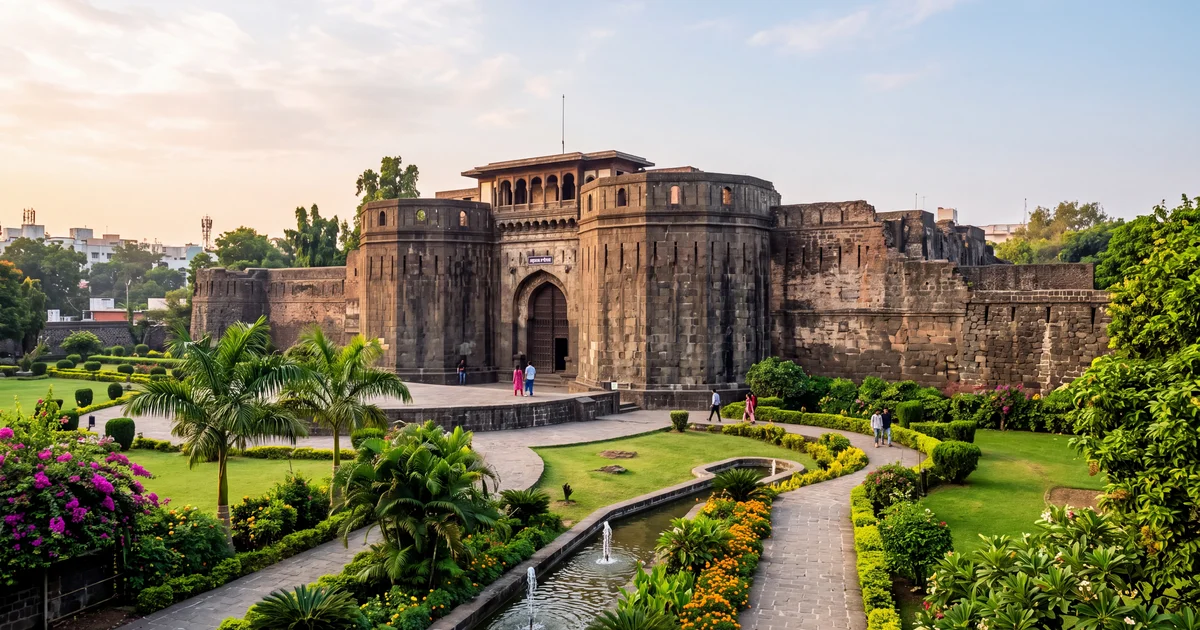
Shaniwar Wada was the seat of the Peshwa rulers from 1732 to 1818. Bajirao I commissioned it, and for 86 years it was the administrative centre of the Maratha Empire. Then the British torched it in 1828 (officially, a fire of "unknown origin"). What remains is the outer fortification wall, the five gates, and the base of what was once a seven storey palace.
The Dilli Darwaza (main gate) still stands at full height, with iron spikes on the doors that were designed to stop war elephants. Walk through it and you enter an open ground where the palace floors once rose. Stone foundation lines mark where the rooms were. The palace had teak pillars, coloured glass windows, and a marble courtyard. All of it burned. The walls survived because they were stone. Everything inside was wood.
The sound and light show runs at 7:15 PM (Marathi) and 8:15 PM (English), ₹50 per ticket. It compresses 86 years of Peshwa politics into 45 minutes, with lights projected on the ruins. The narration is melodramatic by design. The section on Narayanrao's assassination inside these walls is genuinely unsettling when you are standing where it happened.
Entry costs ₹5 for Indian nationals. The site is open 8 AM to 6:30 PM. Go in the morning when the grounds are empty and the Dilli Darwaza catches the early light. The surrounding area (Shaniwar Peth and Kasba Peth) is the old Peshwa quarter, narrow lanes with Wada style houses, most in disrepair.
The caveat: if you expect a grand palace, you will be disappointed. Shaniwar Wada is a ruin. The value is in understanding what it was and what happened here. Read the plaques before walking in. Without context, it is a large open ground with old walls.
Is Sinhagad Fort the Best Day Trek Near Pune?
Sinhagad sits 35 km southwest of the city at 1,312 metres. The name means "Lion's Fort" and it earned that title in 1670 when Tanaji Malusare scaled the cliff face at night to recapture it from the Mughals. He died in the battle. The fort changed hands between Marathas, Mughals, and the British over 200 years.
The trek from the base village of Sinhagad Ghat takes 45 minutes to 1 hour on a marked trail. The path is stone steps for the first half, then dirt and rock. It is manageable for anyone with basic fitness. On weekends, you share the trail with hundreds of Pune residents who treat this as their morning walk. A few college groups will have speakers playing music at full volume. Weekday mornings are quieter.
At the top, the fort ruins include the Pune Darwaza (entrance gate), the Kalyan Darwaza (the gate Tanaji scaled), a Kali temple, and a memorial to Tanaji. The views from the eastern wall look back toward Pune city, and on clear December mornings you can see the Khadakwasla Dam reservoir.
The real reason people come: the food stalls at the summit. Pithla bhakri (spiced gram flour curry with millet bread), curd with jaggery, and kanda bhaji (onion fritters) are sold by women from Sinhagad village. The curd is thick, slightly sour, and served in clay pots. It costs ₹40 per pot. Eating it at 1,300 metres after an hour of climbing is a Pune experience you cannot replicate at a restaurant.
The drive from Pune city takes 45 minutes. The approach road narrows in the last 5 km and is one lane in places. Parking at the base fills by 8 AM on weekends. An auto from Swargate costs about ₹300 one way. If you are exploring treks near Pune, Sinhagad is the entry level option.
Aga Khan Palace: Where Gandhi Was Imprisoned
Aga Khan Palace sits in Nagar Road, 6 km east of the city centre. Sultan Aga Khan III built it in 1892 as a famine relief project, employing 1,000 workers during a drought year. In 1942, the British interned Mahatma Gandhi, Kasturba Gandhi, and Mahadev Desai here during the Quit India movement. Kasturba Gandhi died within these walls in 1944. Her samadhi (memorial) is in the garden.
The palace is now a Gandhi National Memorial. The museum inside has photographs, letters, and personal belongings from the 21 months of imprisonment. Gandhi's room on the first floor has been preserved. The charkha (spinning wheel) and his reading glasses are displayed in a case by the window.
Entry costs ₹5 for Indian nationals. The grounds cover 19 acres of Italian arched corridors, lawns, and the samadhi garden. Visit between 9 AM and 11 AM: the light through the arched corridors is good for photographs, and the tour groups have not arrived yet.
My honest take: the museum is small and takes 30 to 45 minutes. The building and grounds are the draw. The combination of Italianate architecture built during a famine, used as a prison for the independence movement's leaders, and now maintained as a memorial gives the place weight that the displays alone cannot carry. Read about the Quit India movement before visiting. The context transforms a pleasant garden into something more.
How Has Koregaon Park Changed the Pune Food Scene?
Koregaon Park (KP) is Pune's most expensive residential neighbourhood, sitting between Mundhwa Road and the riverfront. In the last decade it has become the city's restaurant and nightlife centre. The stretch between Lane 5, Lane 6, and North Main Road has 100+ restaurants, bars, and cafes within a square kilometre.
For breakfast, Cafe Paashh on Lane 7 does eggs and coffee that compete with anything in Bandra. The german bakery (rebuilt after the 2010 attack, now in a new building) on North Main Road serves continental breakfast and is still a gathering point for the Osho Ashram crowd. For craft beer, Independence Brewing Company (IBC) on Mundhwa Road was one of India's first microbreweries and still makes one of the better IPAs in the country.
KP is also where the Osho International Meditation Resort sits behind a gate on Koregaon Park Road. Whether you visit depends entirely on your interest in meditation. Entry costs ₹870 for a day pass (includes HIV test, which is mandatory for entry). The campus has a swimming pool, a Zen garden, and structured meditation sessions. Opinions on the place range from "life changing" to "expensive silence." I landed somewhere closer to "interesting for 3 hours."
The caveat with KP: it is gentrified and prices reflect it. A meal that costs ₹150 in the Old City costs ₹600 here. If you are on a budget, eat in the peths (the old city neighbourhoods) and drink in KP. That is the local strategy.
What Makes the Peths Worth Walking Through?
Pune's old city is divided into peths (neighbourhoods), each historically tied to a trade or community. Kasba Peth is the oldest, dating to the Peshwa era. Shukrawar Peth has the wholesale markets. Budhwar Peth is the commercial heart. Raviwar Peth has the street food.
The best walk starts at Shaniwar Wada, heads south through Kasba Peth to the Kasba Ganpati temple (the oldest Ganpati temple in Pune, established by Jijabai, Shivaji's mother), then east through Raviwar Peth to Mandai Market. Mandai is a colonial era market building (1885) with vegetable vendors on the ground floor and flower sellers on the first floor. The marigold section on a Tuesday fills the entire upper floor with orange and yellow.
Tulshibaug market, 500 metres south of Shaniwar Wada, is where Pune shops for everything from clothes to electronics to kitchen utensils. It is loud, narrow, and chaotic. Prices are 30 to 50% below mall retail. Bargain on everything.
For food in the peths: Bedekar Misal on Narayan Peth is the reference point for Puneri misal (lighter, thinner gravy than Kolhapuri style). A plate costs ₹80 to ₹120. Chitale Bandhu on Bajirao Road sells the city's best bakharwadi (a spiced, crispy snack) and has since 1952. Buy a box. It survives long train journeys.
Walk the peths in the morning. By noon the streets fill with traffic and the narrow lanes get claustrophobic. Auto navigation in these lanes is an adventure; Rapido bikes are faster and the riders know the shortcuts.
Dagdusheth Halwai Ganpati Temple: Pune's Most Visited Shrine
Dagdusheth Halwai Ganpati sits on Budhwar Peth, a 5 minute walk from Shaniwar Wada. Dagdusheth Gadve, a halwai (sweet maker), established the temple in 1893 after losing his son to plague. The current gold plated idol is insured for ₹50 crore. It is Pune's richest and most visited temple, drawing 50,000+ visitors on regular days and several lakhs during Ganesh Chaturthi.
The temple is small. You will spend 15 to 20 minutes including the darshan queue on a weekday. On Tuesdays and during Ganesh Chaturthi (August or September), the queue extends 200 metres down the road. The gold plating on the idol, added over successive years, catches the light from 40+ lamps inside the sanctum.
The area around the temple has a concentration of sweet shops. Dagdusheth's own sweet shop (across the lane) sells modak, puran poli, and the famous aamras during mango season. A box of modak costs ₹250 to ₹400.
My take: the temple is not architecturally remarkable. The value is cultural. During Ganesh Chaturthi, Pune's processions start from this temple and the energy in Budhwar Peth that week is unlike anything else in the city. If your visit coincides with the festival (September in most years), this is where you want to be. If not, it is still worth the 20 minute stop while walking through the peths.
Rajgad and Torna: For When Sinhagad Feels Too Easy
Rajgad Fort is 60 km southwest of Pune at 1,376 metres. It was Shivaji's capital for 26 years before he moved to Raigad. The trek from Gunjavane village takes 2 to 3 hours and is steeper than Sinhagad, with sections requiring hands on rock scrambling near the top. The fort is massive: three machis (plateaus) connected by narrow ridges, with the Balekilla (citadel) at the centre. You need 2 to 3 hours to explore the top.
Torna Fort, 10 km south of Rajgad, is the tallest fort in the Sahyadri range at 1,403 metres. Shivaji captured it in 1643 at age 16. The trek from Velhe village takes 2.5 to 3 hours. The gradient is consistent and the trail is well marked. At the summit, the Zunjar Machi offers a view of Rajgad across the valley. On clear monsoon days, with green carpet hills and low clouds threading between the peaks, this view is among the best in Maharashtra.
Both forts are full day trips from Pune. Leave by 5:30 AM, reach the base by 7 AM, summit by 10 AM, explore for 2 hours, descend by 1 PM, return to Pune by 3 PM. Carry water (2 litres minimum), lunch, and sunscreen. There are no food stalls at the top of either fort, unlike Sinhagad.
The honest caveat: these are not casual walks. Rajgad's final stretch involves rock surfaces that get dangerous when wet. Torna's length tires out unprepared trekkers. If you have not trekked before, do Sinhagad first. If Sinhagad felt easy, Rajgad and Torna are the logical next step.
FC Road and JM Road: The College District's Food Corridor
Fergusson College Road (FC Road) runs 2 km from the college gates to Deccan Gymkhana. It is Pune's student district. The pavement stalls serve vada pav (₹15 to ₹25), bhel puri, and fresh juice. The restaurants range from fast food chains to 50 year old Maharashtrian eateries.
Vaishali on FC Road has been serving dosas and filter coffee since 1951. The masala dosa costs ₹120. The queue at lunch on Sundays wraps around the building. Goodluck Cafe, across from Fergusson College, serves Irani chai and bun maska (buttered bun with milky sweet chai). It has been there since 1935 and looks like it. The wooden chairs, the glass display case with cakes, the ceiling fans at medium speed. This is the Pune cafe experience.
JM Road runs parallel, 500 metres south. Sujata Mastani on JM Road invented Pune's signature drink: the mastani. It is a thick milkshake blended with ice cream, topped with dry fruits and a cherry. A mango mastani costs ₹120. It is too sweet for some people. I am not one of those people.
Kayani Bakery on East Street (connecting FC and JM Roads) sells Shrewsbury biscuits that Pune treats as a controlled substance. The bakery limits purchases to 2 kg per person. They sell out daily by early afternoon. The biscuits are buttery, crumbly, and faintly sweet. A 500g box costs ₹150. Buy them before visiting anything else on this side of the city.
Parvati Hill: The Sunset Spot That Actually Delivers
Parvati Hill rises 650 metres above sea level in the southern part of the city, 103 steps from the base to the Parvati Temple complex at the top. The temple dates to 1749, built by Balaji Baji Rao (Nanasaheb Peshwa). The complex includes five temples and a small museum of Peshwa era artefacts.
The museum charges ₹5 and has Peshwa era weapons, coins, and a copper plate grant. It takes 15 minutes. The temples take another 10. You are here for the view.
From the temple terrace, Pune city spreads north and east. The Sahyadri foothills are visible to the west. At sunset, the western sky turns copper behind the hill line and the city lights begin switching on below. It is a 30 minute window. On winter evenings (November through January), the temperature at the top drops to 12 to 14°C, and the wind picks up. Bring a layer.
The climb takes 10 to 15 minutes. Go at 5 PM. Avoid weekends when the steps get crowded with joggers and evening walkers. An auto from Swargate bus station costs ₹40.
Where to Stay: Koregaon Park vs Deccan vs Hinjewadi
Koregaon Park puts you in the restaurant and nightlife zone. Hotels and serviced apartments run ₹2,500 to ₹6,000 per night. You are 4 km from Shaniwar Wada, 6 km from Aga Khan Palace, and walking distance from 100+ dining options. This is the best base for a first visit focused on eating and exploring.
Deccan (near FC Road and Shaniwar Wada) is the heritage and student zone. Hotels are ₹1,000 to ₹3,000 per night. You are walking distance from the peths, Shaniwar Wada, and FC Road. The downside is older properties and traffic noise.
Hinjewadi makes sense only if you are visiting on work (the IT parks are here). Hotels run ₹2,000 to ₹5,000 per night. The commute to the Old City is 20 km and takes 45 to 90 minutes depending on Pune's traffic, which is spectacularly bad during office hours.
For tourists, stay in Koregaon Park or Deccan. If your trip is about forts and trekking, Deccan is closer to the western highway exits toward Sinhagad and the Sahyadris. If your trip is about food and nightlife, Koregaon Park.
Day Trip Options: Lonavala, Mahabaleshwar, and Lavasa
Lonavala sits 65 km northwest of Pune on the Mumbai Expressway. The drive takes 1 to 1.5 hours. The main draws are Bhushi Dam (skip during monsoon weekends, dangerously crowded), Tiger's Point for valley views, and the Karla and Bhaja caves (Buddhist rock cut caves from the 2nd century BCE, ₹15 entry). Chikki (a jaggery and nut brittle) shops line the main road. Buy from Maganlal or Cooper's.
Mahabaleshwar is 120 km south, a 3 hour drive. It is a colonial era hill station at 1,353 metres with strawberry farms, viewpoints (Arthur's Seat, Wilson Point, Elephant's Head), and the Venna Lake. October to February is the best window. The strawberry season peaks in December through February. A basket costs ₹100 to ₹200 at the farms.
Lavasa is 57 km west, a planned lakeside town that went through financial trouble and is partially built. The drive through the Sahyadri ghat roads is scenic. The town itself has a few restaurants, a lakefront promenade, and unfinished buildings. It works as a 3 hour drive and lunch stop, not as a destination.
For a weekend trip from Mumbai or Bangalore, pick one day trip and combine it with two days in Pune city. Lonavala works best as a half day stop on the Mumbai to Pune drive. Mahabaleshwar needs a dedicated full day. If you are comparing weekend destinations or looking at group travel options from Pune, the Sahyadri forts are what set Pune apart from other Indian cities.
Quick Reference: Entry Costs and Time per Spot
Shaniwar Wada: ₹5 entry, 1 hour (add 45 minutes for the sound and light show). Aga Khan Palace: ₹5, 45 minutes to 1 hour. Sinhagad Fort: free, 4 to 5 hours round trip including drive. Dagdusheth Ganpati: free, 20 minutes (longer during festivals). Parvati Hill: free, 1 hour. Raja Dinkar Kelkar Museum: ₹100, 1.5 hours.
Total entry cost for Pune's heritage sites: under ₹200. Like Hyderabad, Pune gives you a lot for very little money. The forts are free. The food is cheap. The only thing that costs real money is a car rental for the day trips, and even that splits well in a group of four.
Pune does not compete with Jaipur or Udaipur on palace grandeur. It competes on proximity (3 hours from Mumbai, 1 hour flight from Bangalore), on fort trekking density (12 significant forts within 60 km), and on food culture that locals argue about with the same intensity other cities reserve for politics. That combination is hard to find elsewhere.
If you are planning a trip, check available group trips from Pune or browse destinations across India for comparison.
Frequently asked questions
- What are the top 5 must visit places in Pune?
- Shaniwar Wada for the Peshwa era ruins and evening sound and light show, Aga Khan Palace for its independence history and Kasturba Gandhi memorial, Sinhagad Fort for a weekend trek with a view, Dagdusheth Halwai Ganpati Temple for the city's most visited shrine, and FC Road for the cafe and food walk. These five cover Pune's history, trekking, and food culture in two days.
- How many days are enough for Pune?
- Two to three days cover the city's major sites comfortably. Add a fourth day for Sinhagad Fort or Lavasa. If you are combining with Lonavala or Mahabaleshwar, plan five to six days total. Most Bangalore or Mumbai visitors come for a long weekend and that works well.
- What is the best time to visit Pune?
- October to February offers 15°C to 30°C weather and clear skies. The monsoon months (June to September) turn the surrounding Sahyadris green and waterfalls come alive, but outdoor fort treks get slippery. March to May can cross 38°C and afternoons outdoors are uncomfortable.
- Is Pune good for a weekend trip from Mumbai or Bangalore?
- From Mumbai, Pune is a 3 hour drive on the Expressway or 3.5 hours by Shatabdi Express. From Bangalore, direct flights take 1 hour 20 minutes with 10+ daily departures. The city works well for a Friday night to Sunday evening weekend trip from either city.
- What food should I try in Pune?
- Misal pav at Bedekar Misal or Katakirr for the spicy sprouted moth bean curry, vada pav at any street stall near Mandai Market, mastani (a thick milkshake with ice cream and dry fruits) at Sujata Mastani, and Shrewsbury biscuits from Kayani Bakery on East Street. For sit down meals, try the thali at Shreyas on Bajirao Road.
- Which forts near Pune are best for a day trek?
- Sinhagad Fort (35 km, 1 hour climb, manageable for beginners), Rajgad Fort (60 km, 2 to 3 hour climb, more demanding), Torna Fort (60 km, the tallest fort in the Sahyadris at 1,400 metres), and Lohagad Fort (52 km, easy gradient with a paved path for most of the route). Sinhagad is the most popular because you can drive most of the way and the food stalls at the top sell curd and pithla bhakri.
- How do I get around Pune?
- The Pune Metro has two lines covering 33 km (expanding). Autos run on meters (start at ₹21) but many refuse short trips. Ola and Rapido are the go to apps. For fort trips, rent a car for the day (₹1,500 to ₹2,500 with driver). PMPML buses connect the city but are slow and crowded during peak hours.