Best Places to Visit in Pachmarhi (2026): Waterfalls, Caves and Madhya Pradesh Hills
12 places to visit in Pachmarhi with best months, entry fees and honest notes on what to see, what to skip and how to plan 2 to 3 days.
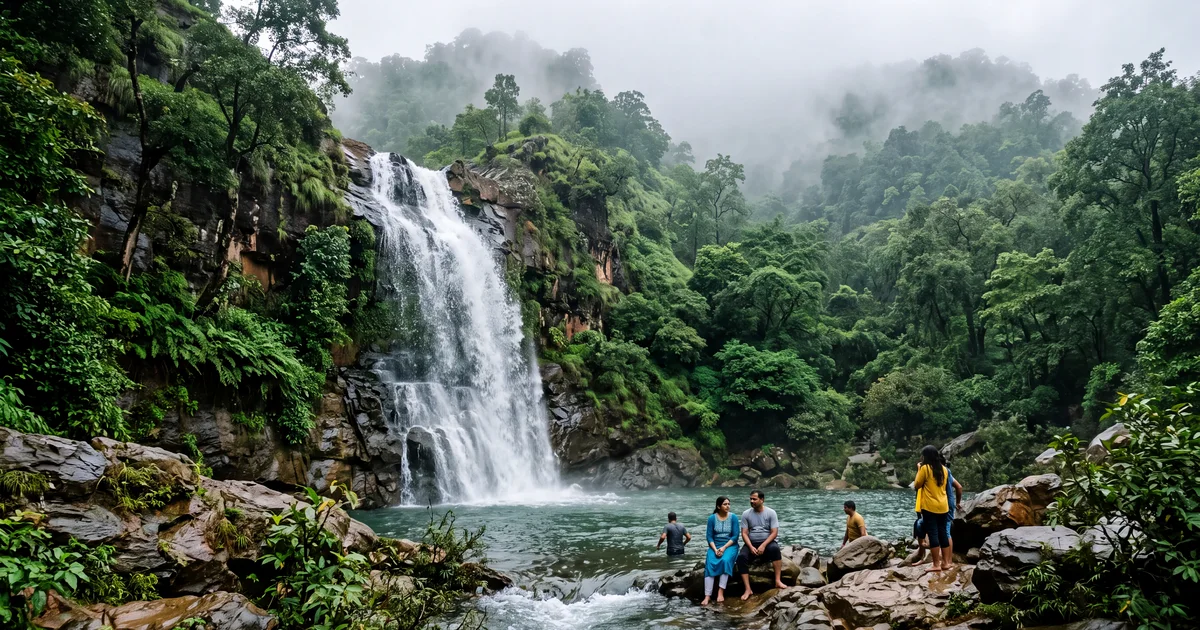
Pachmarhi is Madhya Pradesh's only hill station. That fact alone makes it unusual. While the rest of central India bakes through April and May, this small cantonment town in the Satpura Range sits at 1,067 metres and keeps temperatures 5 to 8°C below Bhopal.
The town has a colonial past (the British established it as a hill station in 1857), a geological present (the Satpuras are among the oldest mountain ranges in India, dating back over 1 billion years), and a quiet tourist economy that runs mostly on domestic visitors from Madhya Pradesh, Maharashtra and Chhattisgarh.
Places to visit in Pachmarhi cluster into three categories: waterfalls, caves, and viewpoints. Most sit within a 15 km radius of the town centre. A hired gypsy (the standard tourist vehicle here, costing 1,800 to 2,500 per day) covers all of them in two days. Three days is more comfortable and lets you add the Satpura Tiger Reserve.
The town itself is small. You can walk from the bus stand to the main market in 10 minutes. The pace is slow. That is either the appeal or the problem, depending on what you came for.
TL;DR
- Pachmarhi is Madhya Pradesh's only hill station, sitting at 1,067 metres in the Satpura Range.
- Two full days cover the major sights. Three days let you add a Satpura Tiger Reserve safari.
- Best months: October to March for weather, July to September for waterfalls at full flow.
- A hired gypsy costs 1,800 to 2,500 rupees per day and is the easiest way to cover the spread out attractions.
- Browse group trips from nearby cities on TripzSearch to skip the transport planning.
Which waterfalls in Pachmarhi are worth the walk?
Bee Falls (3 km from town)
The one waterfall everyone comes for, and it earns the reputation. Bee Falls drops about 35 metres into a rocky pool surrounded by forest. The name supposedly comes from the beehives in the cliff face, though you will not notice them over the sound of the water.
Getting there involves 150 concrete steps down from the parking area. The steps are maintained but get slippery in monsoon. Wear shoes with grip, not sandals. The pool at the base is swimmable in the dry season (October to February) when the current is mild. During monsoon, the flow is too strong and swimming is restricted.
Entry costs 250 rupees through the combined Pachmarhi permit. The falls are at their most impressive in August and September. By February, the flow thins to a trickle. Go in the morning (before 10 AM) to avoid the afternoon crowds.
Honest caveat: The 150 steps back up are harder than they look, especially in humidity. If you have knee problems, budget 30 minutes for the return climb.
Apsara Vihar (2 km from town)
A smaller waterfall with a shallow pool that locals call "Fairy Pool." The water drops about 15 metres into a wide, calm basin. This is the swimming spot in Pachmarhi for people who find Bee Falls too intense. The water stays knee to waist deep near the edges.
The walk from the road takes 10 minutes through a shaded forest path. It is flat and manageable for families with children. The pool has a lifeguard on weekends during peak season, which is reassuring even if you do not need one.
Best months: Year round, but the water level is highest from August to November.
Rajat Prapat (Silver Falls, 6 km from town)
The tallest waterfall in the Satpura Range at 107 metres. You see it from a viewpoint across the valley rather than from the base. The viewing platform is a 500 metre walk from the parking area through dense forest.
Rajat Prapat is more of a spectacle than an activity. You cannot swim here or get close to the base. The view is best in late monsoon (September) when the falls run at full volume and the surrounding forest is deeply green. In the dry season, the falls reduce to a thin stream and the visit feels underwhelming.
Honest caveat: The viewpoint is far from the falls. If you expect a close up waterfall experience, you will be disappointed. Bring binoculars if you have them.
Are the caves in Pachmarhi worth visiting?
Jata Shankar Cave (1.5 km from town)
A limestone cave that Hindu mythology links to Lord Shiva. The cave ceiling has natural rock formations that resemble matted hair (jata), which gives it the name. A Shivling sits inside the cave with a small stream flowing past it.
The cave is dark, cool, and genuinely atmospheric. The walk from the parking area descends through a narrow gorge with 100 metre high sandstone walls on both sides. The gorge alone is worth the visit even if caves are not your thing.
Entry is included in the combined Pachmarhi permit. Bring a torch. The cave interior has minimal lighting and the floor is uneven.
Pandava Caves (1 km from town)
Five rock cut caves on a hilltop, attributed by local legend to the Pandavas from the Mahabharata. Archaeologists date them to the Buddhist period, roughly 1st to 3rd century CE, based on the carving style and a damaged stupa inside one of the chambers.
The caves are small and you can see all five in 20 minutes. The historical value is moderate compared to Ajanta or Sanchi, but the hilltop location offers a panoramic view of Pachmarhi town and the surrounding Satpura forest. That view makes the short climb worthwhile.
Best time to visit: Early morning for photography. The caves face east and catch direct sunlight between 7 and 9 AM.
Mahadeo Cave (10 km from town)
A deeper cave with a naturally formed Shivling, accessible via a 500 metre walk through dense forest. The cave narrows as you go in. By the end, you are crouching through a passage about 1.2 metres high. Water drips from the ceiling year round, and the floor is wet.
This is the cave for people who want something more than a viewing platform. It is mildly claustrophobic and the wet rocks make footing tricky. Children under 8 and elderly visitors should skip this one. Everyone else will find it memorable in a way that the other caves are not.
Viewpoints and sunset spots
Dhoopgarh (7 km from town, 1,352 metres)
The highest point in the Satpura Range and the best sunset viewpoint in Pachmarhi. Dhoopgarh sits at 1,352 metres, about 285 metres above the town. On a clear evening, the sun drops behind layered blue ridges that stretch to the horizon. It is genuinely one of the better sunsets in central India.
The catch: everyone knows about it. The parking area fills up by 4:30 PM on weekends and holidays. Arrive by 4 PM if you want a decent spot near the railing. The drive from town takes 20 minutes on a narrow forest road.
Sunrise works here too. Fewer people show up at 5:30 AM, and the light hitting the eastern Satpura slopes has a different quality. If you are in Pachmarhi for two days, do sunset on day one and sunrise on day two.
Priyadarshini Point (4 km from town)
Formerly called Forsyth Point (after Captain James Forsyth, who "discovered" Pachmarhi for the British in 1857), this cliff edge viewpoint overlooks the Satpura valleys to the south. The view is wide and layered: forest canopy, distant ridges, and on clear days, the plains of the Narmada valley.
This is a good late afternoon stop. The light between 3 and 5 PM hits the valley at an angle that brings out the ridgelines. Unlike Dhoopgarh, the crowds here are manageable even on weekends.
Honest caveat: The railing at the edge is low and the cliff is a straight drop. Keep children close and stay behind the barrier. The stone ledge beyond the railing is not maintained.
Satpura Tiger Reserve: is the safari worth it?
The Satpura Tiger Reserve borders Pachmarhi and covers 1,427 square km of some of the least visited tiger habitat in India. Tiger sighting probability is lower than Bandhavgarh or Kanha (roughly 15 to 20% per safari), but the landscape compensation is high. The reserve has deep gorges, teak and sal forests, and a boat safari option on the Denwa River that most central Indian parks do not offer.
A jeep safari costs 2,500 to 3,000 rupees per vehicle (6 seats). The morning slot (6 to 10 AM) has better wildlife activity. Sloth bears, Indian giant squirrels, and wild boar are common sightings even when tigers are elusive.
Book through the MP Ecotourism website at least a week ahead. Weekend slots sell out during the October to February season. If you have three days in Pachmarhi, the safari is a clear yes. If you only have two, it competes with the waterfalls and caves for time, and those are harder to find elsewhere in Madhya Pradesh.
How to plan 2 to 3 days in Pachmarhi
Day 1: Morning at Bee Falls (go before 10 AM to avoid crowds, allow 2 hours including the climb back). Afternoon at Jata Shankar Cave and Pandava Caves (both near town, 2 to 3 hours total). Sunset at Dhoopgarh (reach by 4 PM).
Day 2: Morning at Rajat Prapat and Mahadeo Cave (half day, the cave requires some effort). Afternoon at Apsara Vihar for a swim. Late afternoon at Priyadarshini Point.
Day 3 (optional): Morning safari at Satpura Tiger Reserve (6 to 10 AM). Return to town for lunch. Afternoon free for the Pachmarhi Museum (small British era collection near the church) or a walk through the cantonment area.
Hire a gypsy for all three days. Walking between sights is impractical because the roads are hilly and distances range from 2 to 10 km. Auto rickshaws exist but charge per trip and the total cost over two days usually exceeds a gypsy rental.
Getting there and where to stay
Pachmarhi has no airport and no railway station. The nearest railhead is Pipariya (52 km, 1.5 hours by road). Pipariya connects to Bhopal (4 hours by Shatabdi), Jabalpur (3 hours), and Nagpur (8 hours by express train).
From Pipariya, shared taxis to Pachmarhi cost 150 to 200 rupees per seat. Private taxis run 800 to 1,200. The road climbs through sal forest and the last 20 km has tight hairpin turns.
From Bhopal by road, the drive is 210 km and takes about 5 hours via Hoshangabad (now renamed Narmadapuram). The road is two lane for most of the stretch. Overtaking is slow behind trucks on the ghat section.
Hotels in Pachmarhi range from MPSTDC properties (government run, 1,500 to 3,500 per night, reliable but basic) to private resorts (3,000 to 8,000 per night). The MPSTDC Rock End Manor is the best located government hotel, sitting at the edge of a cliff with valley views. Book it 2 weeks ahead during long weekends.
For group trips from Bhopal, Nagpur, or Indore, browse fixed departure packages on TripzSearch. Operators handle the Pipariya transfer, gypsy hire, and permit bookings, which removes the three most annoying logistics of a Pachmarhi trip.
Check current group trips and packages on TripzSearch for Pachmarhi and central India destinations.
Frequently asked questions
- What are the top places to visit in Pachmarhi?
- Bee Falls, Jata Shankar Cave, Pandava Caves, Dhoopgarh sunset point, and Apsara Vihar are the most visited spots. Bee Falls and Dhoopgarh are the two that justify the trip on their own. Most others can be seen in a single day with a hired gypsy.
- How many days are enough for a Pachmarhi trip?
- Two full days cover the major waterfalls, caves, and viewpoints comfortably. Three days let you add the Satpura Tiger Reserve morning safari and a slow afternoon at Priyadarshini Point. One day is too rushed because the sights spread across 15 to 20 km of forest roads.
- What is the best time to visit Pachmarhi?
- October to March for clear skies and comfortable 15 to 25°C temperatures. July to September for the waterfalls at peak flow, though trails get muddy and leeches are common. April to June is hot at lower elevations but Pachmarhi stays 5 to 8°C cooler than Bhopal.
- How to reach Pachmarhi from Bhopal?
- Pachmarhi is 210 km from Bhopal, about 5 hours by road via Hoshangabad (Narmadapuram). There is no rail connection to Pachmarhi itself. The nearest railhead is Pipariya, 52 km away, connected to Bhopal by several daily trains including the Shatabdi. Shared taxis from Pipariya to Pachmarhi cost 150 to 200 rupees per seat.
- Is Pachmarhi good for a family trip?
- Pachmarhi works well for families. The waterfalls and caves are easy to access, distances between sights are short, and the climate stays pleasant from October to March. Bee Falls has steps (about 150) which can be tiring for elderly visitors, but most other spots are flat or have gentle slopes.
- What is the entry fee for Pachmarhi tourist places?
- A combined entry permit from the Madhya Pradesh tourism counter costs 250 rupees per person for Indians. This covers most waterfalls and viewpoints inside the cantonment and buffer zone. Satpura Tiger Reserve safari is separate at 2,500 to 3,000 rupees per vehicle (6 seats) for a half day drive.
- Are there group trips to Pachmarhi from nearby cities?
- Some operators run fixed departure group trips to Pachmarhi from Bhopal, Nagpur and Indore, especially during monsoon and Diwali weekends. You can browse operator reviews and compare departure dates on TripzSearch to find trips that match your schedule.