Best Places to Visit in Munnar (2026): Tea Gardens, Viewpoints and What to Skip
15 best places to visit in Munnar for 2026 with honest reviews, timings, entry fees and what to skip for a better trip.
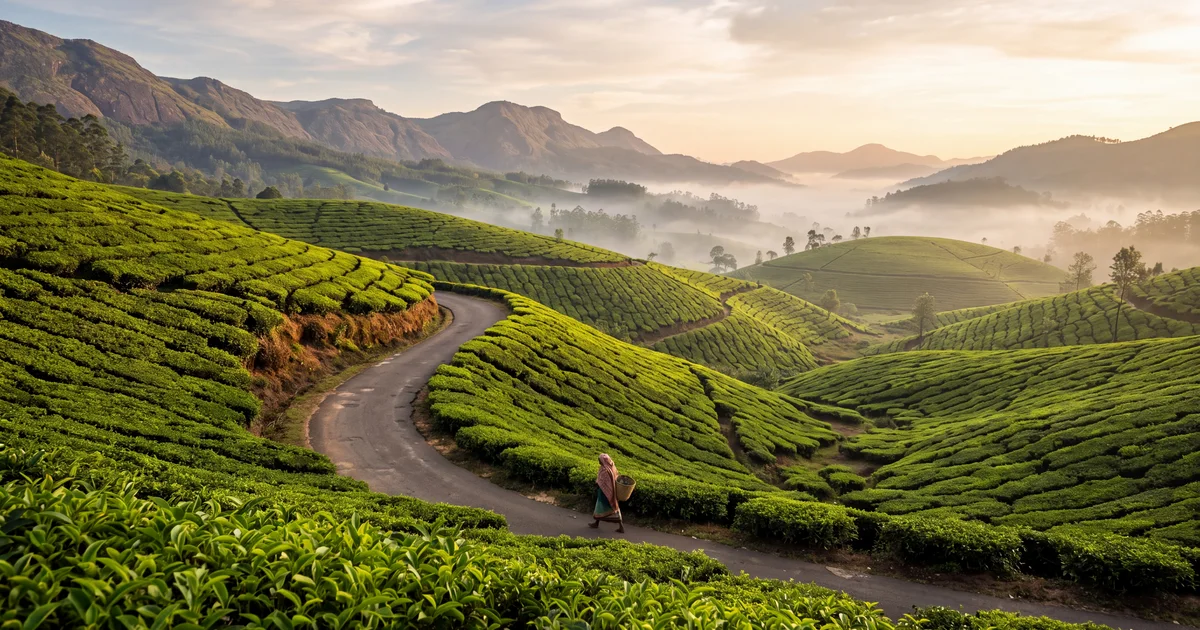
Munnar sits at 1,600 metres in the Western Ghats of Kerala, wrapped in tea plantations that run unbroken for over 80,000 acres. The town itself is unremarkable. A congested bazaar, a bus stand, and hotels stacked along the hillside. The magic is outside town, spread across valleys and ridgelines within 5 to 50 km of the centre.
The problem with most Munnar guides is they list 30 places and treat them all as equal. They are not. Some viewpoints are genuinely spectacular. Others are parking lots with a railing and a ₹50 entry fee. This guide makes the distinction.
These are the places to visit in Munnar that are actually worth your time in 2026, honest calls on what to skip, and practical details on how to structure your days.
TL;DR
- Must visit: Eravikulam National Park, Top Station, Lockhart Gap, KDHP Tea Museum, Headlands
- Worth it if you have time: Marayoor sandalwood forests, Chinnar Wildlife Sanctuary, Meesapulimala trek
- Skip: Echo Point, Photo Point, Flower Garden, wax museums
- Best months: September to March
- Minimum days needed: 3 full days for a complete trip
Which tea estates in Munnar can you actually visit?
Munnar's tea plantations are not public parks. They are working estates owned by Tata (Kanan Devan Hills Plantations, or KDHP) and a handful of smaller companies. You cannot wander into any field you like.
KDHP Tea Museum (Nallathanni): The only official tea tourism facility. Entry is ₹150. You walk through the processing factory, watch leaves being dried and rolled, and taste fresh brew at the end. The best part is not the museum. It is the 2 km stretch of road leading there, bordered by manicured tea rows on both sides. Visit before 10am when the factory is actively processing.
Lockhart Gap: 13 km from town on the road to Top Station. No entry fee, no crowd barriers. You pull over at a curve and look down at 300 metres of uninterrupted tea slopes disappearing into mist. This is where the postcards come from. Twenty minutes here beats two hours at Echo Point.
Kolukkumalai Tea Estate: The highest tea plantation in India at 2,400 metres. Requires a jeep ride from Suryanelli (35 km from Munnar). The road is rough and only accessible in 4x4 vehicles. The estate itself has a working factory using century old machinery. Go at dawn for the views and the quiet.
One limitation: tea plucking happens mainly during monsoon and post-monsoon months (June to November). Visit in December to February and the fields are green but static.
Is Eravikulam National Park worth the entry fee?
Yes. This is the one attraction in Munnar where the price (₹190 Indian / ₹660 foreign) matches the experience.
Eravikulam covers 97 square km of rolling grasslands above 2,000 metres. The park bus takes you to the viewpoint in 15 minutes, and from there you walk a 2 km paved path along the ridge. On clear mornings, the view stretches 40 km across layered mountain ranges.
The Nilgiri tahr (an endangered mountain goat) grazes openly here. You will see them within 10 metres of the path. They are habituated to visitors but genuinely wild. About 800 animals live in the park, making this the largest population of the species anywhere.
Neelakurinji (the blue flower that blooms once every 12 years) last appeared in 2018 and will bloom again in 2030. Outside bloom years, the grasslands are gold and green rather than purple.
Practical tip: the park opens at 7:30am and limits daily visitors to 3,000. During October to December peak season, slots sell out by 9am. Book tickets online at the Kerala Forest Department site the day before if possible.
One honest caveat: the park closes during February and March every year for the tahr calving season. Check dates before planning your trip.
What is at Top Station and is the drive worth it?
Top Station is 32 km from Munnar town. The road climbs to 1,880 metres, making it the highest point accessible by vehicle in the area. The drive itself is half the experience.
Past Lockhart Gap, the road narrows and wraps around ridges with tea on one side and a sheer drop on the other. The last 5 km have no guardrails. This is not dangerous by Indian hill-road standards, but it concentrates your attention.
At Top Station, you get a view into Tamil Nadu's Theni district. The Western Ghats fall away sharply on the eastern side. On clear mornings (before 9am typically), you can see the plains 50 km below.
Worth it? Absolutely, if the weather cooperates. In monsoon and many winter mornings, cloud cover sits at exactly this altitude and you see nothing. Check visibility before driving up. If it is cloudy at Lockhart Gap (which is lower), Top Station will be worse.
The drive takes 75 minutes each way from Munnar town. Budget a half day for the round trip including stops.
What should you skip in Munnar?
Not everything with a signboard deserves your time.
Echo Point: A reservoir with a concrete platform and a ₹50 entry fee. The "echo" works the same as shouting into any valley. Five minutes of novelty, 30 minutes of queue. Skip it.
Photo Point: A viewpoint you can see equally well from the road 100 metres before it. The entry fee exists because they put up a barrier. Nothing inside justifies stopping.
Flower Garden: A small hillside with labelled plants and a glass house. Underwhelming compared to the wild flowers you will see along any roadside drive in September and October. Entry is ₹40. Save the time.
Wax museums and 3D shows: These exist near Munnar town and target bus-tour groups with time to kill between meals. If you are reading this guide, you are not the audience.
My opinion: the number one mistake tourists make in Munnar is spending their mornings at paid attractions near town when the best views are free, scattered along the road to Top Station and Mattupetty.
How many days do you need for Munnar?
Structure your days by direction, not by attraction count.
Day 1 (South/West): KDHP Tea Museum, Attukal Waterfalls, Mattupetty Dam, and the road toward Kundala. This is the standard tourist circuit and the most crowded. Get it done first.
Day 2 (East/Top Station): Lockhart Gap, Top Station, and if time allows, Kolukkumalai jeep trip. Start early. This is the best day of the trip for most visitors.
Day 3 (North): Marayoor sandalwood forests (34 km), Chinnar Wildlife Sanctuary (60 km), and the dolmen archaeological sites. This direction is under-visited and feels like a different landscape altogether.
Day 4 (optional, trekking): Meesapulimala (the highest peak in the Western Ghats outside the Nilgiris at 2,640 metres) or Chokramudi. Both need a guide and permits from the forest department.
Two days work if you compress Day 1 and Day 2 into a single early start. But you will feel rushed. Three days is the sweet spot.
Are the waterfalls near Munnar worth visiting?
Mixed verdict.
Attukal Waterfalls (9 km from town): Accessible by road. The falls are impressive in monsoon (August and September) when the cascade is 15 to 20 metres wide. Outside monsoon, it reduces to a trickle. Free entry. Worth a 20 minute stop on your Day 1 loop.
Lakkam Waterfalls (25 km, on the Udumalpet road): Smaller but surrounded by dense forest. Less visited. You can stand at the base. The short walk from the road (500 metres) through a shola forest path is the highlight.
Thoovanam Falls (Chinnar area, 50 km): Requires a 5 km trek through Chinnar Wildlife Sanctuary. This is the only waterfall near Munnar worth planning a half day around. The forest walk is excellent, and the falls sit in a gorge that feels removed from everything.
Power House Waterfall (near town): Visible from the road. Photograph it from the bridge if you happen to pass. Dedicating time to reaching the base is unnecessary.
Honest take: Munnar is not a waterfall destination. Kerala has better falls in Athirappilly and Vagamon. Visit waterfalls here as roadside bonuses, not as main attractions.
What makes Marayoor and Chinnar different from the rest of Munnar?
Most visitors never leave the western side of Munnar. The eastern side, past the Munnar to Udumalpet road, is drier, flatter, and covered in sandalwood instead of tea.
Marayoor (34 km north) has natural sandalwood forests and ancient dolmen burial sites dating to 1000 BCE. The dolmens are scattered in open fields. No ticket booth, no fence. Just stone structures that predate recorded history in this region, sitting in a sandalwood grove with cattle grazing around them.
The sandalwood processing unit here is government run. You can visit the factory where harvested wood is auctioned. The sweet fragrance fills the entire 2 km stretch approaching the village.
Chinnar Wildlife Sanctuary (60 km northeast) borders Tamil Nadu and sits in a rain shadow. The vegetation shifts from wet montane to dry deciduous. Spotted deer, bonnet macaques, and occasionally wild elephant are visible from the road.
Chinnar requires a ₹100 entry fee and offers guided treks (the Thoovanam waterfall trek is the most popular). Book at the check post on arrival. No advance booking available.
My opinion: if you have done Munnar before or are visiting for 4+ days, skip the congested western circuit entirely on one day and drive to Marayoor and Chinnar. It does not feel like Munnar. That is the point.
How do you get to Munnar from Bangalore?
Three options, none fast.
By road (own vehicle): 480 km via Salem and Udumalpet. Allow 9 to 10 hours with breaks. The last 30 km from Udumalpet to Munnar climbs the ghats through hairpin bends. Night driving on this stretch is risky because of fog and oncoming lorries. Leave Bangalore by 5am to reach before 3pm.
By bus: KSRTC operates a direct sleeper from Majestic (departure 9:30pm, arrival 7:30am, ₹900 to ₹1,200 depending on class). Private operators run similar services. The road quality is acceptable. Sleep is possible.
By train + road: Take any train to Aluva (Ernakulam side). The daily Bangalore to Kochi trains take 10 to 12 hours. From Aluva station, private taxis (₹3,000 to ₹3,500) or KSRTC buses (₹180, 4 hours) reach Munnar. Total travel time similar to driving, but you arrive less exhausted.
No airports are close. Kochi (Cochin International) is 110 km and 4 hours by road from Munnar. Madurai airport is 160 km and 4.5 hours.
For group trip options that handle transport and logistics, check trips from Bangalore or browse Munnar packages on TripzSearch.
What does Munnar cost for a 3 day trip in 2026?
Budget ranges (per person, assuming 2 sharing):
Budget (₹3,000 to ₹5,000/day): Homestays in town, KSRTC bus from Bangalore, shared auto for sightseeing, meals at local restaurants. Comfortable but not luxurious.
Mid-range (₹5,000 to ₹10,000/day): Resort in Chinnakanal or Pothamedu with valley views, own vehicle or rented car with driver, multi-cuisine restaurants. This is what most couples and small groups spend.
Upscale (₹10,000+/day): Boutique tea estate stays like Windermere or Spice Tree, private jeep to Kolukkumalai, guided nature walks. Worth it for honeymoons. Unnecessary for a sightseeing trip.
Entry fees total about ₹400 to ₹500 per person if you visit Eravikulam, the tea museum, and Chinnar. Fuel for a 3 day local sightseeing loop is roughly ₹1,500 (150 km of hill driving).
For current group trip prices, see available packages on TripzSearch.
Pothamedu, Headlands, and other viewpoints locals prefer
The best viewpoints in Munnar are not on the tourist map. They are gaps in the tea rows where the land drops away and the view opens.
Headlands: 5 km from town toward Devikulam. A tea estate junction where you can pull over and look down at the confluence of three valleys. No entry, no sign, no crowd. Ask any resort staff for "Headlands viewpoint" and they will point you here.
Pothamedu: 2 km from town on a ridge above KDHP plantations. Early morning fog fills the valley below while you stand above it. Sunrise here is better than anything you will find at an official viewpoint. Drive up before 6:30am.
Pallivasal viewpoint: On the road to Attukal. A widened curve with a clearing. Tea, cardamom, and coffee estates visible in layers below. Free, rarely crowded, and photogenic from 7am to 9am when angled light hits the rows.
These spots have no facilities. No parking attendants, no chai stalls, no toilets. That is precisely why they remain good.
Meesapulimala: the best trek from Munnar
Meesapulimala (2,640 metres) is the second highest peak in South India. The trek from Rhodo Valley is 16 km round trip through rolling grasslands above the tree line. No forest cover for the last 4 km. Exposed and windy.
You need a guide (mandatory, arranged through the forest department office at Munnar or through your hotel) and a permit. Cost is approximately ₹1,500 for guide + permit for a group of up to 5.
Difficulty is moderate. The trail is well defined and gains about 700 metres over 8 km. No scrambling, no ropes. Fitness for a 6 to 7 hour walk at altitude is the only requirement.
The summit view on a clear day covers 360 degrees of Western Ghats ranges stretching into Tamil Nadu. It is the single best viewpoint in the Munnar region. Better than Top Station, better than Eravikulam.
Best months for the trek: September to February. Avoid monsoon (trail is obscured by cloud and the grassland is slippery). December and January mornings are clear but cold (below 5 degrees at the summit).
Book your guide at least a day in advance. Weekend slots fill up during peak season (October and December).
Frequently asked questions
- How many days are enough for Munnar?
- Three full days let you cover the main tea estates, Eravikulam National Park, Top Station, and one waterfall without rushing. Two days work if you skip the longer drives to Marayoor or Chinnar. Four days are ideal if you want to add a trek or spend unhurried time at plantations.
- What is the best time to visit Munnar?
- September to March gives the best weather. September and October offer post-monsoon greenery with light showers. December to February brings cool nights (8 to 12 degrees Celsius) and clear skies for photography. April and May are warm but still pleasant above 1,500 metres. June to August is heavy monsoon with landslide risks on the ghat roads.
- Is Munnar worth visiting in 2026?
- Yes, if you go beyond the standard tourist circuit. The tea estates, Meesapulimala trek, and Top Station viewpoint remain genuinely impressive. Avoid the overrated attractions (Echo Point, Photo Point) and spend time on the less crowded eastern side near Chinnar for a different experience.
- What should I skip in Munnar?
- Echo Point, Photo Point, and Flower Garden are tourist traps with entry fees and nothing you cannot find for free elsewhere. The wax museum and 3D shows near town add nothing to a nature trip. Skip them and use that time at Lockhart Gap, Headlands, or the KDHP tea factory instead.
- How do I reach Munnar from Bangalore?
- Drive via Salem and Udumalpet (480 km, 9 to 10 hours) or via Madurai (500 km, 10 hours). No direct train. The nearest railway station is Aluva (110 km), connected to Bangalore by daily trains. KSRTC runs a direct Bangalore to Munnar bus (10 hours, departing from Majestic at 9:30pm).
- Are there group trips to Munnar from Bangalore?
- Several operators run weekend group trips to Munnar from Bangalore, typically 3 days and 2 nights, covering transport, stay, and sightseeing. You can browse available departures and compare packages on TripzSearch at /from/bangalore.