Best Places to Visit in Meghalaya (2026): Living Root Bridges, Caves and Waterfalls
Best places to visit in Meghalaya in 2026 with travel tips, costs, best months, and what to skip in the abode of clouds.
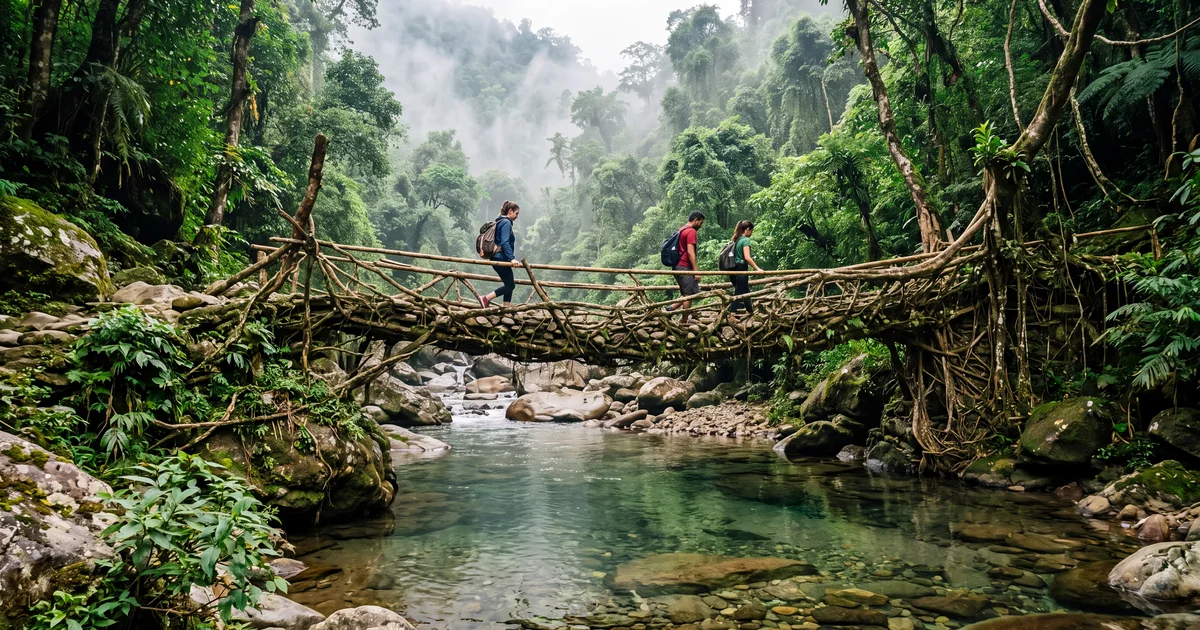
Meghalaya sits on the edge of the Shillong Plateau, 1,500 metres above the Bangladesh plains. The places to visit in Meghalaya cover everything from ancient living root bridges grown over 200 years to river pools so clear they look photoshopped. The state receives more rainfall than anywhere else on Earth (Mawsynram averages 11,871 mm annually), which feeds hundreds of waterfalls and keeps the landscape impossibly green.
Most visitors fly into Guwahati and drive 3 hours to Shillong. From there, the main circuits fan out south toward Cherrapunji and Dawki. A full Meghalaya trip needs 5 to 6 days. This guide covers what is genuinely worth the effort in 2026, what to skip, and the logistics that most blog posts leave out.
TL;DR
- The double decker living root bridge at Nongriat requires 3,500 steps down (and back up); budget a full day
- Dawki river clarity peaks November to March; monsoon visits are disappointing
- Cherrapunji and Mawsynram waterfalls peak July to September, but roads become risky
- October to November is the sweet spot: waterfalls still flowing, trails accessible, roads intact
- Budget 5 to 6 days from Shillong; a group trip handles the shared Sumo logistics
What Are the Living Root Bridges and How Do You Get There?
The Khasi people train the aerial roots of Ficus elastica trees across rivers and valleys. Each bridge takes 15 to 30 years to become walkable. There are dozens scattered through the East Khasi Hills, but three are accessible to regular tourists.
Double Decker Root Bridge (Nongriat)
The most photographed one. Two living bridges stacked at different levels over the Umshiang stream. Getting there requires descending roughly 3,500 steps from Tyrna village (3 km from Cherrapunji). The descent takes 1.5 to 2 hours. The climb back up takes 2.5 to 3.5 hours depending on fitness.
Most people stay overnight at Nongriat village (basic guesthouses, 500 to 800 per night, no hot water, limited food options). Starting the descent after 1 PM is a bad idea because you will be climbing back in the dark.
The bridge itself is stunning. It spans about 50 metres and supports several people at once. A natural swimming pool sits beside it, deep enough for a swim.
One honest reality: the 3,500 steps back up are brutal if you are not used to hiking. I would not recommend this for anyone with knee issues or low cardiovascular fitness. There is no shortcut and no vehicle access to Nongriat.
Single Root Bridge at Riwai
If 3,500 steps sound excessive, the Riwai root bridge near Mawlynnong is a 10 minute walk from the road. It is smaller (about 20 metres span) but still a genuine living root structure. Accessible to anyone who can walk on uneven terrain for 10 minutes. No entry fee.
Mawlynnong Living Root Bridge
In the village itself. Short walk, well maintained path. Mawlynnong was named "cleanest village in Asia" in 2003 (the title is disputed, but the village is genuinely spotless by Indian standards). You can combine this with the nearby sky walk (bamboo platform overlooking Bangladesh plains, 20 entry).
Where Are the Best Waterfalls in Meghalaya?
Meghalaya has more waterfalls than you can visit in a week. These are the ones worth the detour.
Nohkalikai Falls (Cherrapunji)
India's tallest plunge waterfall at 340 metres. The water drops into a blue green pool at the base. You view it from a railing above (the descent to the base is closed). Best seen between July and October when the volume is highest. Even in November, it still flows impressively.
The viewpoint is 7 km from Cherrapunji town. Entry fee: 30 per person. Gets crowded between 11 AM and 2 PM on weekends.
Wei Sawdong Falls (three tiered)
Three cascades on different levels, the lowest falling into a turquoise pool. Reaching the bottom requires a 30 minute scramble down slippery rocks (not suitable for everyone). The upper tier is visible from a viewpoint with minimal effort.
Location: 12 km from Cherrapunji on the Shella road. The trail starts from the road with no signage. Ask locals at the Laitkynsew junction. Carry water; there is no shop nearby.
Krang Suri Falls (Jaintia Hills)
A curtain waterfall falling into a wide emerald pool where you can swim. The pool has a sandy bottom and the water temperature stays around 18°C year round. You can walk behind the curtain.
Getting there: 2.5 hours from Shillong toward Jowai. Entry fee: 50. The road condition deteriorates in the last 5 km. Weekdays are empty; weekends see 100+ visitors.
Is Dawki Worth the 3 Hour Drive from Shillong?
Dawki sits on the India Bangladesh border where the Umngot River is famously transparent. Between November and March, boats look like they are floating on glass. It is not an exaggeration. The water clarity reaches 15 to 20 feet of visibility.
The drive from Shillong takes 3 hours (80 km of winding mountain road, not highway). A boat ride costs 800 to 1,200 for 30 minutes.
Is it worth three hours each way? If you are visiting between November and March, yes. The river clarity is genuinely unique in India. If you are visiting during monsoon, no. The water turns milky green and the visual effect disappears entirely.
Combine Dawki with Mawlynnong village (30 minutes further) and the Riwai root bridge to make a full day loop from Shillong.
What Is There to Do in Shillong Itself?
Shillong works better as a base than a destination. The city itself has a handful of genuine attractions.
Ward's Lake and Police Bazaar
Ward's Lake is a small landscaped park (entry 30, camera 50 extra) worth 30 minutes. Police Bazaar is the main commercial area. Useful for buying supplies, rain gear, and SIM cards. Not scenic.
Don Bosco Museum
Seven floors covering Northeast India's tribal cultures, textiles, and history. One of the best museums in the region. Allocate 2 hours. Entry: 200. The rooftop gives a 360 degree view of Shillong.
Laitlum Canyon
22 km from Shillong. A viewpoint overlooking terraced hills dropping into a deep valley. The drive takes 45 minutes, the walk from parking to the main viewpoint is 15 minutes. Best in morning light. The canyon trail descends steeply (1 to 2 hours down to the village below, 2 to 3 hours back up).
This is probably the most photogenic viewpoint near Shillong. It is also nearly empty on weekdays.
Umiam Lake
15 km from Shillong on the Guwahati highway. A large reservoir with boating and kayaking. Views are best at sunset. Water sports cost 200 to 500. The area around the lake has several resorts (2,000 to 5,000 per night) if you prefer staying outside Shillong's traffic.
What About the Caves?
Meghalaya has the longest cave systems in the Indian subcontinent. Most require prior arrangement with local caving groups, but two are tourist accessible.
Mawsmai Cave (Cherrapunji)
A lit limestone cave with a 150 metre walkthrough. Tight passages in places (you will crouch). No guide needed, the path is marked. Entry: 30. Takes 20 to 30 minutes. Gets claustrophobic when crowded, so visit early morning.
This is the easy, touristy cave. If you have visited caves elsewhere in India, Mawsmai will feel small and underwhelming.
Krem Mawmluh
The fourth longest cave in India at 7.2 km. Only partially explored. Requires a local guide (arranged through Meghalaya Adventurers' Association). The tourist section goes about 1 km deep with helmet and headlamp. Real caving expeditions go further with proper gear.
How Do You Plan the Logistics?
Getting around: Shared Sumos (10 seater) are the standard transport. Shillong to Cherrapunji: 150 per seat, 2 hours, departs Police Bazaar around 8 AM. Shillong to Dawki: 250 per seat, 3 hours. Hiring a private vehicle for the full trip costs 3,500 to 5,000 per day depending on the car.
Accommodation: Shillong has options from 800 hostels to 4,000 mid range hotels. Cherrapunji has limited stays (Cherrapunjee Holiday Resort at 3,500, or basic guesthouses at 1,000). Nongriat has 500 to 800 per night bare bones rooms. Book Cherrapunji accommodation ahead during October to November.
Food: Khasi cuisine is pork and rice heavy. Jadoh (red rice with pork), tungrymbai (fermented soybean), and doh khleh (pork salad) are local staples. Vegetarian options are limited outside Shillong. Carry snacks for days in the field.
Connectivity: 4G works in Shillong, Cherrapunji town, and Dawki. Signal drops entirely in Nongriat, Krang Suri area, and most caves. Download offline maps before leaving Shillong.
Budget: A 6 day trip from Guwahati costs roughly 15,000 to 25,000 per person (mid range, shared transport, excluding flights). Group trips from Delhi typically run 18,000 to 35,000 all inclusive.
If you are planning a Meghalaya trip, check verified group departures on TripzSearch to compare itineraries and find operators who handle the shared Sumo bookings and Nongriat logistics.
Frequently asked questions
- How many days are enough for a Meghalaya trip?
- Five to six days cover the highlights without rushing. Day one for Shillong arrival and local sights. Two days for Cherrapunji and the living root bridges (one night stay at Tyrna or Nongriat). One day for Dawki and Mawlynnong. One day for Mawsynram or Jaintia Hills caves. Add a seventh day if you want to trek to the double decker root bridge and take it slow.
- What is the best time to visit Meghalaya?
- October to November for clear skies, green landscapes, and post monsoon waterfalls still flowing strong. February to April for pleasant 15 to 25°C weather and dry trails. June to September brings 10,000+ mm of rain in Cherrapunji (roads wash out, treks become risky). December to January is cold (5 to 12°C in Shillong) but dry and uncrowded.
- Is Meghalaya safe for solo female travellers?
- Meghalaya is among the safest states in India for solo female travellers. Khasi and Jaintia societies are matrilineal, and women play a central role in community life. Crime rates are low in tourist areas. The main concern is infrastructure, not safety: roads are narrow, public transport is infrequent, and mobile signal drops in valleys. A shared taxi network connects major points, or join a group trip for logistics.
- How to reach Meghalaya from Delhi or Bangalore?
- Fly to Shillong (Umroi Airport, limited flights) or Guwahati (Lokpriya Gopinath Bordoloi International Airport, well connected). Guwahati to Shillong is 100 km by road (3 hours by shared Sumo, 250 per seat, or private taxi 2,500). From Bangalore, expect a flight to Guwahati with one connection (typically via Kolkata or Delhi), taking 5 to 7 hours total.
- Is Dawki river really that clear?
- Yes, between November and March the Umngot River at Dawki is genuinely transparent to 15+ feet depth. Boats appear to float in air. The clarity drops significantly during monsoon (June to September) when upstream runoff adds sediment. Visit in the morning before tour groups arrive around 10 AM. Boating costs 800 to 1,200 for a 30 minute ride depending on season.
- Do I need a permit to visit Meghalaya?
- Indian citizens do not need any permit for Meghalaya. Foreign nationals need an Inner Line Permit (ILP) which can be obtained online through the Meghalaya government portal or at the Guwahati office. Processing takes 1 to 2 working days. Carry multiple photocopies as checkposts between Guwahati and Shillong verify them.