Best Places to Visit in Leh Ladakh (2026): Passes, Monasteries and Pangong
15 places to visit in Leh Ladakh in 2026 with real tips on altitude, timing, permits, and what the brochures leave out.
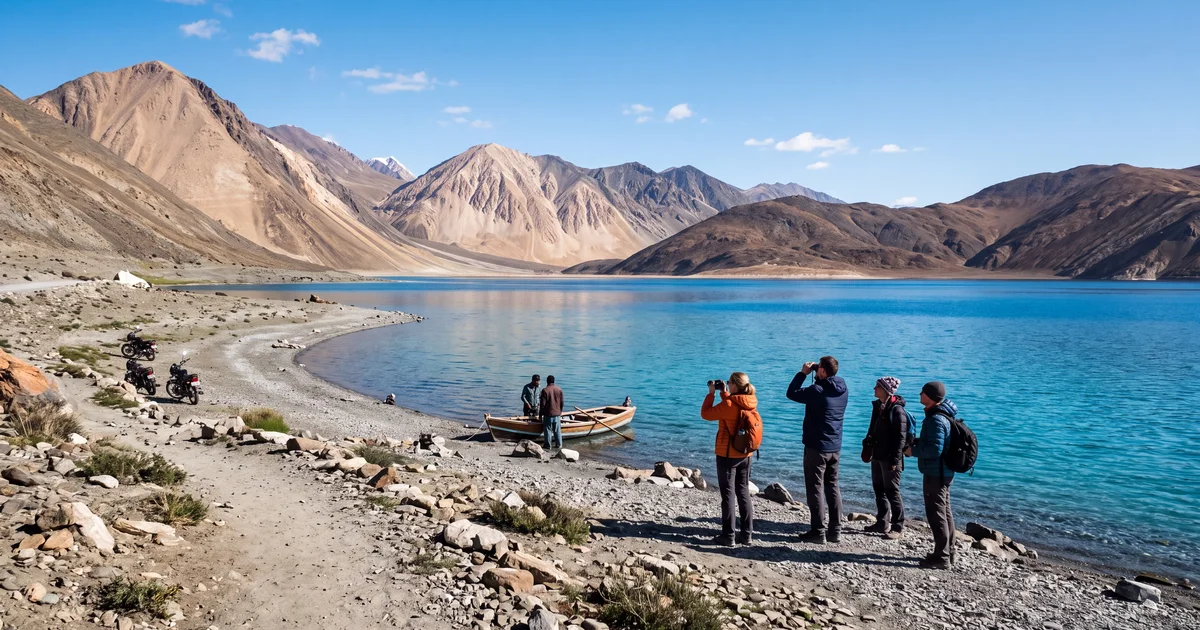
Ladakh sits between the Karakoram and the Great Himalayan Range at altitudes where the air has 40% less oxygen than sea level. The landscape is brown, bare, and enormous. Glacial lakes turn colours that do not look natural. Monasteries cling to cliff faces above valleys that have not changed much in 500 years. People keep coming because nowhere else in India looks like this.
This is what actually matters when you plan a places to visit in Leh Ladakh itinerary. Not a list of 30 spots with identical paragraphs. Fifteen places, notes on which ones are worth the altitude headache, and which ones you can skip.
TL;DR
- Pangong Lake, Nubra Valley, and Leh town monasteries form the core. Seven days covers them with proper acclimatization.
- June to September is the window. September is the sweet spot: fewer tourists, clear skies, golden poplars.
- Budget ₹3,000 to ₹6,000 per person per day. A shared Innova for the Pangong plus Nubra loop runs ₹18,000 to ₹22,000 for four days.
- Acclimatize on Day 1 in Leh. No excursions, no passes. Your body needs 24 hours at 3,500 metres.
- Inner Line Permits are mandatory for Pangong, Nubra, and Tso Moriri. Apply online or at the DC office in Leh.
What Makes Pangong Lake Worth the 5 Hour Drive?
Pangong Tso stretches 134 km from India into China, sitting at 4,350 metres. Only about 40% of the lake falls on the Indian side. The water shifts between shades of blue, green, and grey depending on the time of day, the angle of sunlight, and the depth. No river feeds into it. Snowmelt and underground springs keep it full.
The drive from Leh takes 5 to 6 hours via Chang La (5,360 metres). The road is paved until Tangtse. After that, expect gravel, dust, and occasional army convoys. Most travellers reach the lake by early afternoon and stay overnight in tented camps at Spangmik or Man village. A basic camp charges ₹1,500 to ₹3,000 per night including dinner and breakfast.
The lake looks best between 7 AM and 9 AM. The surface is still. The surrounding mountains reflect in the water. By noon, wind picks up and the reflections break.
One caveat: the famous "3 Idiots" spot at Spangmik is now a parking lot with souvenir stalls and photographers charging ₹200 for a photo with a yellow scooter. If you walk 2 km south along the shore, past the last tent camp, the lake is the same lake minus the circus.
September visitors get something extra. The marshes near Merak village, about 30 km further along the shore, turn golden. There are fewer vehicles on the road. The camps are half empty. The permit still covers this stretch.
If you are planning a trip from Delhi, the standard circuit is Leh to Pangong to Nubra to Leh, which takes four days with one night at each stop.
Is Nubra Valley Actually Desert in the Himalayas?
Nubra Valley sits north of Leh, past Khardung La. The valley floor at Hunder and Diskit drops to around 3,000 metres, which is lower than Leh itself. The altitude relief makes the air feel warmer and thicker. After days at 3,500+ metres, that difference is physical.
The white sand dunes at Hunder stretch for about 2 km between the Shyok River and the village. Double humped Bactrian camels (fewer than 200 remain in this area) graze here. A 15 minute camel ride costs ₹300 to ₹500. Yes, it feels touristy. The dunes against the Karakoram backdrop at sunset are still worth it.
Diskit, 7 km from Hunder, has a 32 metre Maitreya Buddha statue built in 2010 above the village. Diskit Monastery (founded in the 14th century by Changzem Tserab Zangpo) perches on the ridge behind it. The prayer hall on the upper floor has 600 year old murals that are fading but still legible. The monks hold morning prayers at 6 AM. Visitors are welcome if you sit quietly.
Sumur village, 30 km north of Diskit, has Samstanling Monastery and the Panamik hot springs. The springs are lukewarm rather than hot (around 40°C) and the infrastructure around them is basic. Worth a stop if you are passing through. Not worth a special trip.
The honest limitation: Nubra requires a minimum two night stay to avoid spending the entire time in a vehicle. The drive from Leh over Khardung La takes 4 to 5 hours each way. Doing it as a day trip is physically possible and a bad idea. Your body is still adjusting to altitude.
How High Is Khardung La, and Does It Matter?
The sign at Khardung La says 5,602 metres. GPS measurements put it closer to 5,359 metres. The Indian Army maintains the road and the pass. Either way, it is among the highest motorable passes in the world, and the 39 km drive from Leh takes about 1.5 hours.
The road is a single lane with army trucks, tourist vehicles, and the occasional motorcycle group competing for space. The surface alternates between tarmac and loose gravel. In June and July, snow walls still line the road near the top. In September, the pass is clear but the wind at the summit can hit 60 km/h.
You stop at the top for photos and a cup of chai from the army canteen. That is all there is to do. The oxygen level at 5,300+ metres means some people get headaches within 10 minutes. Do not linger more than 20 to 30 minutes. The real reward is Nubra Valley on the other side, where the road descends through switchbacks into a green, sheltered valley.
Most people treat Khardung La as a transit point rather than a destination. That is the right approach.
Which Monasteries in Leh Are Worth Visiting?
Ladakh has over 30 active Buddhist monasteries. You do not need to visit all of them. Four are worth the early start, all within 60 km of Leh town.
Thiksey Monastery sits on a hill 17 km from Leh. It looks like a miniature Potala Palace from the road. The 12 storey complex houses 120 monks, a 15 metre Maitreya Buddha statue, and a morning prayer ceremony at 6:30 AM that involves chanting, horns, and drums. Get there by 6 AM. The terrace above the prayer hall offers views of the Indus Valley at sunrise. This is the one monastery that justifies an early alarm.
Hemis Monastery, 45 km from Leh, is the largest and wealthiest monastery in Ladakh. The annual Hemis Festival (usually June or July, dates follow the Tibetan calendar) draws masked dancers and thousands of visitors. Outside festival season, the museum holds a 400 year old thangka embroidered with pearls. The courtyard feels empty on regular days. Visit during the festival if your dates align.
Shey Palace and Monastery sits 15 km from Leh. The 7.5 metre copper and gold Buddha statue inside was commissioned by King Deldan Namgyal in the 17th century. The palace ruins above are crumbling but give you 360 degree views of the valley. Most group tours skip it. Fifteen minutes here is enough to see the statue and the views.
Lamayuru Monastery, 127 km west of Leh on the Srinagar highway, is the oldest in Ladakh (founded in the 10th century). The landscape around it looks lunar. Eroded clay formations surround the monastery on three sides. The Yuru Kabgyat festival (July) features Cham dances with elaborate masks. If you are driving between Leh and Srinagar, this is a natural half day stop.
For finding group trips that cover these monasteries, most operators include Thiksey and Hemis on their standard Ladakh itineraries.
Does Magnetic Hill Actually Pull Your Car Uphill?
Magnetic Hill sits 30 km west of Leh on the Srinagar highway. A yellow box on the road marks the spot where you park with the engine off and the car in neutral. The vehicle appears to roll uphill.
It is an optical illusion. The surrounding terrain creates a visual gradient where a slight downhill slope looks like an uphill one. The Indian Army maintains a small signboard explaining this. The experience takes about 5 minutes.
Is it worth a stop? If you are driving to or from the airport or heading toward Lamayuru, yes. It is directly on the route. Making a special trip from Leh for this alone would be a waste of half a day.
The confluence of the Indus and Zanskar rivers is 2 km past Magnetic Hill. Two distinct water colours (brown Indus, blue green Zanskar) merge in a visible line. This is the better stop. Spend your time here. There is a viewpoint on the highway with parking.
What Is Tso Moriri and Should You Add It?
Tso Moriri sits 240 km south of Leh at 4,522 metres. It is a freshwater lake (unlike the brackish Pangong), 28 km long, surrounded by peaks above 6,000 metres. The village of Korzok on its western shore has about 300 residents and one of the highest inhabited settlements in India.
Getting there takes 7 to 8 hours from Leh via Chumur. The road south of Mahe is rough, and fuel stations are nonexistent between Upshi and Korzok. Fill your tank in Leh.
Why go: Tso Moriri gets a fraction of Pangong's visitors. The lake is quiet. Wild kiangs (Tibetan wild ass) graze near the shore. The water is so clear you can see the bottom 10 metres out. Korzok Monastery, on a hill above the village, has a small prayer hall with views down the full length of the lake.
The trade off is time. Adding Tso Moriri means two extra days (one night at Korzok, one night in transit). If you have 10 or more days, include it. For a 7 day trip, Pangong and Nubra are the better use of your time.
How Bad Is Altitude Sickness in Ladakh?
Leh sits at 3,500 metres. That is high enough for acute mountain sickness (AMS) to hit anyone, regardless of fitness. Common symptoms: headache, nausea, dizziness, shortness of breath when climbing stairs. These usually appear 6 to 12 hours after arrival.
The fix is simple. Do nothing on Day 1. Seriously. No sightseeing, no walking to the market, no driving up to Shanti Stupa. Drink 3 to 4 litres of water. Eat light. Sleep. Most guesthouses in Leh will advise the same thing when you check in.
Diamox (Acetazolamide) helps. Take 125 mg twice daily starting 24 hours before arriving in Leh. It is not a cure. It speeds up acclimatization. Consult your doctor before the trip.
The danger zone is Pangong (4,350 m) and Khardung La (5,359 m). If you have headaches in Leh, delay the Pangong trip by a day. Pushing through altitude symptoms at higher elevations can turn AMS into high altitude pulmonary oedema (HAPE), which is life threatening.
The army maintains a HAPE treatment centre in Leh and small medical posts along the Khardung La road. Know where they are before you drive up.
Is the Leh to Manali Highway Worth the Drive?
The Leh to Manali highway (474 km) is open from late May to mid October. The drive takes 12 to 15 hours if the road is clear, but landslides between Pang and Sarchu can add hours. Most travellers split it across two days with an overnight at Sarchu or Jispa.
The road crosses five passes above 4,000 metres: Lachalung La (5,065 m), Nakee La (4,739 m), Baralacha La (4,890 m), Rohtang La (3,978 m), and Tanglang La (5,325 m). The stretch between Pang and the More Plains is a straight 40 km road across a flat, treeless plateau at 4,500 metres. That stretch alone makes the drive memorable.
Is it better than flying? For the experience, yes. The highway shows you Ladakh's transition from high desert to Himalayan green valleys. For comfort, no. The road beats up your spine. Shared taxis from Leh to Manali cost ₹2,500 to ₹3,500 per person.
If you explore trips from Delhi that include the Manali to Leh route, most group tours run it as a one way drive (fly in to Leh, drive out via Manali or the reverse).
What Can You Actually Do in Leh Town?
Leh town is where you start and end. The old town below Leh Palace has narrow alleys, whitewashed houses, and a few 400 year old buildings in various states of repair. The palace itself (built in the 17th century, modelled on the Potala Palace in Lhasa) is half ruin, half museum. Entry is ₹100. The views from the top floor are the best in town.
The Main Bazaar runs 500 metres through the centre. Pashmina shawls, Tibetan jewellery, dried apricots, and seabuckthorn juice line both sides. Prices are negotiable. A quality Pashmina stall starts around ₹3,000 and goes to ₹15,000 depending on the weave.
Shanti Stupa, built by a Japanese Buddhist organization in 1991, sits on a hill above Changspa road. The 500 step climb is manageable if you have acclimatized for a day. Go at sunset. The stupa is white against an orange sky, with the Stok Range behind it and Leh town spread below.
Changspa is the backpacker area. Guesthouses, German bakeries (legacy of 1990s trekking tourism), and cafes with WiFi that works about 60% of the time. A dorm bed costs ₹500 to ₹800. A private room in a family run guesthouse costs ₹1,200 to ₹2,500.
For food, try a thukpa (Tibetan noodle soup) at any local restaurant. Skyu, a Ladakhi pasta stew with root vegetables, is worth ordering at least once. The destinations page has more on Leh as a base for wider exploration.
Should You Ride a Bike to Ladakh?
The motorcycle trip to Ladakh has become a rite of passage for a certain kind of traveller. Royal Enfield Himalayan or Classic 350, Manali to Leh or Srinagar to Leh, five to seven days on the saddle. Rental bikes in Manali cost ₹1,200 to ₹2,000 per day.
The honest version: the ride is physically punishing. Eight to ten hours of riding per day at altitude. Cold hands above 4,000 metres even in July. Punctures on gravel roads between Pang and Sarchu. Water crossings near Baralacha La that can submerge your exhaust pipe.
If you have riding experience and can handle a loaded motorcycle on unpaved mountain roads, it is an extraordinary trip. If your longest ride before this was Bangalore to Mysore on a well paved highway, reconsider. The Leh to Manali stretch has zero margin for error at several points.
Group motorcycle trips reduce the risk. Shared support vehicles carry luggage, a mechanic rides in the group, and someone has a satellite phone. Solo is for experienced riders who understand that "no network for 100 km" means exactly that.
When Should You Actually Go?
The short answer: June to September. But the month matters more than people realize.
June is when the roads open. Manali to Leh highway clears by late May or early June depending on snowfall. The landscape is still brown and bare. Streams are swollen with snowmelt. Passes can be snowy. The advantage: fewer tourists than peak season. The disadvantage: unpredictable road closures.
July and August are peak tourist months. The weather is warmest (15 to 25°C in Leh during the day, 5 to 10°C at night). Pangong Lake is at its most intense blue. The Hemis Festival falls in June or July. Roads are stable. The downside: every guesthouse and camp is full, shared taxi prices rise 30 to 40%, and the queues at Khardung La are long.
September is the month most repeat visitors recommend. Crowds drop. Prices return to off peak levels. The poplars and willows turn golden in every village between Leh and Hemis. The sky is crystal clear. The only risk is an early snowfall on high passes, which happens once in three or four years.
October is a gamble. The Manali highway starts closing around the second week. Flights are the only reliable way in and out. The cold sets in. Some guesthouses close for winter. If you fly in and stick to Leh, Thiksey, and Hemis, it works. Skip Pangong and Nubra in October.
How Do Permits Work in Ladakh?
Three areas require permits: Nubra Valley, Pangong Lake, and Tso Moriri (including the Changthang region).
Indian nationals need an Inner Line Permit (ILP). Apply at the DC office in Leh (open 10 AM to 4 PM, Monday to Saturday) or through the Ladakh UT e-permit portal. The fee is ₹400 to ₹600 per person depending on the number of areas. Processing takes 15 minutes at the DC office. Online processing can take 24 to 48 hours. Your hotel or guesthouse can often arrange it for a ₹200 to ₹300 service fee.
Foreign nationals need a Protected Area Permit (PAP). This requires a minimum group of two and a registered tour operator's sponsorship. Your operator handles the paperwork. Processing takes 2 to 3 working days.
Carry printed copies of your permit. Checkpoints at South Pullu (on the way to Khardung La and Nubra) and Chang La (on the way to Pangong) will stop you and ask for it. Digital copies on your phone are accepted at most checkpoints now, but the network drops out at both passes, so a paper copy saves time.
What About Zanskar Valley?
Zanskar is Ladakh's wilder, more remote extension. The main town, Padum, sits 240 km from Leh via the Pensi La (4,401 metres). The road opened to regular traffic only in 2024. Before that, Zanskar was accessible only by a multi day trek or by the frozen Chadar River in winter.
The valley is for people who find Leh too developed. Monasteries older than many European cathedrals (Phuktal, built into a cliff cave in the 12th century, is the standout). Trails that see 50 trekkers a year. Villages where the only accommodation is a homestay and the only food is what the family cooks.
The trade off: it adds 4 to 5 days to your trip. The road from Kargil to Padum takes 8 to 10 hours and is rough. Fuel and medical facilities between Kargil and Padum are limited. This is not a side trip. It is a separate expedition.
If you are interested in exploring more destinations beyond Leh, Zanskar is the extension for travellers who want remoteness over convenience.
Getting Around: Shared Taxis, Private Cars, and Bikes
Leh does not have Uber or auto rickshaws. Transport options:
Shared taxis operate from the Leh taxi stand near the Main Bazaar. Fixed rates set by the Leh Taxi Union. Leh to Pangong (shared): ₹1,200 to ₹1,500 per person. Leh to Nubra (shared): ₹1,000 to ₹1,300 per person. Private Innova for a 4 day Pangong plus Nubra circuit: ₹18,000 to ₹22,000.
Renting a bike in Leh costs ₹1,000 to ₹1,800 per day for a Royal Enfield. You need a valid Indian driving licence. Fuel stations exist in Leh, Diskit (Nubra), and Karu (on the Pangong road). Nowhere else. Carry a 5 litre jerry can if you are riding to Tso Moriri.
Within Leh town, everything is walking distance. The Main Bazaar to Shanti Stupa is a 20 minute walk. The airport is 3 km from the centre. A taxi from the airport to Changspa costs ₹300 to ₹400.
For comparing group trip options that include transport, most operators run Innovas or Tempo Travellers and handle all the permit logistics.
What Should You Skip?
Hall of Fame museum: A military history museum 4 km from Leh. Well made, but unless you have specific interest in Indo-Pak war history, the 2 hours it takes could be spent at Thiksey Monastery instead.
Spituk Monastery: Close to the airport, often the first stop on group tours. It is average compared to Thiksey or Hemis. Skip it unless your flight is delayed and you have 2 hours to kill.
Pangong's 3 Idiots Point: The signboards, souvenir shops, and photo setups have nothing to do with why the lake is worth visiting. Walk away from the crowd.
Driving to Umlingla La: India's highest motorable pass at 5,798 metres. The road is open to tourists but the altitude is genuinely dangerous for anyone who has not spent at least a week acclimatizing. Several tourist deaths have been reported. Unless you are an experienced high altitude traveller, this is a pass to admire from a distance.
Pack for cold mornings even in July. Layer up. A down jacket, thermal base layers, sunscreen (UV at 4,000 metres is strong), and a good water bottle are the essentials. The bazaar in Leh sells everything from Pashmina to hiking poles, but quality varies. Bring what matters from home.
Frequently asked questions
- What are the top 5 must visit places in Leh Ladakh?
- Pangong Lake for the colour shift from blue to green across 134 km, Nubra Valley for the sand dunes and Bactrian camels at Hunder, Khardung La for the pass experience at 5,359 metres, Thiksey Monastery for the sunrise prayer ceremony, and Magnetic Hill for the optical illusion on the Srinagar highway. These five can be covered in a 5 to 6 day trip from Leh.
- How many days are enough for Leh Ladakh?
- Seven days is the minimum if you want to do Pangong, Nubra, and explore Leh town without altitude sickness ruining it. The first day is mandatory rest for acclimatization. Five days feels rushed and you will skip either Pangong or Nubra. Ten days lets you add Tso Moriri and Hanle for a more complete circuit.
- What is the best time to visit Leh Ladakh?
- June to September. Roads open by late May, and the Manali to Leh highway stays passable until mid October. July and August bring brief rain spells but Pangong is at its bluest. September has clear skies, fewer tourists, and golden poplars in every village. Winter (December to February) means sub zero temperatures, closed passes, and limited flights.
- Do I need a permit for Pangong Lake or Nubra Valley?
- Yes. Indian nationals need an Inner Line Permit (ILP), available online through the Ladakh UT administration portal or at the DC office in Leh for ₹400 to ₹600 per person. Foreign nationals need a Protected Area Permit (PAP), which requires a group of at least two people and a registered tour operator. Apply one to two days before your planned visit.
- How do I reach Leh from Delhi or Bangalore?
- Direct flights from Delhi to Leh take 1 hour 15 minutes. From Bangalore, connect through Delhi, total travel time 5 to 7 hours. The Manali to Leh highway (474 km, 12 to 15 hours) and the Srinagar to Leh highway (434 km, 10 to 12 hours) are the road options, both seasonal. The road from Manali opens late May and closes by October.
- Is Leh Ladakh safe for solo travellers?
- Yes, Leh town is safe and tourist friendly. The main bazaar, cafes, and guesthouses cater to solo backpackers. For Pangong and Nubra, travelling in a shared taxi or with a small group is practical because the permits and fuel costs make solo vehicle hire expensive. Network coverage drops after Khardung La, so inform someone of your route.
- What should I budget for a Leh Ladakh trip?
- Budget ₹3,000 to ₹6,000 per person per day including guesthouse stays, meals, and shared transport. A private Innova for the Pangong and Nubra circuit costs ₹18,000 to ₹22,000 for 4 days. Flights from Delhi run ₹5,000 to ₹12,000 depending on the month. September bookings are cheaper than July.