20 Best Places to Visit in Kochi (2026): Fort Kochi, Backwaters and Spice Markets
20 best places to visit in Kochi in 2026 with timings, ferry routes, and what to skip in Fort Kochi.
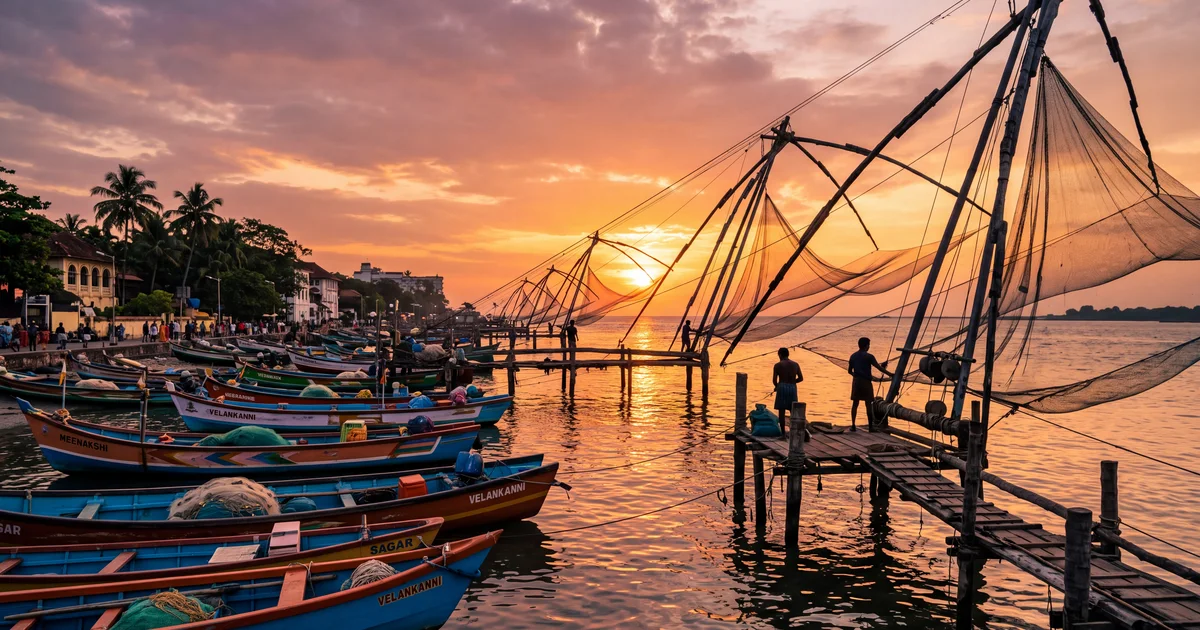
Kochi sits on a cluster of islands and peninsulas along Kerala's coast, where the Arabian Sea meets a web of backwater lagoons. The city has been a port for over 600 years. Arab, Chinese, Portuguese, Dutch, and British traders all passed through, and each left something behind. The Chinese left fishing nets that still line the Fort Kochi waterfront. The Portuguese left St Francis Church, where Vasco da Gama was buried in 1524 before his remains were shipped back to Lisbon. The Dutch left a synagogue that is still active. The British left a rail network and the Wellington Island naval base.
Places to visit in Kochi split across three zones. Fort Kochi and Mattancherry sit on a peninsula at the harbour mouth and hold the colonial and religious heritage. Ernakulam on the mainland is the commercial centre with Marine Drive, malls, and the metro. The backwaters start at the city's southern edges and stretch south toward Alleppey. Two days cover all three comfortably. Three days let you add Athirappilly Waterfalls or an Alleppey houseboat.
The city has roughly 2.1 million people. Cochin International Airport (COK) was the world's first fully solar powered airport when it switched in 2015. The Kochi Metro opened in 2017 and covers 25 km from Aluva to Pettah. Public ferries connect Ernakulam to Fort Kochi every 20 minutes for ₹6.
TL;DR
- Fort Kochi plus Mattancherry is a half day walk. Start at the Chinese fishing nets, end at the Jewish Synagogue.
- The Ernakulam to Fort Kochi ferry (₹6, 15 minutes) is better than driving. Park in Ernakulam.
- October to March is ideal. Monsoon brings 3,000 mm of rain and dismantled fishing nets.
- Budget ₹1,500 to ₹3,000 per person per day for stays, food, ferry rides, and entry fees.
- Eat appam and fish curry at least once. Then eat it again the next morning.
What Is the Best Way to See the Chinese Fishing Nets?
The Chinese fishing nets (cheena vala) stretch along the northern tip of Fort Kochi, facing the harbour. The cantilever nets are 10 metres wide, suspended from teak poles, and operated by a team of 4 to 6 fishermen who lower them into the water and raise them after a few minutes. The technique supposedly arrived from the court of Kublai Khan via Chinese traders in the 1300s.
There are about 10 active nets along a 500 metre stretch of the waterfront. The best time for photographs is between 5 PM and 6:30 PM when the sunset backlights the nets against the harbour. In the morning (6 AM to 8 AM), the fishermen operate the nets for the actual catch rather than for tourists, and you can buy fish directly from them.
Stalls behind the nets will cook your purchased fish on the spot: grilled, fried, or in a basic curry. The prices are marked up for tourists (₹400 to ₹600 for a plate that would cost ₹150 at a restaurant one street back). It is a fun experience once. For better seafood value, walk 200 metres inland.
The caveat: the nets are in poor repair. Several have been non functional for years, and the Kochi Corporation periodically announces restoration plans that move slowly. During monsoon (June to August), the rough seas force most nets to be dismantled entirely. If you visit in monsoon, expect fewer nets standing than photographs suggest.
How Do You Walk Fort Kochi to Mattancherry?
The walk from the Chinese fishing nets to the Jewish Synagogue in Mattancherry covers about 2.5 km and takes 2 to 3 hours with stops. This is the essential Kochi experience and does not require a guide or a vehicle.
Start at the Chinese fishing nets. Walk south along the waterfront for 5 minutes to reach St Francis Church, the oldest European church in India. The Portuguese built it in 1503. Vasco da Gama was buried here in 1524, and his tombstone is still inside (his remains were moved to Lisbon in 1539). The church was later Dutch Reformed, then Anglican. Entry is free. Ten minutes inside is enough.
Continue south along Church Road to the Santa Cruz Cathedral Basilica. The Portuguese originally built it in 1505, but the British demolished it and the current structure dates to 1905. The painted ceiling inside has nine large panels depicting scenes from Christ's life. Skip this if short on time, but the ceiling paintings are worth 10 minutes.
Turn east onto Princess Street (now officially Burgher Street). This is Fort Kochi's cafe and gallery lane. Dutch and Portuguese era warehouses have been converted into restaurants, boutique shops, and during Biennale years, art installations. The Kochi Muziris Biennale runs December to March in even numbered years and uses these buildings, old pepper godowns, and abandoned rice mills as exhibition spaces. Outside Biennale years, the street is quieter but still worth walking for the architecture and the coffee.
From Princess Street, continue southeast into Mattancherry. The neighbourhood transitions from colonial European to a mix of Gujarati merchant houses, Muslim quarter streets, and the Jewish quarter. The change happens gradually over 500 metres.
What Can You Actually See Inside Mattancherry Palace?
Mattancherry Palace (also called the Dutch Palace) sits on Palace Road, about 1.5 km southeast of the Chinese fishing nets. The Portuguese built it in 1555 and presented it to the Raja of Kochi. The Dutch renovated it in 1663. The name stuck.
The palace is worth visiting for one reason: the murals. The walls of the royal bedchambers and the coronation hall are covered with Hindu mythological paintings dating from the 1500s to the 1700s. The Ramayana cycle in the coronation hall runs across all four walls in vivid colour. The bedroom murals depict scenes from the Puranas, including some explicit erotic scenes that surprise visitors who expected a standard palace tour. The painting style is the Kerala mural tradition, characterized by bold outlines, flat colour planes, and expressive faces.
Entry is ₹5 for Indians. Photography is not allowed inside (this is enforced). The palace is open 10 AM to 5 PM, closed Fridays. Plan 45 minutes to 1 hour. The courtyard temple dedicated to the deity Pazhayannur Bhagavathy is accessible from inside the palace.
One thing to know: the palace has minimal signage. Without context, the murals are beautiful but confusing. Read up on the Ramayana scenes before you go, or you will spend most of the time trying to figure out which episode each panel depicts.
Is the Jewish Synagogue on Jew Town Road Worth the Entry Fee?
The Pardesi Synagogue on Jew Town Road in Mattancherry was built in 1568. It is one of the oldest active synagogues in the Commonwealth and the oldest in India. The Paradesi (foreign) Jewish community settled in Kochi in the 1500s, fleeing persecution in Spain and Portugal.
The floor is the first thing you notice. It is covered with 1,100 hand painted Chinese tiles, each one unique, imported from Canton in the mid 1700s. The ceiling has Belgian glass chandeliers. A copper plate grant from the local ruler (displayed inside) gave the Jewish community trading rights in the 10th century, making the Jewish presence in Kochi over 1,000 years old.
Entry is ₹5 for Indians, ₹10 for foreigners. Photography inside is prohibited. The synagogue is open 10 AM to 12 PM and 3 PM to 5 PM, closed Saturdays and Jewish holidays. Plan 20 to 30 minutes.
Jew Town Road itself is an antique and spice market lane. The spice shops sell cardamom, pepper, vanilla, and tea in bulk. Prices are fair compared to tourist shops elsewhere, but compare 2 or 3 stalls before buying. The antique shops (Gujarati merchant families have run several for generations) sell brass lamps, colonial furniture, and old maps, but bargaining is expected and starting prices are inflated.
The honest caveat: the Paradesi Jewish community in Kochi has dwindled to fewer than 10 members. The synagogue survives as a monument and a tourist attraction more than as an active religious centre. The last wedding in the community was years ago. It is a living end to a 1,000 year history, and that context makes the visit more affecting than the building alone would be.
What Is Marine Drive in Ernakulam Like?
Marine Drive is a 3 km waterfront promenade along the backwater lagoon in Ernakulam. The stretch runs from the Ernakulam Boat Jetty (where you catch the ferry to Fort Kochi) southward past the Subhash Bose Park area. The promenade has a paved walkway, benches, and views across the water to Willingdon Island and the Bolgatty Palace.
The best time is 5 PM to 7 PM when the heat drops and the sunset lights up the water. Weekday evenings are quieter. Weekend evenings draw families, joggers, and street food vendors. The area around the boat jetty has chai stalls and snack carts. Not much else to do beyond walk and look, but the 45 minutes of quiet waterfront time is a useful break after a day in Fort Kochi's heat.
Marine Drive is also the access point for the Ernakulam Boat Jetty ferries. If you are staying in Ernakulam and visiting Fort Kochi by ferry, you will pass through here anyway.
What Other Temples and Churches Are Worth Visiting?
Kochi's religious diversity is unusual for an Indian city its size. Within 5 km you move from the Portuguese churches of Fort Kochi to the Hindu temples of Ernakulam to the mosques of Mattancherry's Muslim quarter to the Jewish synagogue.
The Chottanikkara Bhagavathy Temple is 20 km east of Ernakulam. It is one of the most visited temples in Kerala, dedicated to the goddess Bhagavathy, and draws thousands of devotees daily. The temple is known for its evening ritual (Guruthi Pooja) and for devotees seeking cures for mental illness, a tradition that continues. If you visit one Hindu temple near Kochi, this is the one with the most cultural weight. Entry is free. Go early morning to avoid the queue.
The Thrikkakara Vamana Moorthy Temple in Edappally is significant because it is the mythological home of King Mahabali and the centre of Onam celebrations. The temple is small and can be combined with a trip to the Lulu Mall area (which is 2 km away, if malls are your thing).
The Basilica of Our Lady of Ransom in Vallarpadam is on an island connected by a bridge from the NH. The church is a minor basilica that draws Catholic pilgrims, especially during the Vallarpadam feast in September. The building is modern and large.
For mosques, the Cheraman Juma Masjid in Kodungallur (35 km north of Kochi) claims to be the oldest mosque in India, built in 629 AD by Malik Dinar, a companion of the Prophet. The current structure is rebuilt, but the site's historical claim is significant.
Is a Day Trip to Athirappilly Waterfalls Worth It From Kochi?
Athirappilly Waterfalls is 75 km east of Kochi, about 2 hours by road through the Thrissur district. The falls drop 24 metres across a wide rock face on the Chalakudy River. Athirappilly is the largest waterfall in Kerala and has been used as a filming location for several Bollywood and Malayalam movies (the Bahubali waterfall scenes were shot elsewhere, but Athirappilly stars in enough films that the comparison comes up constantly).
The falls are most impressive during and just after monsoon (June to October) when the river is at full volume. The width of the falls in full flow is about 100 metres. In the dry season (February to May), the volume drops and the falls split into several smaller streams.
Entry is ₹40 for Indians. The viewing area involves a 10 minute walk from the parking lot down steps to the base. A second viewpoint at the top is accessible via a separate path. Both are worth seeing. The base viewpoint is the more dramatic one.
Combine Athirappilly with Vazhachal Falls, 5 km further upstream. Vazhachal is smaller but the forest setting is denser and there are fewer visitors.
My take: if you have a spare day in Kochi and have already covered Fort Kochi and the backwaters, the Athirappilly drive is the best option. The road passes through rubber plantations and tropical forest. Leave by 7 AM to beat the tour bus crowds that arrive by 10 AM. The falls themselves take 1 to 1.5 hours. Budget the full day for the round trip.
How Do the Kochi Backwaters Work for a Short Visit?
The backwaters start at Kochi's southern edge and extend to Alleppey (Alappuzha, 55 km south) and beyond. For a short backwater experience without committing to an overnight Alleppey houseboat, you have several options from Kochi itself.
The public ferry from Ernakulam Boat Jetty to Fort Kochi (₹6, 15 minutes) is a backwater ride in miniature. The longer ferry to Vypin Island or to Cherai Beach gives you 30 to 45 minutes on the water for under ₹20.
For a proper backwater tour without leaving Kochi, private motorboat rides from Marine Drive or Fort Kochi last 2 to 3 hours and cost ₹1,500 to ₹3,000 per boat (not per person). These loop through the narrow canals south of the city, passing coconut groves, village houses, and toddy tappers.
For the full houseboat experience, Alleppey is the standard. A basic houseboat for 2 to 3 people starts at ₹6,000 for a day cruise (4 to 6 hours) or ₹8,000 for an overnight stay with meals. The overnight option is the iconic one: you cruise at sunset, anchor for the night, and the crew cooks Kerala fish curry on board. Book through aggregator platforms rather than at the jetty, where touts add commission.
The cheapest and arguably best option: the public Alleppey to Kottayam boat. It costs ₹30 per person, takes 2.5 hours, and passes through the same backwater channels the houseboats use. No food or luxury, but the scenery is identical.
Where Should You Stay in Kochi?
Fort Kochi has the heritage homestays and boutique hotels. Princess Street and the lanes around St Francis Church have the highest concentration. Expect ₹1,500 to ₹4,000 per night for a room in a converted Dutch or Portuguese house. The area is walkable and atmospheric. The downside: getting to Ernakulam or the airport requires a ferry plus auto or a long drive around the harbour.
Ernakulam (MG Road and Marine Drive area) has the business hotels, mid range chains, and metro access. Rooms run ₹1,000 to ₹3,000. Better connected to the airport (35 km) and train stations, but less character.
For most visitors spending 2 days: stay one night in Fort Kochi for the evening waterfront and one night in Ernakulam for the convenience. Or stay entirely in Fort Kochi if you are happy with the ferry commute.
How Do You Plan 2 Days in Kochi?
Day 1 (Fort Kochi and Mattancherry): Ferry from Ernakulam at 9 AM. Walk from the Chinese fishing nets south through St Francis Church, Princess Street, to Mattancherry Palace (1 hour inside). Continue to the Jewish Synagogue on Jew Town Road (30 minutes). Lunch at a Fort Kochi restaurant (appam and fish curry). Afternoon free for gallery browsing or cycling. Return to the waterfront by 5 PM for sunset at the fishing nets. Dinner in Fort Kochi.
Day 2 (Ernakulam and day trip): Morning at Marine Drive and the Hill Palace Museum in Tripunithura (10 km from Ernakulam, the largest archaeological museum in Kerala, entry ₹25). Afternoon options: Cherai Beach on Vypin Island (30 km, 1 hour), or Lulu Mall and Broadway Market in Ernakulam for spice shopping. If skipping the day trip, use the afternoon for the Chottanikkara Temple.
Day 3 (if available): Athirappilly Waterfalls (leave by 7 AM, back by 3 PM), or an Alleppey houseboat day cruise (leave by 8 AM, back by 6 PM).
How Do You Get to Kochi?
Cochin International Airport (COK) handles direct flights from Mumbai (1 hour 45 minutes), Delhi (2 hours 45 minutes), Bangalore (1 hour 15 minutes), Chennai (1 hour 20 minutes), and over 20 other domestic cities. International flights connect to Dubai, Singapore, Kuala Lumpur, and Doha. The airport is 30 km northeast of Fort Kochi.
By train, Ernakulam Junction and Ernakulam Town are the main stations. Trains from Bangalore take 11 to 12 hours (overnight), from Chennai 12 hours, and from Mumbai 24 hours. The stations are in central Ernakulam, walking distance from Marine Drive.
By road, Kochi connects to Munnar (4.5 hours, 130 km), Alleppey (1.5 hours, 55 km), and Thrissur (1.5 hours, 80 km). KSRTC buses run hourly on the major routes.
Within the city, the Kochi Metro covers Aluva to Pettah (25 km, ₹10 to ₹60). Public ferries connect Ernakulam, Fort Kochi, Mattancherry, and Vypin Island. Ola and Uber work well in Ernakulam but can be slower in Fort Kochi's narrow lanes.
For group trips and curated Kochi travel packages, compare departures on TripzSearch. If you are planning a larger Kerala circuit covering Kochi, Munnar, and Alleppey, browse trip options that handle transport, stays, and the houseboat booking.
Frequently asked questions
- What are the top 5 must visit places in Kochi?
- Fort Kochi for the Chinese fishing nets and colonial streets, Mattancherry Palace for the Hindu murals from the 1500s, the Jewish Synagogue on Jew Town Road for one of the oldest active synagogues in the Commonwealth, Marine Drive promenade for an evening walk along the backwaters, and a houseboat or public ferry to Vypin Island. These five cover Kochi's colonial history, religious diversity, and waterfront life in one packed day.
- How many days are enough for Kochi?
- Two days cover Fort Kochi, Mattancherry, Ernakulam, and a backwater trip comfortably. Add a third day for the Athirappilly Waterfalls day trip (75 km, 2 hours each way) or a full day Alleppey houseboat. Most visitors from Bangalore or Mumbai come for a long weekend and that works well without feeling rushed.
- What is the best time to visit Kochi?
- October to March offers 25°C to 32°C weather with low humidity and dry skies. The Kochi Muziris Biennale (December to March, every two years) turns Fort Kochi into a contemporary art gallery. April to May gets hot and sticky above 35°C. Monsoon (June to September) brings heavy rain, 3,000 mm across the season, and the Chinese fishing nets are often dismantled during rough sea days.
- How do I get around Kochi without a car?
- The Kochi Metro runs from Aluva to Pettah (25 km) and covers Ernakulam well. For Fort Kochi and Mattancherry, take the public ferry from Ernakulam Boat Jetty (₹6, runs every 20 minutes, 15 minute crossing). Auto rickshaws and Ola/Uber work across the city. Fort Kochi itself is small enough to walk or rent a bicycle (₹150 per day from shops on Princess Street).
- Is Fort Kochi worth visiting or just overhyped?
- Fort Kochi is worth a half day minimum. The Chinese fishing nets on the waterfront are photogenic but take 10 minutes. The real draw is the 2 km walk from the nets through St Francis Church, the Dutch Cemetery, Princess Street with its cafes in converted warehouses, and on to Mattancherry Palace and the Jewish Synagogue. During the Kochi Biennale years, the warehouses and pepper godowns become art galleries. Outside Biennale years, it is quieter and more of a heritage walk than an art destination.
- What food should I try in Kochi?
- Kerala fish curry with appam (rice pancakes) at any Fort Kochi restaurant. Toddy shop lunch for cheap fish fry, karimeen (pearl spot), and tapioca with fish curry. Puttu and kadala curry for breakfast. Malabar biryani at a local Muslim eatery in Mattancherry. For seafood, the stalls near the Chinese fishing nets cook the fresh catch on the spot, but the tourist markup is 2x to 3x. Better value at restaurants a street back.
- Can I do Alleppey houseboats as a day trip from Kochi?
- Alleppey (Alappuzha) is 55 km south of Kochi, about 1.5 hours by road. A full day houseboat starts around ₹6,000 for a basic boat (2 to 3 people). The standard is an overnight cruise, but 4 to 6 hour day cruises exist for ₹3,000 to ₹4,000. You can also take the public boat from Alleppey to Kottayam (₹30, 2.5 hours) for the same backwater scenery at a fraction of the price. Book ahead in December and January when availability is tight.