Best Places to Visit in Kanyakumari (2026): Where Three Seas Meet
15 best places to visit in Kanyakumari in 2026, from Vivekananda Rock to Padmanabhapuram Palace, with honest tips and what to skip.
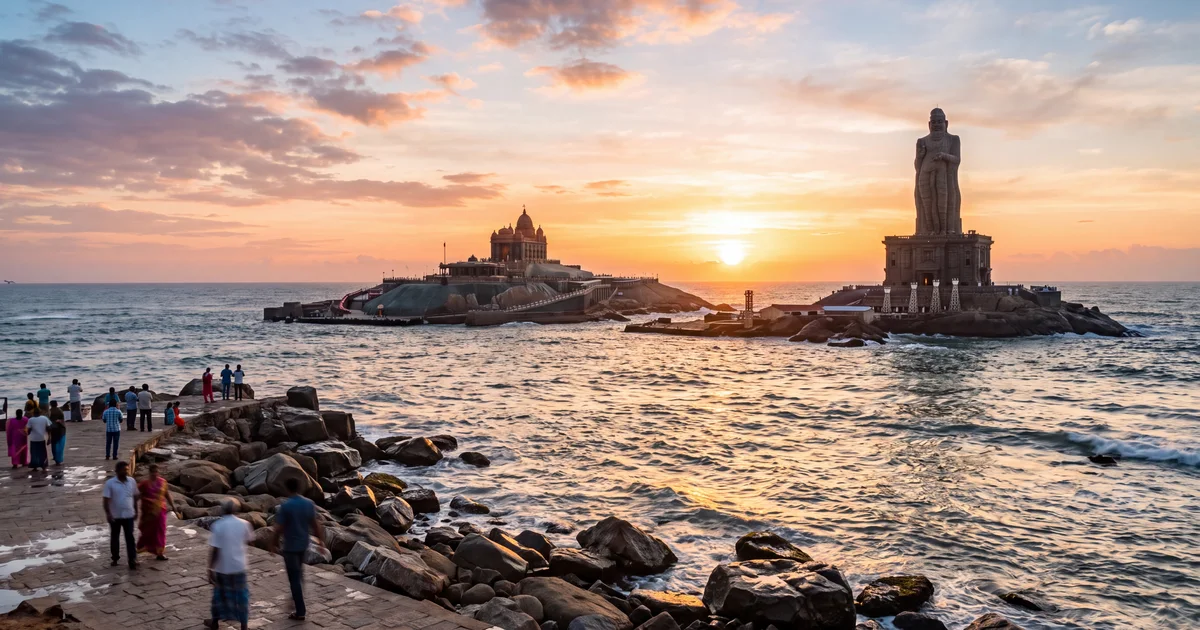
Kanyakumari sits at the very bottom of the Indian peninsula, at the exact point where the Arabian Sea, the Bay of Bengal, and the Indian Ocean meet. It is 90 km from Trivandrum, about 700 km from Bangalore, and occupies a space in Indian geography that most people know from school textbooks but have never actually visited.
The town itself is small. You can walk the entire seafront in 20 minutes. Most visitors come for the sunrise, visit Vivekananda Rock, buy a few seashell souvenirs, and leave by afternoon. That is a mistake. The district around Kanyakumari has one of the oldest palaces in South India, an aqueduct taller than most apartment buildings, waterfalls that run full between October and January, and coastal stretches where you will not see another tourist.
This guide covers the places worth your time in 2026, with real distances, timings, and honest notes on what to skip.
TL;DR
- Vivekananda Rock Memorial and Thiruvalluvar Statue are the two must visits. Book the ferry early (before 9 AM) to avoid 90 minute queues.
- Padmanabhapuram Palace, 55 km away, is one of South India's best heritage buildings. Do not miss it.
- Best time: October to March. The ferry shuts down in rough monsoon seas.
- Budget: 1,000 to 2,500 per day per person depending on hotel tier.
- Two full days is the minimum. Three if you want to cover the waterfalls and off route beaches.
What Are the Must Visit Places in Kanyakumari Town?
The town clusters around the seafront, and you can cover the core sights in a single day on foot plus one ferry ride.
Vivekananda Rock Memorial sits on a rocky islet about 500 metres offshore. Swami Vivekananda reportedly meditated here in December 1892 before his famous Chicago address. The memorial building was completed in 1970. You reach it by a government ferry that departs every 30 minutes from the mainland jetty. The ride takes 10 minutes. Peak season queues (December and January) can stretch beyond an hour, so aim for the first ferry at 8 AM. Entry is 20 rupees for the ferry and 20 for the memorial. The meditation hall inside is quiet, which is surprising given the tourist volume.
The Thiruvalluvar Statue stands on the adjacent rock, a 133 foot stone figure of the Tamil poet Thiruvalluvar. You access it from the same ferry. The statue is visible from anywhere on the seafront, but up close the scale registers differently. The pedestal alone is 38 feet tall.
One honest caveat: the ferry stops running when the sea gets rough. This happens frequently between June and September and occasionally in October. If the ferry is cancelled, you lose both these sights. Check with the jetty office (or any hotel) the evening before.
Kanyakumari Bhagavathy Amman Temple is right on the seafront, one of the 51 Shakti Peethas. Non Hindus can enter the outer courtyard but not the inner sanctum. The temple is old, busy, and architecturally modest compared to the larger Tamil Nadu temples. The real draw is the location: the sea is literally at the back wall.
Gandhi Memorial (Mahatma Gandhi Memorial Mandapam) is a 200 metre walk east along the seafront. It is built so that on Gandhi's birthday (October 2nd), sunlight falls directly on the spot where his ashes were kept before immersion. The architecture is deliberately simple. Worth 15 minutes.
Is the Sunrise at Kanyakumari Really Worth Waking Up For?
Short answer: yes, but with conditions.
The sunrise viewpoint is at the eastern end of the seafront, near the Gandhi Memorial. During October to March, the sun rises around 6:15 AM to 6:30 AM and the light hitting the water where three seas merge creates a colour gradient you do not get at a single ocean shore. Reds, oranges, and the dark blue of deeper water all sit in one frame.
The catch is cloud cover. Kanyakumari mornings are clear about 60% of the time in winter. If you see thick clouds on the eastern horizon at 5:45 AM, manage your expectations. Hotels along the seafront (Sparsa, Hotel Tamil Nadu) have rooftop access that gives a better angle than the ground level crowd.
During April full moon nights, locals claim you can watch the sunset and moonrise simultaneously from the same spot. This is technically possible because of the peninsula's geometry. In practice, clouds intervene more often than not.
Sunset is underrated here. Most tourists leave after the sunrise. The evening crowd is thinner, and the sun dropping into the Arabian Sea side while the sky shifts colour over the Bay of Bengal side is worth staying for.
One opinion: skip the "sunrise point" selfie crowd at ground level. Walk 5 minutes south along the rocks near the temple backwall. Fewer people, same view, better photos.
What to See Outside Kanyakumari Town (Within 60 km)
The district around Kanyakumari holds more interesting places than the town itself. You need a car or a hired auto for these.
Padmanabhapuram Palace is 55 km northwest, in a village called Thuckalay. It is the former seat of the Travancore kings and one of the largest wooden palaces in Asia. The carved rosewood ceilings in the council chamber alone justify the trip. The palace complex covers 6 acres with multiple buildings dating from the 14th to 18th century. Entry is 50 rupees; a guide (around 300 rupees) is worth hiring because the architecture details are easy to miss. The palace is closed on Mondays.
This is one of the best heritage buildings in South India. Most Kanyakumari tourists skip it because it requires a detour. That is their loss.
Mathoor Aqueduct (Mathoor Hanging Trough) is 70 km north. Built in 1966, it carries water across the Pahrali river valley at a height of 115 feet, making it one of the tallest aqueducts in Asia. The structure is not architecturally beautiful in a classical sense, but the engineering scale and the surrounding countryside make it a worthwhile stop. Early morning visits get the best light. There is no entry fee.
Thirparappu Falls is 55 km from town, near Pechiparai. The falls are about 50 feet high and flow strongest between October and January. By March the flow reduces to a trickle. There is a small Shiva temple at the base. Swimming is technically allowed in the pool below the falls, but the rocks are slippery and the current can be strong after heavy rain. Go before 10 AM to avoid weekend crowds from Nagercoil.
Sothavilai Beach is just 8 km west of Kanyakumari town. It is the beach that Kanyakumari should be known for but is not, because the town seafront is not really a beach. Sothavilai has clean sand, palm trees, a lighthouse, and almost no commercial activity. Swimming is safe most of the year except during monsoon. A small fishing village sits at the southern end.
Where to Stay and How to Get Around
Kanyakumari town has accommodation ranging from 800 rupee lodges to 5,000 rupee seafront hotels. The two notable properties are Hotel Sparsa (sea facing rooms, rooftop breakfast with the sunrise view) and the TTDC Hotel Tamil Nadu (government run, basic but clean, prime seafront location). Budget travellers find decent options on the streets behind the bus stand.
Getting there from Bangalore means either a flight to Trivandrum (1 hour 20 minutes) plus a 90 minute drive, or the direct road route (12 to 14 hours via Madurai or Salem). From Chennai, the overnight Kanyakumari Express takes about 14 hours.
Within Kanyakumari, autos are the default. There is no Ola or Uber. Negotiate before you sit. A full day auto hire runs 1,200 to 1,500 rupees and covers the town plus nearby sights like Sothavilai and Muttom. For Padmanabhapuram and Thirparappu, hire a cab (2,500 to 3,000 for the day round trip).
One caveat about the town itself: it is a pilgrimage destination first and a tourist town second. Restaurants close early (by 9:30 PM), alcohol is not widely available, and nightlife does not exist. If you want beach town vibes, Kovalam is 80 km north.
How Does Kanyakumari Compare to Other South India Coastal Towns?
Kanyakumari is not a beach holiday destination. Comparing it to Goa or Pondicherry misses the point. You come here for the geographical significance, the sunrise, the heritage, and the quiet.
It sits closer in spirit to Rameswaram: a temple town at a dramatic coastal point with limited commercial tourism infrastructure. The difference is that Kanyakumari's surroundings (Padmanabhapuram Palace, the Western Ghats foothills, the Muttom fishing harbour) offer more variety than Rameswaram's flat island.
For travellers flying into Trivandrum, a 2 night Kanyakumari stop pairs well with Kovalam and Trivandrum's museums. From Bangalore, consider a longer Southern Tamil Nadu loop: Madurai (2 nights), Rameswaram (1 night), Kanyakumari (2 nights), Trivandrum (1 night). That is a proper week trip.
Browse group trips and destinations across India to see what fits your dates.
Practical Tips Before You Go
The ferry to Vivekananda Rock runs from 8 AM to 4 PM. Last entry is 4 PM but this shifts seasonally. Do not plan the ferry as your last activity of the day.
Carry cash. Many shops, smaller hotels, and auto drivers do not accept UPI consistently. The nearest ATMs are near the bus stand.
The seafront gets windy in the evenings, especially between November and February. Carry a light jacket if you plan to watch the sunset.
Photography is restricted inside Padmanabhapuram Palace (no flash, no tripods). Phone cameras are allowed.
If you are coming from Bangalore or planning a multi stop South India trip, check current trip options for group departures that handle transport and stays. Solo planning is easy too, since Kanyakumari is well connected by train and bus from all major Tamil Nadu cities.
Frequently asked questions
- How many days are enough for Kanyakumari?
- Two full days cover the main sights comfortably. Day one for Vivekananda Rock Memorial, Thiruvalluvar Statue, the sunrise viewpoint, and the seafront temples. Day two for Padmanabhapuram Palace, Mathoor Aqueduct, and Thirparappu Falls. If you add Sothavilai beach and Muttom, stretch to three days.
- What is the best time to visit Kanyakumari?
- October to March is the best window. Temperatures sit between 24°C and 32°C, humidity drops compared to summer, and the sea stays calm enough for the ferry to Vivekananda Rock to run consistently. April and May get hot. June to September brings monsoon rain that can shut down the ferry for days at a stretch.
- Is Kanyakumari worth visiting from Bangalore?
- It is a long trip. Bangalore to Kanyakumari is about 700 km by road (12 to 14 hours) or a flight to Trivandrum plus a 90 minute drive. For a weekend, it feels rushed. Combine it with Trivandrum or Kovalam for 3 to 4 days and the distance makes more sense. From Chennai, the overnight train (about 14 hours) is a common option.
- Can you see both sunrise and sunset from Kanyakumari?
- Yes, and that is one of the few places in India where you can. The sunrise viewpoint is at the eastern end of the seafront near the Gandhi Memorial. Sunset is visible from the same stretch looking west. During April full moon, you can reportedly see the moonrise and sunset simultaneously, though cloud cover makes this unreliable.
- What should I skip in Kanyakumari?
- The wax museum and 3D art gallery near the town centre are overpriced tourist traps with poor maintenance. The baywatch amusement park is dated and not worth the entry fee. The commercial boat rides (other than the ferry to Vivekananda Rock) are short, expensive, and add nothing to the experience.
- Is Kanyakumari safe for solo travellers?
- Kanyakumari is generally safe. It is a pilgrimage town so the crowd is mostly families and religious tourists. The seafront is well lit and busy until late evening. Auto rickshaws are the main transport; negotiate fares before boarding since meters are rare. Solo women travellers report feeling comfortable here compared to larger cities.