Best Places to Visit in Hyderabad (2026): Charminar, Hussain Sagar and the Biryani Trail
22 best places to visit in Hyderabad in 2026 with timing tips, entry costs, and what the guides usually skip.
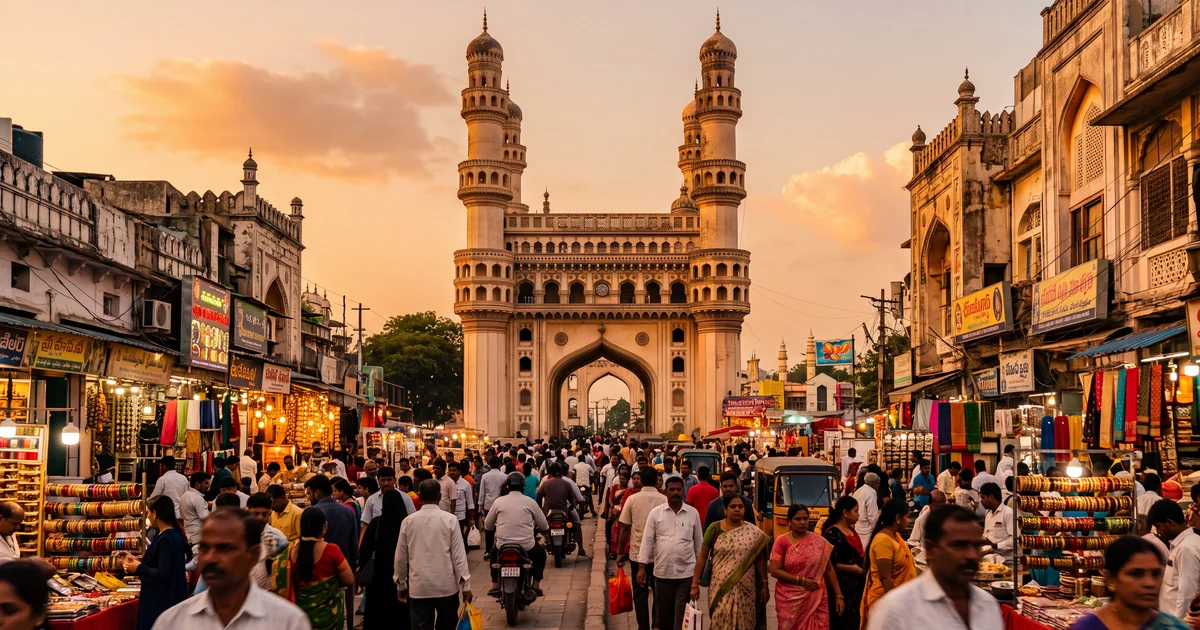
Hyderabad is a city that runs on two clocks. The Old City around Charminar operates at the pace of 1591, when Muhammad Quli Qutb Shah built the four minarets to mark the end of a plague. Cross the Musi River north and you hit Banjara Hills, HITEC City, and the glass towers where half the country's IT services contracts get signed. Most travel guides treat these as separate itineraries. They are not. The distance between Charminar and Cyber Towers is 16 km. You can do both before lunch.
I spent four days in Hyderabad in February 2026 and ate biryani at seven different places (not by plan, it just kept happening). The city is easier to navigate than it looks on a map, the metro covers the key tourist stretches, and the cost of everything from entry tickets to meals sits well below what you pay in Bangalore, Mumbai, or Delhi. Here is what is worth your time and what is not.
TL;DR
- Charminar, Golconda Fort, Hussain Sagar, and Salar Jung Museum are the non negotiable four. Three days covers them.
- October to February is the best window. Summer crosses 40°C by April.
- Budget ₹1,500 to ₹3,500 per person per day for stays, food, and local transport.
- The Hyderabad Metro connects the airport, Old City, and HITEC City. Use it.
- Eat biryani at least twice. Paradise for Kachchi, Bawarchi for Pakki. The debate is real.
What Makes Charminar More Than a Photo Stop?
Charminar was built in 1591 from granite and lime mortar. Four minarets, each 48.7 metres tall, rise from arches that face the four cardinal directions. The mosque on the top floor still holds Friday prayers. Entry costs ₹25 for Indian nationals and the ticket counter opens at 9:30 AM.
Most visitors photograph the structure from the road and leave within ten minutes. That is a mistake. Climb the 149 steps inside the south western minaret (the only one open to visitors). The spiral staircase is narrow, about 60 cm wide in places, and the last stretch is steep enough to make you question your breakfast choices. At the top, the Old City spreads below in every direction. You can see Mecca Masjid 100 metres south, the Laad Bazaar stretching west, and the Charminar's own shadow cutting across the intersection at the right time of morning.
The area around Charminar is where you spend your time. Laad Bazaar runs 200 metres west, selling lac bangles in colours that do not exist in nature. Each shop has a craftsman heating and shaping bangles at the back. A set costs ₹100 to ₹2,000 depending on material and design. Pathergatti Road, running east from Charminar, sells pearls. Hyderabad has been a pearl trading centre since the Qutb Shahi era. Freshwater cultured pearls start at ₹500 for a basic strand.
The caveat: the intersection around Charminar is traffic chaos during the afternoon. Autos, bikes, and pedestrians compete for the same 30 metres of road. Visit before 10 AM or after 5 PM when the light is also better for photographs. Friday afternoons are especially crowded because of prayers at Mecca Masjid.
Is Golconda Fort Worth the 3 km Walk?
Golconda sits 9 km west of Charminar on a 120 metre granite hill. It started as a mud fort in the 13th century under the Kakatiyas, expanded under the Bahmani Sultanate, and reached its current form under the Qutb Shahi dynasty between 1518 and 1687. The fort complex covers 5 km of outer wall with 87 bastions and 8 gates. It could house 10,000 people during a siege.
The acoustics trick is real. Clap your hands under the entrance dome at the Fateh Darwaza (Victory Gate) and the sound carries to the Bala Hissar pavilion at the summit, 1 km away and 120 metres higher. This was the alert system. Guards at the top could hear a warning clap from the gate. Test it with a friend at the top. It works.
The climb from the main entrance to the Bala Hissar takes 30 to 40 minutes on the paved path. Bring water. There is one chaiwalla halfway up and nothing after that. The summit gives you a 360 degree view of Hyderabad. On clear winter mornings you can pick out Charminar, Hussain Sagar, and the HITEC City skyline from a single spot.
Entry costs ₹15 for Indian nationals, ₹200 for foreign tourists. The sound and light show runs at 6:30 PM (English) and 7:30 PM (Hindi/Telugu) on weekdays, ₹130 per ticket. It covers 400 years of Golconda history in 50 minutes. The narration is dramatic enough to keep you awake, which is not always guaranteed with heritage sound and light shows.
Go early. The fort opens at 8 AM. By 10:30 AM the granite absorbs enough heat to make the climb uncomfortable. If you are exploring trips from Hyderabad, Golconda is the one spot that earns its "half day" allocation.
Hussain Sagar: The Lake at the Centre of the City
Hussain Sagar is an artificial lake built in 1563 under Ibrahim Quli Qutb Shah. It measures 5.7 km across and separates the twin cities of Hyderabad and Secunderabad. The centrepiece is a 17.5 metre, 350 tonne monolithic Buddha statue installed on Rock of Gibraltar island in 1992. Getting there costs ₹75 for the boat from Lumbini Park.
The lake itself is not for swimming. Pollution levels make that a bad idea. But the 3 km Tank Bund road running along the eastern shore is one of the better evening walks in any Indian city. Thirty three statues of notable figures from Andhra Pradesh and Telangana line the road, each with a plaque worth reading if you want compressed local history.
Lumbini Park on the south eastern shore has a laser show at 7:15 PM (₹50). It is a decent 20 minute display, better than most municipal equivalents. Necklace Road on the western shore has restaurants and cafes. Eat N Enjoy and Ohri's have been there for decades.
One thing to know: the lakefront gets genuinely crowded on weekends and public holidays. The boat queue at Lumbini Park can cross 45 minutes on a Sunday. Weekday evenings are better. The sunset behind the Buddha statue, with the HITEC City skyline to its right, is one of those views that actually looks like the postcard.
Salar Jung Museum: 43,000 Objects, One Afternoon
Salar Jung Museum sits on the south bank of the Musi River, a 10 minute auto ride from Charminar. The collection was built over three generations by the Salar Jung family, who served as Prime Ministers to the Nizams. The museum opened as a public institution in 1951. It holds 43,000 objects spanning 38 galleries.
The highlights: a Veiled Rebecca marble sculpture by Giovanni Maria Benzoni (1863) where the marble veil looks translucent, a Mughal jade dagger with a horse head handle, a 300 year old Quran written in microscopic script, and the Musical Clock from 1860 England where a wooden figure strikes a gong every hour. If you are there at noon, the clock draws a crowd of 200+ in the gallery. Position yourself early.
The museum charges ₹20 for Indian nationals and opens at 10 AM. Closed on Fridays. Plan 2.5 to 3 hours. Most galleries are well lit and air conditioned, which matters when it is 38°C outside. The European paintings gallery has 6 works attributed to Ravi Varma and an unexpected collection of Japanese metalwork in the Eastern Art wing.
My take: this museum competes with the National Museum in Delhi for breadth. The difference is that one family assembled it, which gives the collection a personal, eccentric quality. There is a section of ivory carvings, a room of 200+ ornamental weapons, and a jade collection that came from Mughal courts. It feels curated rather than institutional.
What Should You Eat Besides the Obvious Biryani?
Yes, you will eat biryani. Multiple times. The two reference points are Paradise (the Secunderabad original, not the branches) for Kachchi Dum biryani, where the raw marinated meat cooks with the rice in sealed pots, and Bawarchi (RTC X Roads) for the richer, spicier Pakki style. A plate costs ₹250 to ₹350 at either. The lines at Paradise on weekends start at 12:30 PM and do not clear until 2 PM. Go at 11:30 or after 3 PM.
But Hyderabad's food runs deeper than rice and meat. Irani cafes (there are about 40 left, down from over 400 in the 1950s) serve chai in glass tumblers with Osmania biscuits, a crumbly, slightly salty cookie that exists only in this city. Nimrah Cafe near Charminar opens at 5 AM. The chai costs ₹15. The biscuit costs ₹10. The experience of sitting on wooden benches while the Old City wakes up costs nothing.
Haleem peaks during Ramadan but several places serve it year round. Pista House on Road No. 1 near Charminar has built an industry around it. The dish is wheat, barley, meat, and ghee, slow cooked for 12 hours into a paste that sits heavier than you expect. One bowl (₹150 to ₹250) is a meal. Do not order biryani alongside. I made that error.
For kebabs, Shah Ghouse near Tolichowki serves Band Murg (whole chicken stuffed and roasted) and Pathar ka Gosht (meat cooked on a heated stone slab). The stone cooking predates modern teppanyaki by several centuries. Expect ₹400 to ₹600 per dish.
The Qutb Shahi Tombs: Quieter Than Golconda, Better Preserved
The Qutb Shahi Tombs complex sits 800 metres north of Golconda Fort. Seven of the eight Qutb Shahi rulers are buried here in domed granite tombs set within a Persian garden. The Aga Khan Trust for Culture completed a 10 year restoration in 2023, and the result is visible. Lawns are manicured, water channels flow again, and the dome stonework has been cleaned of 400 years of lichen.
Sultan Muhammad Quli Qutb Shah's tomb (the Charminar builder) is the largest, with a dome reaching 15 metres. The smaller tombs around it range from simple platforms to elaborate multi storey structures. The complex also holds a working mosque, a mortuary bath, and a garden of 80+ rare tree species restored from historical records.
Entry costs ₹25. The complex is open from 9:30 AM to 4:30 PM. Visitor numbers are a fraction of Golconda's. On a Wednesday morning in February, I counted 14 other people in the entire complex. This is one of the most significant Deccan heritage sites in India and it remains undertouristed.
The honest caveat: the information boards are sparse. Without context, the tombs look like similar domed buildings repeated eight times. Read the entry pamphlet or do 10 minutes of reading beforehand. The architecture details (the Hindu lotus motifs on Islamic tombs, the Persian four garden layout adapted for the Deccan climate) become interesting once you know what to look for.
How Does the Hyderabad Metro Help With Sightseeing?
The Hyderabad Metro has three lines covering 69 km and 57 stations. The Blue Line (Nagole to Raidurg) connects the Old City area to HITEC City. The Red Line (Miyapur to LB Nagar) crosses the Blue at Ameerpet, the busiest interchange. The Green Line runs from JBS to MGBS.
For tourists, the key stations are: MG Bus Station (MGBS) for Charminar and the Old City (1.5 km walk or auto from the station), Nampally for the state museum, Lakdi ka Pul for Hussain Sagar's south shore, and Raidurg for HITEC City and Shilparamam.
A single trip costs ₹10 to ₹60 depending on distance. The Tourist Day Pass costs ₹120 for unlimited rides. Trains run from 6 AM to 11 PM at 5 to 8 minute intervals. The stations are air conditioned and cleaner than most Indian metro systems. The Ameerpet interchange, where lines cross, is where you wait longest (8 to 12 minutes for a transfer during off peak).
The metro does not reach the airport directly yet, though the extension is under construction. Currently, the airport is connected by TSRTC Pushpak buses (₹250, every 20 minutes from multiple city points) and by cabs (₹600 to ₹800 via Ola/Rapido for the 24 km trip).
Ramoji Film City: Is It Worth Half a Day?
Ramoji Film City covers 674 hectares, making it the largest integrated film studio complex in the world (Guinness certified). It sits 28 km east of the city centre. The basic entry ticket costs ₹1,500 for adults and includes a guided bus tour, 3 to 4 indoor attractions, and a garden walk.
The guided tour covers sets from Telugu, Hindi, and regional film productions. You see a Japanese garden, a London street facade, a Mughal palace set, and an airport terminal set within 2 hours. Some of these are genuinely impressive in scale. The London set has 40+ building facades that look real until you walk behind them. Others feel like a theme park past its fresh years.
Who should go: families with children (the bird park and adventure zone keep kids occupied), film enthusiasts curious about set construction, and anyone with half a day they need to fill. Who should skip: anyone expecting a working studio tour (active shoots are cordoned off and you see nothing of the actual production process), or anyone on a tight 2 day itinerary. Your time is better spent at Golconda and the Old City.
The honest take: Ramoji is fun for what it is, but it competes with Charminar, Golconda, and the Salar Jung Museum for your limited time. If you have three days, skip Ramoji. If you have five, add it on day four.
The Old City After Dark: Pathergatti and Mozamjahi Market
The Old City around Charminar does not shut down after sunset. It wakes up. Pathergatti Road, running east from the monument, lights up with pearl shops, perfume (attar) stalls, and street food vendors. The attar shops sell traditional Hyderabadi perfumes in small glass bottles. A 10 ml bottle of musk or rose attar costs ₹150 to ₹500. The shopkeepers will dab samples on your wrist until you run out of forearm space.
Mozamjahi Market (1935, built in the Art Deco style during the Nizam era) sits 1.5 km northwest of Charminar. It was recently restored and reopened. The ground floor has fruit and vegetable stalls, the upper floor is being repurposed for local brands. The building itself, with its clock tower and arched colonnades, is worth the walk.
For dinner in the Old City, Hotel Shadab on High Court Road serves biryani, kebabs, and Hyderabadi desserts until 11 PM. The double ka meetha (bread pudding with condensed milk, saffron, and dry fruits) is the dessert to try. It costs ₹80 to ₹120 per portion.
Walk the Old City at night only on the main roads (Pathergatti, High Court Road, Madina Circle). The side lanes are narrow and not well lit. Autos are available at Charminar circle through the night, and Rapido bikes take 5 to 8 minutes to arrive in this area.
Birla Mandir and the View You Did Not Expect
Birla Mandir (1976) sits on a 85 metre hill called Naubath Pahad, overlooking Hussain Sagar Lake to the north and the Legislative Assembly to the south. Built entirely from white Rajasthani marble, the temple is dedicated to Lord Venkateshwara but incorporates symbols from multiple religions in its architecture. Entry is free. Shoes go in a locker at the base.
The temple itself is worth 20 minutes. The carved marble work on the ceiling took 10 years to complete. But you come here for the terrace. The 360 degree view covers Hussain Sagar, Tank Bund, the Old City skyline with Charminar visible on clear days, and the Secretariat buildings. At sunset, the lake catches copper and orange light.
The climb from the base takes 10 minutes on well maintained steps. An auto from Lakdi ka Pul metro station costs ₹30 to ₹50. Visit between 4 PM and 6 PM: the marble stays cool after the daytime heat fades, and the sunset timing aligns with the terrace view.
Skip the midday visit. The marble absorbs heat and the open terrace at 42°C in April is not a spiritual experience.
Chowmahalla Palace: The Nizam's Residence That Still Has the Cars
Chowmahalla Palace was the seat of the Asaf Jahi dynasty (the Nizams of Hyderabad) from 1750 to 1869. The complex spans two courtyards, four palaces, and a clock tower modelled on the Shah's palace in Tehran. Entry costs ₹80 for Indian nationals. It is open from 10 AM to 5 PM, closed on Fridays.
The Khilwat Mubarak (the Durbar Hall) is the centrepiece. Its ceiling rises 15 metres, with 19 Belgian crystal chandeliers still hanging from the original hooks. The throne platform at the far end once held the Nizam's golden throne, now in a bank vault. The hall still hosts occasional government ceremonies.
In the southern courtyard, the vintage car collection includes a 1911 Rolls Royce Silver Ghost, a 1937 Buick, and a yellow Packard Convertible that was the seventh Nizam's personal car. Nine cars total, each with a placard. The Rolls Royce alone draws crowds on weekends.
What makes Chowmahalla different from other palace museums: it feels inhabited. The furniture, the clocks, the wardrobe collections in the side galleries, these are not reconstructions. They are the Nizam's actual possessions, maintained in situ by the family trust. The last Nizam, Mukarram Jah, sold the palace to the state government in 2000, and the restoration has been careful.
Combine Chowmahalla with Charminar (500 metres apart) and the Salar Jung Museum (1 km east) for a full day in the Old City. Start at Chowmahalla when it opens at 10 AM, walk to Charminar by 12:30, eat at Nimrah or Shadab, then finish at Salar Jung by 2 PM.
Where to Stay: Old City vs Banjara Hills vs HITEC City
Three areas make sense depending on what you prioritize.
The Old City (near Charminar) puts you walking distance from Charminar, Chowmahalla, Mecca Masjid, and Laad Bazaar. Hotels here are budget to mid range: ₹1,000 to ₹2,500 per night. The food is the city's best and cheapest. The downside is traffic congestion, limited nightlife, and auto dependency for anything west of the Musi River.
Banjara Hills and Jubilee Hills are the upscale middle ground. Hotels and serviced apartments run ₹2,500 to ₹6,000 per night. Restaurants, bars, and cafes cluster on Road Nos. 1 through 14. You are 6 km from Hussain Sagar, 10 km from Charminar, and 8 km from HITEC City. The Jubilee Hills metro station is 1 km from most hotels.
HITEC City makes sense if you are visiting on work and want modern amenities. Novotel, Westin, and Sheraton are all here. Rates run ₹4,000 to ₹8,000. The area has malls (Inorbit, Next Galleria) and restaurants but no heritage. Commute to Charminar is 14 km, about 45 minutes by metro or 60+ minutes by road during peak hours.
For a first visit focused on sightseeing, stay in Banjara Hills. The location splits the difference between the Old City and the modern west, and the group trips from Hyderabad usually start pickups from this area.
Day Trip: Nagarjuna Sagar and the World's Tallest Masonry Dam
Nagarjuna Sagar sits 150 km southeast of Hyderabad. The dam across the Krishna River, completed in 1967, is 124 metres tall and 1.6 km long. The reservoir behind it is one of the largest in India. The island in the middle of the reservoir holds Nagarjunakonda, an archaeological site with Buddhist ruins dating to the 2nd century CE. A boat (₹100, 30 minutes each way) takes you there.
The museum on the island has stone sculptures, coins, and structural remains relocated from the valley floor before it was submerged. It is a small museum (45 minutes to walk through) but the setting, on an island surrounded by 400 year old submerged history, adds weight.
The drive takes 3 to 3.5 hours each way. Leave by 6:30 AM to catch the first boat at 9:30 AM. The last boat back is at 3:30 PM. Pack lunch; the island has one small canteen. The TSRTC runs a daily bus from MGBS bus station (₹350, 4 hours), but driving gives you flexibility on timing.
Only go if you have a fifth day. It is not worth it on a three day trip. The dam is impressive during the monsoon release season (August to October) when the spillway gates open and the water volume is visible from kilometres away.
Quick List: What Each Spot Costs and How Long It Takes
Charminar: ₹25 entry, 1 to 1.5 hours (add 2 hours for Laad Bazaar shopping). Golconda Fort: ₹15 entry, 2.5 to 3 hours including the climb. Salar Jung Museum: ₹20, 2.5 to 3 hours. Hussain Sagar boat ride: ₹75, 30 minutes. Chowmahalla Palace: ₹80, 1 to 1.5 hours. Qutb Shahi Tombs: ₹25, 1 to 1.5 hours. Birla Mandir: free, 45 minutes. Ramoji Film City: ₹1,500, half day.
Total entry cost for all heritage sites (excluding Ramoji): under ₹250. Hyderabad is absurdly affordable for what you get.
If you are comparing destinations across India or looking at group travel options, Hyderabad consistently ranks among the most value for money cities. Three days here costs less than two days in Goa or Jaipur, and the depth of history, food, and architecture is at least equal.
The city does not market itself as aggressively as Rajasthan or Kerala. That is partly why it remains underpriced, uncrowded at most sites, and worth putting on the 2026 list.
Frequently asked questions
- What are the top 5 must visit places in Hyderabad?
- Charminar for the 430 year old monument and surrounding bangle market, Golconda Fort for the acoustics hall and sunset views, Hussain Sagar Lake for the 18 metre Buddha statue and evening boat ride, Ramoji Film City if you have half a day to spare, and Salar Jung Museum for one of the largest single owner collections in the world. These five cover history, water, architecture, and entertainment without needing more than three full days.
- How many days are enough for Hyderabad?
- Three to four days cover the Old City, the western heritage circuit, and the modern side comfortably. Add a fifth day if you want Ramoji Film City or a day trip to Nagarjuna Sagar. Most people underestimate the Old City because they allocate only an afternoon. It needs a full day.
- What is the best time to visit Hyderabad?
- October to February is ideal, with temperatures between 15°C and 30°C. The monsoon (June to September) cools the city but makes outdoor sightseeing at Golconda and Qutb Shahi Tombs slippery. March to May crosses 40°C and walking outdoors becomes uncomfortable by 11 AM.
- Is Hyderabad safe for solo travellers and women?
- The tourist areas around Charminar, Banjara Hills, and Hussain Sagar are well policed and busy at most hours. The metro runs until 11 PM. Autos and cabs (Ola and Rapido are more common than Uber here) are available through the night in central areas. Standard precautions apply after midnight in less central neighbourhoods.
- What food should I try in Hyderabad besides biryani?
- Haleem during Ramadan season (available year round but best then), Irani chai with Osmania biscuits at any Irani cafe in the Old City, double ka meetha for dessert, and the kebabs at Shah Ghouse near Tolichowki. Hyderabadi biryani itself splits into two styles: the drier Kachchi at Paradise and the juicier Pakki at Bawarchi. Try both before picking a side.
- How do I reach Hyderabad from Bangalore or Delhi?
- Direct flights from Bangalore take 1 hour 10 minutes, with 15+ daily departures. From Delhi, flights take 2 hours. Trains from Bangalore (Kacheguda Express) take about 12 hours overnight. The Rajdhani from Delhi takes around 22 hours. Shamshabad airport is 24 km from the city centre, connected by metro since 2024.
- What can I skip in Hyderabad?
- Snow World and Jala Vihar are dated amusement spots not worth the entry fee. NTR Gardens is a plain municipal park unless you are picnicking with children. Shilparamam in Madhapur has the same handicrafts you find cheaper at Laad Bazaar. The Birla Mandir is worth the climb but not during midday heat.