23 Best Places to Visit in Ahmedabad (2026): Heritage Walks, Sabarmati and Street Food
23 best places to visit in Ahmedabad in 2026 with timings, entry fees, and what works for a 2 day trip.
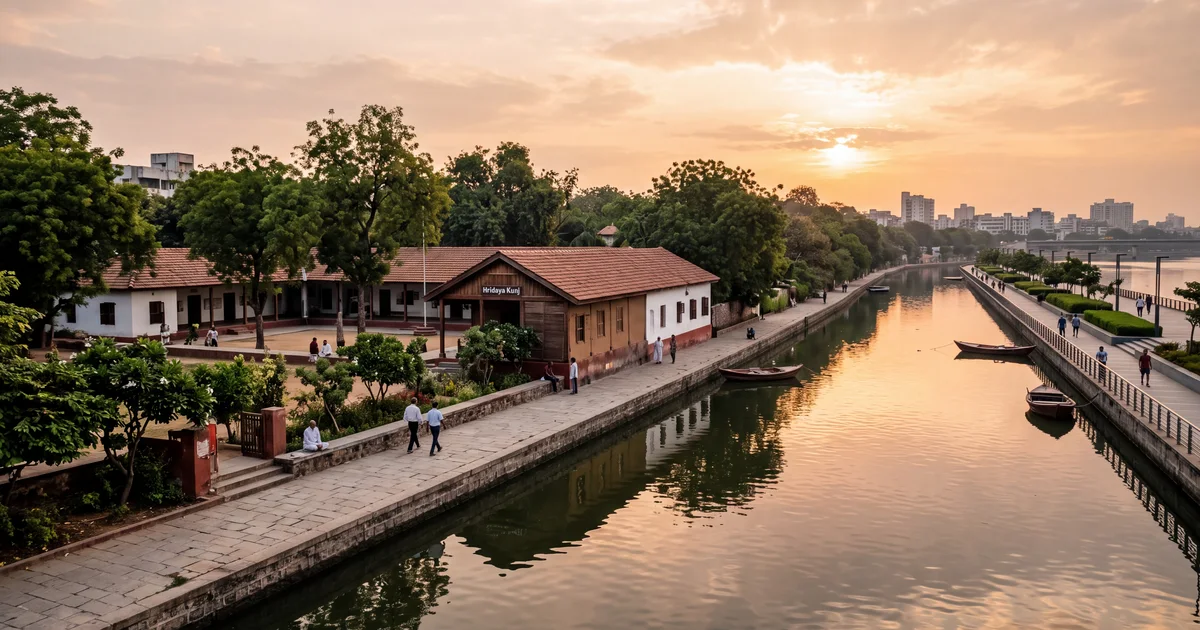
Ahmedabad is India's first UNESCO World Heritage City, a designation it received in 2017. The city sits on both banks of the Sabarmati River in Gujarat, with 8 million people, a textile industry that once rivalled Manchester, and a street food culture that treats breakfast as a competitive sport. The Old City on the eastern bank has 600 year old wooden houses connected by secret doors. The western bank has the IIM campus that Le Corbusier never designed but Louis Kahn did, and a riverfront that was an open sewer 15 years ago and is now a 10 km promenade.
The places to visit in Ahmedabad split into three layers. The Sultanate and Mughal era mosques and stepwells from the 1400s. The Independence era sites (Sabarmati Ashram, the textile mills, the Congress headquarters). And modern Ahmedabad, which includes Kahn's IIM, Doshi's Sangath studio, and a street food economy that runs from 6 AM fafda stalls to 1 AM Manek Chowk sandwich counters. Two days cover the essentials. Three days let you add the Modhera Sun Temple day trip.
TL;DR
- The Old City heritage walk (8 AM, ₹100) is the single best experience in Ahmedabad. Book it.
- Sabarmati Ashram is free, takes 1 hour, and should be your first stop on day one.
- Uttarayan (January 14) is the best time to visit. The entire city flies kites from every rooftop.
- Budget ₹1,200 to ₹2,500 per person per day for stays, food, and transport.
- Eat a Gujarati thali at least once. The 20+ item meal is the city's defining food experience.
Why Does the Old City Heritage Walk Get Recommended by Everyone?
The Ahmedabad Heritage Walk starts at 8 AM from the Swaminarayan Temple in Kalupur and winds through the pols (walled neighbourhood clusters) of the Old City for 2 to 2.5 hours. The walk costs ₹100 per person and covers about 2 km. You need to book it through the Ahmedabad Municipal Corporation's heritage cell or at ahmedabadheritage.com.
A pol is not a lane. It is a self contained neighbourhood with one main entrance, shared courtyards, and connecting doors between houses that allowed residents to move through the cluster without going outside. The system was defensive: close the main gate and the pol becomes a fortress. Some of the pols in the Old City date to the 1400s. The wooden facades have jharokhas (projecting balconies), carved bird cages built into the walls, and rooftop bridges connecting houses across the lane.
The walk passes through 4 to 5 pols, including the Fernandez Bridge (a secret door that connects a Hindu pol to a Muslim neighbourhood, built during communal tensions so residents could escape through each other's territory). The guides are local historians who grew up in these pols. They know which door leads to a hidden temple, which house has a 200 year old swing in the courtyard, and where the bird feeders are built into the external walls.
The caveat: the walk starts at 8 AM sharp and runs only in the morning. The Old City is a working neighbourhood, not a museum. By 10 AM the lanes fill with traffic, vendors, and noise. After 11 AM the heat makes walking uncomfortable from March onwards. Go on time or skip it.
My take: of everything in Ahmedabad, this walk changed how I thought about Indian cities. We build over our history. The pols are the rare exception where the history still functions as a living space. The carved wooden facades on some of these houses would be in museums anywhere else. Here, families live behind them.
What Can You Still See at Sabarmati Ashram?
Sabarmati Ashram sits on the western bank of the Sabarmati River, 5 km north of the city centre. Gandhi established it in 1917 as a base for the Indian independence movement. He lived here until 1930, when he walked out the gate on the Salt March to Dandi and never returned. The ashram is now a museum and memorial.
The grounds cover 36 acres along the river. The key structures are Hriday Kunj (Gandhi's personal residence, preserved with his spinning wheel, writing desk, and spectacles), Vinoba Kutir (where Vinoba Bhave stayed), and the museum building, which has an extensive collection of letters, photographs, and documents from the independence movement. The letter exchange between Gandhi and Lord Irwin before the Salt March is displayed in full.
Entry is free. The ashram is open 8:30 AM to 6:30 PM. The museum takes 30 to 45 minutes if you read the letters. Hriday Kunj takes 10 minutes. The grounds take another 20 minutes if you walk to the river bank. Go between 9 AM and 10:30 AM when the grounds are quiet and the light through the ashram windows is at its best.
The ashram is not ornate. It is deliberately austere. Low buildings, open courtyards, and the spinning wheel in the centre of every room. The power of the place comes from its ordinariness. Gandhi chose this location because it was between a jail and a cremation ground. He said the satyagrahi should be ready for both. The jail is gone. The cremation ground is still there, across the road.
One thing to know: the Sabarmati Riverfront Project has transformed the area around the ashram. The river bank that was a mud flat when Gandhi lived here is now a paved promenade with gardens, an amphitheatre, and a 10 km walking path. The contrast between the spartan ashram and the manicured riverfront is striking.
Is the Adalaj Stepwell the Best Stepwell in Gujarat?
Adalaj Vav (stepwell) is 18 km north of the city centre. Queen Rudabai commissioned it in 1498, making it over 500 years old. The stepwell descends five storeys underground to the water level. Each storey has carved sandstone pillars, walls with floral and geometric motifs, and platforms where travellers rested during the heat of the day.
Stepwells were not just water sources. They were rest stops on trade routes, socializing spaces for women (who collected water), and cool retreats during Gujarat's 45°C summers. Adalaj's temperature at the bottom level stays around 25°C even when the surface is 42°C. The engineering is practical and the carved decoration is a bonus, not the point.
The carving quality is what separates Adalaj from simpler stepwells. The pillars have stories from the Mahabharata and Ramayana carved in relief. Floral patterns cover every surface. A section near the bottom has Islamic geometric patterns alongside Hindu motifs, reflecting the cultural overlap of Sultanate era Gujarat. The entire structure is octagonal rather than the more common linear design, which means light enters from multiple angles.
Entry is free. The site is open sunrise to sunset. An auto from the city centre costs ₹250 to ₹300 one way. Combine it with a visit to Gandhinagar (the state capital, 30 km from Ahmedabad) and the Akshardham Temple if you want to fill a half day trip.
The honest caveat: Adalaj is the most photogenic stepwell in Gujarat, but Rani ki Vav in Patan (130 km north) is the UNESCO listed one and is larger. If you can do only one, Adalaj is closer and requires less time. If you have a full day for a road trip, do Patan and Modhera together (see the day trip section below).
What Makes the Calico Museum the Best Textile Museum in India?
The Calico Museum of Textiles sits in the Sarabhai family's Retreat compound in Shahibaug. It holds the world's largest collection of Indian textiles, spanning 500 years. The collection includes Mughal court fabrics, trade textiles made for export to Southeast Asia, temple hangings from Gujarat, and patola silk from Patan that costs ₹2 lakh per saree today and cost the equivalent 200 years ago.
The museum runs guided tours only. No walk in visits. Morning tours start at 10:30 AM and cover the textile galleries. Afternoon tours at 2:45 PM cover the religious art galleries. Each tour takes 1 hour 15 minutes. Entry is free but you must book in advance by calling +91 79 2286 8172 or visiting the gate the day before. Photography is not allowed inside.
The guides are knowledgeable enough to explain the difference between a double ikat patola and a single ikat one, and why the double version takes six months to weave. The Mughal gallery has court textiles with gold thread that has not tarnished in 400 years because of the alloy composition. A section on trade textiles shows how Gujarat supplied fabric to Indonesia, Japan, and East Africa using designs customized for each market.
The restriction on photography is frustrating, but the quality of the collection justifies it. These textiles are fragile. UV light and flash accelerate deterioration. The Sarabhais have kept the collection in climate controlled rooms since the 1940s, which is why pieces from the 1500s look like they were made last year.
My take: this is the single most underrated museum in India. People visit Ahmedabad for the ashram and the food, and miss a collection that London's V&A would build a wing around. If you care about craft, design, or material culture, block the morning for this.
Is Manek Chowk the Best Night Food Market in Gujarat?
Manek Chowk is a square in the Old City that changes function three times a day. Mornings, it is a vegetable market. Afternoons, it is a jewellery market (Ahmedabad is one of India's diamond cutting centres). After 10 PM, the food stalls roll in and it becomes an open air night food market that runs until 1 AM or later.
The food stalls serve pav bhaji, masala sandwiches, gola (shaved ice), kulfi, and Ahmedabad's own invention: the cheese sandwich with 200 grams of grated cheese on two slices of bread, toasted on a griddle with butter. It costs ₹80 to ₹120 and contains approximately a day's worth of calories. The stall owners compete on cheese volume. Restraint is not the point.
The better items are the pav bhaji (₹60 to ₹80) and the hand churned kulfi (₹40 to ₹60). Trishul and Asharfi specialize in the pav bhaji. For kulfi, look for the carts rather than the permanent stalls. The sandwich stalls are fun once for the spectacle. The food itself is aggressively mediocre. Go for the cheese theatre, stay for the pav bhaji.
The caveat: Manek Chowk is loud, crowded, and has nowhere to sit. You eat standing or leaning against a wall. The hygiene is street food standard. If that bothers you, this is not your scene. If it does not bother you, this is the most Ahmedabad experience in Ahmedabad.
Go between 10:30 PM and midnight. The market peaks around 11 PM. Getting there: an auto from CG Road or Navrangpura costs ₹80 to ₹120. The metro does not run that late. Plan a return auto.
What Are the Best Mosques and Islamic Architecture Sites in Ahmedabad?
Ahmedabad was founded in 1411 by Sultan Ahmed Shah, and the Islamic architecture from the Sultanate period is some of the finest in western India. Three sites stand out.
Jama Masjid (1424) sits at the centre of the Old City. It has 260 pillars supporting 15 domes. The pillars were repurposed from demolished Jain and Hindu temples, which means every third pillar has carved figures that predate the mosque by centuries. The central courtyard fits 25,000 people for Friday prayers. The mosque is open to visitors outside prayer times. Remove shoes and dress modestly.
Sidi Saiyyed Mosque (1573) is small, just a prayer hall with a few arches, but the stone jali (lattice screen) on the rear wall is one of the most photographed objects in Gujarat. The jali depicts an intertwined tree of life carved from a single slab of sandstone. The carving is so fine that light passes through the leaves. The same design appears on the IIM Ahmedabad logo. The mosque is near Lal Darwaza and takes 10 minutes to visit. Open daylight hours.
Sarkhej Roza (1451), 7 km southwest of the city, is a complex of mosques, tombs, and a palace built around an artificial lake. It was the country retreat of Ahmed Shah's successors. The complex mixes Islamic and Jain architectural styles in a way that reflects Gujarat's cultural overlap. The lake is dry most of the year, but after monsoon (September to November) it fills and the reflections of the tombs on the water make it worth the drive. Entry is free.
The caveat for all three: Ahmedabad's Islamic sites do not have the tourist infrastructure of Agra or Delhi. No audio guides, limited signage, and the surroundings are dense urban neighbourhoods. Bring context with you. The heritage walk (morning) covers Jama Masjid and Sidi Saiyyed; the afternoon is better for Sarkhej Roza.
Is a Day Trip to Modhera Sun Temple and Rani ki Vav Worth It?
Modhera Sun Temple is 106 km from Ahmedabad (2 hours by road). Rani ki Vav is in Patan, 130 km from Ahmedabad (2.5 hours). Both sites are UNESCO World Heritage Sites and can be combined in a single day trip.
Modhera was built in 1026 by the Solanki dynasty, designed so that the sun's rays fall directly on the deity during the equinoxes. The temple has a prayer hall, an assembly hall with 52 intricately carved pillars, and a stepped tank (kund) with over 100 miniature shrines along its walls. No active worship happens here. The temple is preserved as a monument by the ASI.
Rani ki Vav was commissioned in 1063 by Queen Udayamati as a memorial to her husband. The stepwell descends seven storeys with over 800 sculptures along the walls. The bottom level has a carving of Vishnu in Anantashayana (reclining on the cosmic serpent) that alone justifies the trip. The preservation is exceptional because the well was buried by silting from the Saraswati River for centuries and was only excavated in the 1980s.
A practical itinerary: leave Ahmedabad by 7 AM. Reach Modhera by 9 AM (entry ₹40, 1 to 1.5 hours). Drive to Patan (30 km, 40 minutes). Rani ki Vav (entry ₹40, 1 to 1.5 hours). Lunch in Patan (try the local Gujarati thali). Return to Ahmedabad by 4 PM. Hire a car with driver for the day (₹2,500 to ₹3,500).
This day trip is the strongest half day addition to an Ahmedabad itinerary. If your trip is only 2 days, skip it. If you have 3, this is what day 3 is for.
Where Do You Eat the Best Gujarati Thali in Ahmedabad?
The Gujarati thali is a meal format: 20 to 30 items served on a steel plate with small bowls, unlimited refills, and a structured sequence from sweet to savoury. Ahmedabad takes this format seriously. Three restaurants do it exceptionally well.
Gordhan Thal on Ashram Road serves a thali with 28 items. The meal starts with a sweet (basundi or shrikhand), moves through four sabzis, two dals, kadhi, rotli (hand rolled chapati thinner than anywhere outside Gujarat), rice, khichdi, and ends with paan. Refills are unlimited and the servers circulate with each item. The meal costs ₹350 to ₹400 per person. Go between 12:30 PM and 1:30 PM.
Vishalla on Vasna Road is the experience version. You sit on the floor in a recreated village setting with kerosene lanterns, puppet shows, and a utensil museum next door. The food is traditional Gujarati village fare: bajra rotla, undhiyu (winter vegetable stew), and fresh white butter. Dinner costs ₹500 to ₹600. It opens at 7:30 PM. Book ahead on weekends.
Agashiye at the House of MG (a heritage hotel in the Old City) serves a refined Gujarati thali on the rooftop terrace overlooking the city. The food is less rustic than Vishalla and more polished. Dinner costs ₹800 to ₹1,000. The setting is the draw: eating on a rooftop under the Old City skyline.
For street food thalis, Rajwadu on SG Highway does a village theme similar to Vishalla at half the price. The food is simpler but honest.
One thing that catches visitors off guard: Gujarati food is sweet. The dal has jaggery. The kadhi has sugar. Even the savoury items have a sweetness to them. This is not a mistake. It is the regional palate. Resist the urge to ask for "less sweet." The balance is intentional.
What Should a 2 Day Ahmedabad Itinerary Look Like?
Day 1 (Old City and heritage): Heritage walk at 8 AM (2.5 hours). Jama Masjid and Sidi Saiyyed Mosque (30 minutes total, both are on the walk route). Lunch at a nearby thali place in the Old City. Calico Museum afternoon tour at 2:45 PM (1.5 hours). Sabarmati Ashram at 5 PM (1 hour). Dinner at Agashiye or Gordhan Thal. Manek Chowk night food market at 10:30 PM.
Day 2 (Stepwell and modern Ahmedabad): Adalaj Stepwell at 9 AM (1 hour including drive). IIM Ahmedabad campus (the Louis Kahn brick buildings, open to visitors, free). Lunch at Vishalla. Law Garden market in the evening for handicrafts and chania choli embroidery. Sabarmati Riverfront for an evening walk.
If you have Day 3: Modhera Sun Temple and Rani ki Vav day trip (full day, see above).
For group packages that cover transport and stays, check trip options from Ahmedabad. The destinations page lists curated local experiences including the heritage walk, cooking classes, and textile tours.
Getting around: the Ahmedabad Metro runs from Thaltej Gam to Vastral (east to west) and from Motera to APMC Market (north to south). It covers the central areas well. Auto rickshaws are metered (₹15 start, ₹10 per km after). Ola and Uber both operate. For day trips outside the city, hire a car with driver (₹10 to ₹12 per km, minimum 200 km). Browse available trips for curated options.
Practical Tips That Save Time and Money
Ahmedabad is a dry city. Gujarat has alcohol prohibition. No bars, no wine with dinner, no beer after sightseeing. Some hotels have permits for guests (ask at check in), and a few places in SG Highway's hotels operate discreetly. Plan accordingly. The city compensates with chai. Every street corner has a chai stall, and Ahmedabadis take their tea as seriously as Kolkata takes its sweets.
Hotels in the ₹1,500 to ₹3,000 range cluster along CG Road, Navrangpura, and Ashram Road. These areas are central, metro accessible, and close to restaurants. The heritage hotels in the Old City (House of MG, French Haveli) cost ₹4,000 to ₹8,000 but the location inside the pols is worth the premium for one night.
The best souvenir from Ahmedabad is textiles. Bandhani (tie dye), ajrakh (block print), and patola silk are available at Law Garden's evening market and at the Gurjari showroom (government fixed price, no bargaining). For patola silk, the real thing starts at ₹30,000. Anything cheaper is machine printed. Know what you are buying.
The Sabarmati Riverfront is best in the evening (5 PM to 7 PM). The 10 km promenade has a cycling track, gardens, and food stalls. Rent a cycle at the Riverfront West station (₹50 per hour). The stretch between Ellis Bridge and Sardar Bridge has the best views of the Old City skyline reflected in the water. On Sundays, the riverfront hosts flea markets and live music.
Frequently asked questions
- What are the top 5 must visit places in Ahmedabad?
- Sabarmati Ashram for Gandhi's living quarters and the Salt March history, the Adalaj Stepwell for its five storey carved stone architecture, the Calico Museum for the world's largest textile collection, the Old City heritage walk through the pols for a look at 600 year old wooden houses, and Manek Chowk for the night food market. These five cover Ahmedabad's history, craft, and food in two days.
- How many days are enough for Ahmedabad?
- Two days cover the major sites comfortably. Add a third day for Modhera Sun Temple and Rani ki Vav at Patan (both UNESCO sites within 130 km). Most visitors from Mumbai or Delhi come for a long weekend and that works well. The Old City heritage walk alone takes a full morning.
- What is the best time to visit Ahmedabad?
- November to February offers 12°C to 28°C weather and clear skies. The International Kite Festival (Uttarayan) on January 14 fills the sky with thousands of kites and is the single best time to be in the city. March to June crosses 42°C regularly and outdoor sightseeing is miserable after 10 AM. Monsoon (July to September) brings flooding in the low lying Old City areas.
- What street food should I try in Ahmedabad?
- Khaman dhokla at Das Khaman on CG Road (the original, running since 1926), fafda jalebi on Sunday morning from any street cart in Maninagar, dabeli at Karnavati Dabeli near Law Garden, and a full Gujarati thali at Gordhan Thal on Ashram Road (₹350 for 20+ items). For the full night food market experience, visit Manek Chowk after 10 PM for pav bhaji, sandwiches, and kulfi.
- Is the Ahmedabad heritage walk worth doing?
- The morning heritage walk through the Old City pols is the best single experience in Ahmedabad. It starts at 8 AM from Swaminarayan Temple and runs 2 to 2.5 hours through carved wooden houses, secret doors between neighbourhoods, and rooftop bridges. The walk costs ₹100 per person and covers 2 km of lanes you would never find on your own. Book at ahmedabadheritage.com.
- How do I get to Ahmedabad from Mumbai or Delhi?
- From Mumbai, the Shatabdi Express takes 6.5 hours or direct flights take 1 hour 15 minutes. From Delhi, the Rajdhani takes 10 hours (overnight) or flights take 1 hour 40 minutes. Ahmedabad airport is 12 km from the city centre. The metro covers the central corridor from Thaltej to Vastral. Ola and Uber work well across the city.
- Is Ahmedabad a vegetarian city?
- Largely yes. Ahmedabad has the highest concentration of vegetarian restaurants of any Indian city. Most restaurants in the Old City and CG Road area are pure veg. Non vegetarian food exists in Behrampura, Juhapura, and a few places in Navrangpura, but it is the exception. If you eat meat, plan around it. The Gujarati thali is the city's pride and it is entirely vegetarian.