Monsoon Treks from Bangalore (2026): Where the Western Ghats Turn Green
The 5 best monsoon treks near Bangalore, with honest notes on safety, gear, and how to find a group departure you can trust for July to September.
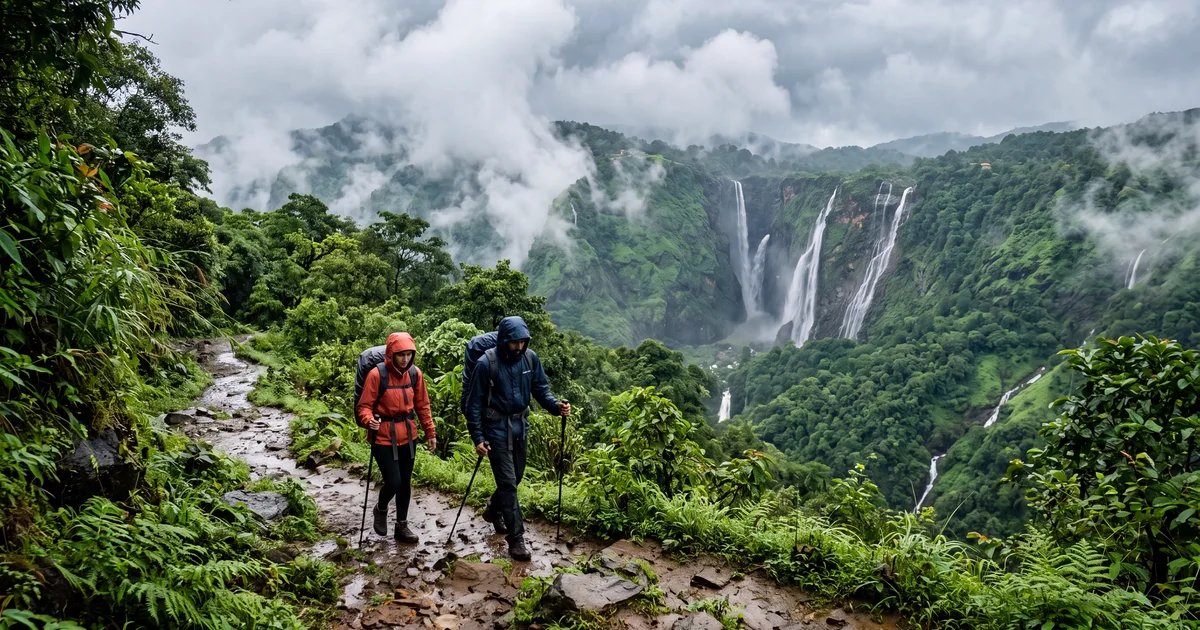
June arrives in Bangalore with overcast skies and a collective forgetting that some of the best monsoon treks from Bangalore begin just three hours away. Most people park their trekking shoes until October. That is a mistake. The Western Ghats during the monsoon are a completely different landscape from the dry, dusty trails you walked in January: waterfalls appearing on slopes you did not notice before, shola forest wrapped in low cloud, and trails quiet enough that you might not see another group for hours.
The dry season gets the bookings. The monsoon earns the photos.
TL;DR
- Top monsoon treks from Bangalore: Kodachadri, Kudremukh, Kumara Parvatha, Tadiandamol, Brahmagiri
- July and August have the heaviest rain and the best scenery; October is the easier entry point
- Expect leeches and mud; plan for both with gaiters, a waterproof jacket rated 10,000mm+, and salt
- Solo navigation in heavy fog is risky; go with a group or a guide who knows the trail in monsoon
- Current group departures for these treks are on TripzSearch
Why the Monsoon Season Is Underrated for Western Ghats Trekking
The Western Ghats receive between 2,000 and 7,000mm of rainfall between June and September. At that volume, the landscape transforms in ways that photographs do not fully capture. Waterfalls appear on previously bare slopes. The shola forests, the dense mossy high-altitude forests found only in the Ghats above 1,500 metres, reach their peak. Streams that were barely trickling in February run hard and loud enough that you hear them before you see them.
October to February delivers clear skies and easy going. But if you want the Ghats at their most alive, the monsoon window is the one to book. This is not subjective preference. Kodachadri in July, standing in the meadow at 1,343 metres above a carpet of cloud, is an experience that the same trek in December cannot replicate.
The honest caveat for this section: the beauty comes with real inconvenience. Leeches are present in numbers on most forest trails from June through September. They are not dangerous but they are relentless, and if you are not prepared for them they will ruin your day. Gaiters and salt solve this problem entirely.
The Best Monsoon Treks from Bangalore
Not every trail in the Western Ghats is worth attempting in July. Some become genuinely hazardous; others are just muddy anti-climaxes with no view and no payoff. These five are the ones that deliver.
Kodachadri (Shivamogga, 430 km)
This is the definitive monsoon trek from Bangalore. At 1,343 metres in the Shivamogga district, the summit meadow sits above the clouds on most July mornings before 9am. The final stretch requires either a jeep ride or a steep forest walk, depending on your operator and the trail conditions that weekend. The Hidlumane Falls near the base are worth the detour, though the path there gets slippery after 48 hours of continuous rain.
The trail passes through Mookambika Wildlife Sanctuary, so permits and a registered guide are required. Book through an operator who runs this route regularly. The logistics on a self-organised Kodachadri trip in July are more complicated than they appear.
Kudremukh (Chikkamagaluru, 330 km)
The trail runs across rolling high grassland inside Kudremukh National Park, without the steep technical sections that define Kodachadri or Kumara Parvatha. It is physically demanding over distance, but the effort is in your legs rather than your lungs or your balance. The park requires permits and a forest department guide, so this is always done as an organised departure. Most operators from Bangalore run Kudremukh on alternating weekends through the monsoon.
The name comes from the horse-face shape of the mountain, which is visible from specific angles on the approach. In the monsoon the grassland turns an unreasonable green and the Bhadra river runs full and fast through the valley.
Kumara Parvatha (Pushpagiri, 280 km)
This is the hardest trek on this list. The trail climbs nearly 1,700 metres of vertical gain over the full Pushpagiri route, with two camp options for overnight stays. In the monsoon, the upper sections sit in cloud for most of the day, which removes the summit view but adds a strange atmospheric quality to the forest on the ascent. The trail gets ankle-deep in places in July.
Do not attempt this as your first monsoon trek. The descent in wet conditions requires care, trekking poles, and good footwear. That said, the Ghats forest on the way up is spectacular regardless of summit visibility, and regular trekkers plan their KP trip for the monsoon specifically because of the forest.
Tadiandamol (Coorg, 270 km)
At 1,748 metres, the highest peak in Coorg. The trail climbs through shola forest to open grassland, with no technical sections. This is the right choice if you want your first monsoon overnight trek, or if half your group prefers coffee estates to peak-bagging and you are combining it with a Coorg weekend. One thing to check before booking: the road to the trailhead gets waterlogged in heavy rain and some years requires a 4x4 or a longer approach walk.
Brahmagiri (Coorg, 280 km)
A gentler climb to 1,608 metres through some of the best shola forest in the Western Ghats. It sees far less footfall than Kodachadri, which in the monsoon means the forest is almost entirely yours. The Brahmagiri Wildlife Sanctuary restricts entry some years during peak monsoon; check the Karnataka Forest Department notice before you book. When it is open, this is the quietest and most atmospheric monsoon trek within reach of Bangalore.
Group departures for all five are on the monsoon treks collection or across the full trips page.
Is It Safe to Trek in the Western Ghats During Monsoon?
Yes, with specific conditions attached.
The risks that actually matter are not dramatic. Slippery rocks and tree roots cause most injuries. Go slowly on the descent, plant your poles before you step, and accept that the last 2 km of every descent will feel longer than the first 5 km. Visibility can drop to 20 metres in heavy cloud, which makes trail navigation difficult on routes you do not know well.
Flash flooding is the serious risk, and it comes with warning signs. A stream that is rising faster than the rain falling on you, a sound from upstream you cannot explain, or continuous heavy rain for more than 12 hours. In those conditions, do not cross running water above knee depth. Most group operators have clear protocols for this. Individual guides do too.
The reason to go with a group or a registered guide is not primarily about physical safety. It is about navigation. Monsoon cloud removes landmarks. Trail markers are less visible under wet vegetation. A guide who has walked Kodachadri in July 40 times navigates differently than someone who last did it in October.
The honest caveat: even experienced trekkers misjudge water crossings. The Kudremukh National Park administration has specific crossing rules during high water that apply even to registered guides. Those rules exist because people have been hurt ignoring them.
What Should You Pack for a Monsoon Trek from Bangalore?
This is the part most first-time monsoon trekkers get wrong, either overloading or underestimating.
The non-negotiables:
A waterproof jacket rated at 10,000mm hydrostatic head or higher. A basic rain poncho works for the first 20 minutes. After that it fails and stays wet. A proper jacket stays dry all day.
Gaiters. This is the single item that changes the leech problem from a constant annoyance to a non-issue. Ankle gaiters that cover the boot-trouser gap cost around 400 to 600 rupees and last years.
High-ankle waterproof trekking boots or trail shoes. Sneakers turn the descent on a wet forest trail into a controlled fall. Your ankles will pay for the wrong footwear by the third hour.
A dry bag or waterproof liner inside your pack. Not a bag cover. Bag covers leak at seams in sustained rain. A liner keeps your phone, spare clothes, and food dry regardless.
Salt. The standard leech removal method. A small container in an accessible pocket, not buried in your bag.
Trekking poles. Not optional on KP or Kodachadri in the monsoon. The descent with tired legs on wet roots and mud is where knees get injured.
Leave cotton behind entirely. The Kudremukh trailhead at 7am in July runs around 11 to 13°C. Cotton stays wet, adds weight, and draws heat away from your body. Lightweight synthetics or merino dry fast and stay warm.
How to Find a Reliable Group Trek for the Monsoon Season
Most operators run fixed departures to Kodachadri, Kudremukh, and Tadiandamol through July to September. Departure frequency varies. Larger operators run every weekend. Smaller ones run twice a month.
The things that separate a reliable departure from a bad one in the monsoon:
A stated guide to trekker ratio. Monsoon trails need more supervision per group because water crossings and route decisions require real-time judgment.
A real operator name you can look up. Not a WhatsApp group, not an anonymous Instagram handle.
Clear rescheduling terms. Monsoon departures get called off because of trail closures, extreme rain, or forest department restrictions. What happens to your payment if the trek is cancelled three days before you leave?
Permit and guide arrangements confirmed in advance. For Kodachadri and Kudremukh, these are legal requirements, not optional extras.
You can compare operators and check current departures from Bangalore on the from Bangalore page. Every listing on TripzSearch shows the operator name, departure dates, group size, and verified reviews.
The monsoon season is short. Four months, and the best trails book out well ahead of weekends in July and August. If Kodachadri in the cloud is on your list, book at least two weeks out.
Frequently asked questions
- Which is the best monsoon trek from Bangalore for beginners?
- Tadiandamol in Coorg is the most approachable, a 270 km drive from Bangalore with a trail that climbs through shola forest to open grassland at 1,748 metres. It does not require technical skill, runs as a group departure on most weekends in July and August, and fits neatly into a Coorg weekend for those who want more than just the summit.
- Is it safe to trek in the Western Ghats during monsoon?
- Yes, with specific preparation. The risks that matter are slippery rocks and roots, poor visibility in heavy fog, and water crossings after sustained rain. Go with an organised group or guide who knows the trail in monsoon conditions. Avoid crossing streams above knee depth if rain has been continuous for more than 12 hours.
- What should I carry on a monsoon trek near Bangalore?
- A waterproof jacket rated at 10,000mm or above, gaiters, high-ankle waterproof trekking boots, a dry bag or waterproof liner inside your pack, salt for leeches, and trekking poles. Skip cotton entirely. The morning temperature on Kudremukh and Kodachadri in July sits between 10 and 14°C, which feels cold when you are also wet.
- When is the best time for monsoon trekking near Bangalore?
- July and August bring the heaviest rain and the most dramatic landscapes. Early October is the transition window, when the forests are still green but the trails are beginning to dry out. June is the start of the monsoon, with lighter rain and good trail conditions on the higher peaks.
- Do I need a guide for a monsoon trek from Bangalore?
- For any trail inside a national park or wildlife sanctuary, yes, a registered guide is legally required. For trails like Kodachadri and Kudremukh, permits are needed and most operators bundle both. Even outside park boundaries, monsoon navigation is meaningfully harder in cloud and fog, and an organised group departure is the safer choice.
- How far are the Western Ghats from Bangalore?
- The nearest Ghats trailheads are 250 to 330 km from central Bangalore. Kodachadri and Kudremukh are roughly 430 and 330 km respectively. Most overnight group departures leave Friday night or Saturday early morning to reach the trailhead before noon.