Kheerganga Trek (2026): Route from Kasol, Hot Springs and Group Departures
Everything you need for the Kheerganga trek from Kasol in 2026, including the route, difficulty, hot spring details, best season, and how to book group departures.
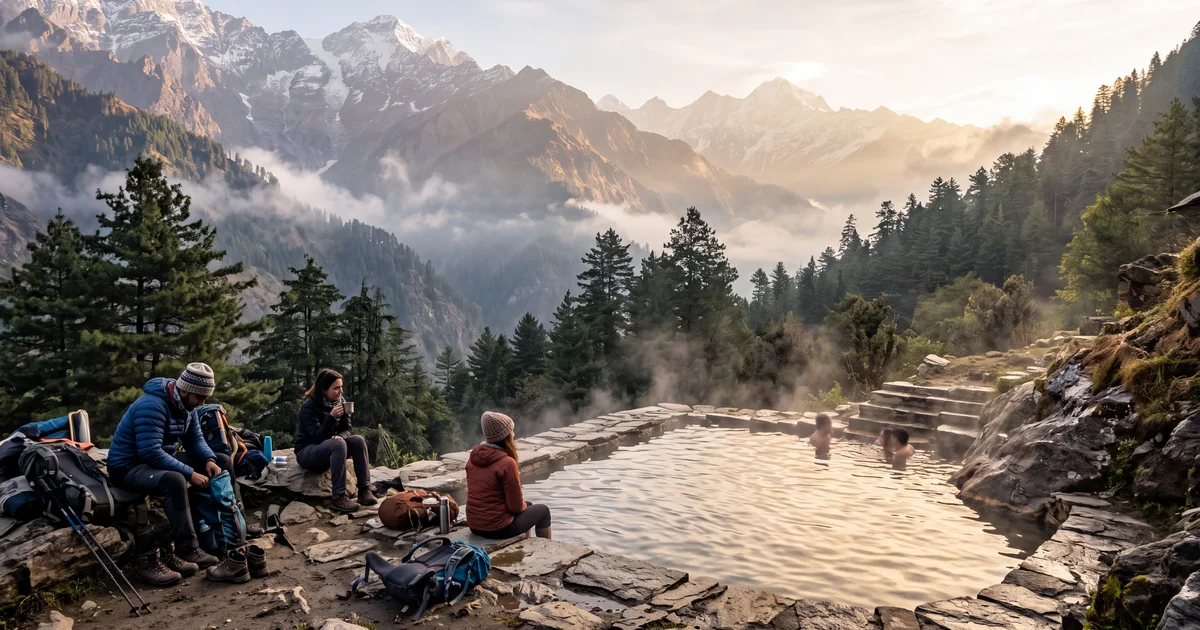
Kheerganga sits at 2960 metres in the Parvati Valley, and the main reason people climb there is a natural hot spring on an alpine meadow with Himalayan peaks in every direction. You spend six hours walking uphill through pine forests and river gorges, arrive sweating, and then lower yourself into water that is naturally 40°C. That contrast is the entire pitch, and it works.
The trek starts from Barshaini, a small roadhead village 16 km beyond Kasol. The route follows the Parvati River upstream, climbs through thick forests past a few waterfalls, and ends at a flat grassy clearing where the hot spring and a Shiva temple have drawn visitors for centuries. It is not a difficult trek by Himalayan standards. But it is long enough to separate the committed from the casual.
TL;DR
- 12 km one way from Barshaini, 1500 metres elevation gain, moderate difficulty.
- The hot spring at the top is real and accessible year round (weather permitting).
- Best months: May to June, September to November. Avoid monsoon and deep winter.
- Camping permits required since 2023. Book through operators or the HP forest department.
- Group departures from Delhi run most weekends from April to November, typically 3 to 4 day packages.
What is the Kheerganga trek route from Kasol?
The trek does not start from Kasol itself. You first need to reach Barshaini, which is 16 km further up the valley by road. Most trekkers take a taxi from Kasol (about 400 rupees, 30 minutes) or catch one of the local buses that run hourly.
From Barshaini, the trail crosses a bridge over the Parvati River and forks. Two routes lead to Kheerganga:
The Nakthan route (left fork) goes through the village of Nakthan, then climbs steeply through dense pine and oak forest. This is the shorter route at about 11 km but it is steeper, especially the last 3 km. Most trekkers use this going up.
The Kalga route (right fork) passes through Kalga village and then follows the river more closely before climbing gradually. This is about 13 km but gentler on the knees. Better for descent.
The common strategy: go up via Nakthan, come down via Kalga. This gives you variety and saves your knees on the return.
How hard is it, really?
If you can walk for six hours straight with a daypack on moderate uphill, you can do Kheerganga. The trail has no technical sections. No rock climbing, no rope work, no glacier crossings. The path is well worn and obvious for 90% of the distance.
The challenge is endurance. Twelve kilometres of continuous uphill at altitude tires most people more than they expect. The last 2 km before the meadow are the steepest section on the Nakthan route, and they come right when your legs want to quit.
Some numbers: fit trekkers finish the ascent in 4 to 5 hours. Average pace with breaks is 5 to 7 hours. Descent takes 3 to 4 hours.
One honest warning: the trail gets slippery and dangerous during monsoon. Three or four landslides hit the path between Nakthan and Kheerganga every July. People have been injured. The Parvati Valley is beautiful in rain but the risk is real between June 15 and September 15.
The hot spring: what to expect
The hot spring at Kheerganga is a natural sulphur spring that surfaces at about 40°C. There are two pools: one open air (mixed, small, about 4 by 3 metres) and one enclosed structure near the Shiva temple that is slightly hotter.
The water smells faintly of sulphur. The pool depth is about waist high. The bottom is rocky and uneven. After a long day of trekking, sitting in that water with cold mountain air on your face is one of those rare things that lives up to its reputation.
Morning is the best time to soak. The meadow is empty, mist sits in the valley below, and you can see the snow peaks of the Parvati range catching first light. By midday in peak season (October weekends) there can be 20+ people waiting for a turn.
Bring a towel and a change of dry clothes. The air temperature at 2960 metres drops to 5°C at night even in October, and walking back to your tent wet is a fast way to get hypothermia.
When to go (and when to skip)
May to June: Best weather window. Snow has melted from the trail, the meadow is green, days are warm (15 to 20°C) and nights are cold but manageable (5 to 8°C). The spring is warmest relative to air temperature, which makes the soak better.
September to November: Second best window. Post monsoon clarity means sharper mountain views. October is peak season with the most group departures running. November gets cold (below 0°C at night) but is doable with proper sleeping gear.
July to August: Monsoon. Waterfalls are dramatic, the forest is its greenest, but the trail is actively dangerous. Leeches are thick below 2500 metres. Landslides block the path regularly. Several operators suspend departures in July. Skip unless you are experienced and accept the risk.
December to February: Snow covers the trail above Nakthan. The hot spring steams dramatically in the cold, but reaching it requires snow gear (crampons, gaiters) and the trail is not maintained. Only for winter trekkers with experience.
March to April: Transitional. Snow is melting, trail is muddy and unpredictable. Some years it is clear by late March; other years snow persists through April. Check conditions before booking.
What to pack
The gear list is short since this is not a high altitude expedition:
A 30 to 40 litre daypack. Trekking poles (they save your knees on the descent, especially via Kalga). Two litres of water (refill points at Nakthan and a small stream before the final ascent). A headlamp in case you are slower than planned. One warm layer for the summit and night. Rain gear from May to September.
Shoes matter here. The trail has loose rock, tree roots, and stream crossings. Proper trekking shoes with ankle support are strongly recommended. People do it in sneakers. Some of them regret it on the slippery sections.
If you are camping, most operators provide tents and sleeping bags. Self supported trekkers need a tent, a sleeping bag rated to 0°C (for October onward), and a sleeping mat.
How to book a group trek to Kheerganga
Most operators in the Delhi to Manali corridor run Kheerganga as a 3 or 4 day package. A typical itinerary:
Day 1: Overnight Volvo from Delhi to Kasol (leave 6 PM, arrive 8 AM). Day 2: Transfer to Barshaini, trek to Kheerganga, camp. Day 3: Morning hot spring soak, descend, explore Kasol, overnight Volvo back to Delhi. Some operators add a day in Tosh or Malana.
Package prices range from 4,500 to 9,000 per person depending on transport quality (semi sleeper vs Volvo), tent quality, and whether meals are included. Most group sizes are 15 to 25 people.
For solo travellers, these group batches are the easiest way in. You do not need friends to join. Book a single seat, show up at the Delhi pickup point, and you will be trekking with a group of strangers who had the same idea.
Check current departures and verified operators on TripzSearch. Operators listed there show real reviews and real pricing.
Is Kheerganga worth it compared to other Himalayan treks?
It depends on what you want. Kheerganga is not a summit trek. There is no dramatic pass crossing, no glacier camping, no 5000 metre peak to claim. It is a valley trek that ends at a hot spring.
What it does better than most alternatives: accessibility. No prior trekking experience required. No permits for the trek itself (only camping permits). Reachable from Delhi in one overnight bus. And the hot spring is a genuine reward, not a view you photograph and leave.
If you want something harder from the same base, the Pin Parvati Pass (5319 metres, 7 to 10 days) starts from the same valley. If you want a shorter trek with similar vibes, Rasol from Kasol is 3 km and reaches a village at 2500 metres with valley views.
For most first time Himalayan trekkers, Kheerganga is the right entry point. It gives you enough challenge to feel like a real trek, enough beauty to understand why people chase mountains, and a hot spring that means you finish relaxed instead of just tired.
The Parvati Valley context
Kheerganga is not just a trek. It is part of a broader Himalayan trekking ecosystem in the Parvati Valley that includes Kasol, Tosh, Malana, and the Sar Pass route. Many trekkers combine Kheerganga with a day or two exploring Kasol's cafes and the Tosh village viewpoint.
Kasol itself is 1580 metres, a backpacker town on the Parvati River. It has become significantly more crowded and commercial since 2019. If you want the mountain quiet that drew people here originally, you will find it on the Kheerganga trail above Nakthan, not in Kasol.
The bus route from Delhi runs through Chandigarh and Mandi before reaching Bhuntar (the Kullu airport town) and then climbing into the valley. Total distance is about 520 km. The road quality from Bhuntar to Barshaini is narrow and winding but paved.
Getting there from other cities
From Delhi: Overnight Volvo or semi sleeper bus from ISBT Kashmere Gate to Bhuntar (10 to 12 hours, 800 to 1500 rupees). Then local bus or taxi to Barshaini (2 hours, 200 to 400 rupees).
From Chandigarh: Bus to Bhuntar (7 to 8 hours) or drive via Mandi (NH21). Same route from Bhuntar onward.
From Bangalore: Fly to Chandigarh or Delhi (3 hours), then overnight bus to the valley. Total one way travel time is about 18 to 20 hours. Most Bangalore trekkers book a group trip from Delhi that handles all transport.
From Mumbai: Fly to Delhi (2 hours), then overnight bus. Or the longer route via Chandigarh direct flight.
The nearest airport is Bhuntar (Kullu Manali airport), about 30 km from Kasol. Flights from Delhi operate seasonally and are often cancelled due to weather. Do not rely on them for a fixed itinerary.
The bottom line
Kheerganga works because the payoff matches the effort. Six hours up, a natural hot spring at the top, one night under stars at 2960 metres, and a manageable descent the next morning. It is not the hardest trek or the highest. It is the one that converts people into trekkers.
If you are planning your first Himalayan trek and want something that does not require a week of leave, start here. Check group departures on TripzSearch for upcoming dates and pricing from operators who actually run this route.
Frequently asked questions
- How difficult is the Kheerganga trek for beginners?
- Kheerganga is a moderate trek suitable for fit beginners. The trail is 12 km one way from Barshaini with about 1500 metres of elevation gain. No technical sections or scrambling, but the length and continuous uphill make it tiring. Most first timers finish in 5 to 7 hours up.
- Is the Kheerganga hot spring still open in 2026?
- The natural hot spring at the summit meadow is open. The Himachal Pradesh forest department closed camping at Kheerganga in 2022 to reduce waste but reopened it in 2023 with regulated permits. The hot spring pool itself has always remained accessible to day visitors and permitted campers.
- What is the best time to do the Kheerganga trek?
- May to June and September to November are the best windows. Monsoon (July to August) brings heavy rain, leeches, and landslide risk on the trail. Winter (December to February) means snow above Nakthan which makes the trail dangerous without proper gear. Spring and autumn give clear skies and comfortable temperatures.
- Can I do Kheerganga trek in one day?
- Technically yes, but it is exhausting. The round trip is 24 km with 1500 metres elevation gain and loss. You would need to start by 5 AM from Barshaini and expect to return by 7 PM. Most people prefer to camp overnight at the top and soak in the hot spring at sunrise before descending the next morning.
- How do I reach Kheerganga from Delhi?
- Take an overnight bus from Delhi ISBT to Bhuntar (10 to 12 hours). From Bhuntar, a local bus or taxi to Kasol takes 1.5 hours, then another 30 minutes to Barshaini where the trek starts. Total travel from Delhi is about 14 hours. Group trip operators typically include Volvo transport from Delhi in their packages.