Jivdhan Fort Trek (2026): Naneghat Route, Difficulty and Group Treks from Pune
Jivdhan fort trek guide: the Ghatghar route, rock cut steps, Vanarlingi pinnacle, Naneghat combo plan, difficulty and group treks from Pune.
Some forts were built for kings. Jivdhan was built for cargo. The Jivdhan fort trek climbs to the watchtower of Naneghat, the mountain pass where trade caravans hauled goods between the Konkan coast and the Deccan plateau more than 2,000 years ago. The fort guarded the toll gate. The toll gate funded an empire.
Today that history translates into one of the best moderate treks in the Junnar region, 115 odd km from Pune: rock cut steps, a summit at about 1,145 metres, and the 385 ft Vanarlingi pinnacle standing beside it like an exclamation mark.
It also pairs with the Naneghat walk in a single day, which is exactly how you should do it.
TL;DR
- Base village: Ghatghar, about 115 to 125 km from Pune via Junnar
- Climb time: 90 minutes to two hours, moderate grade
- Height: around 1,145 metres (3,754 ft)
- Combine it with the Naneghat caves and reverse waterfall point
- Best window: late September to February; monsoon only for experienced groups
- Vanarlingi pinnacle is for roped climbers, not trekkers
How difficult is the Jivdhan fort trek?
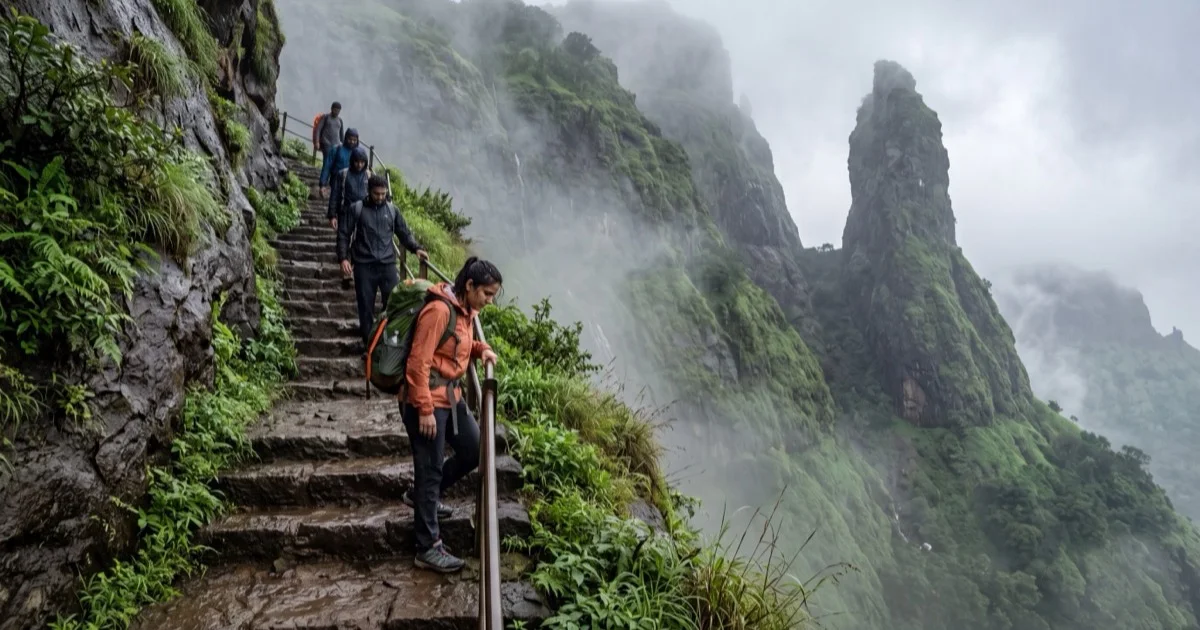
Honest answer: moderate, with a personality change by season. In dry months the Ghatghar route is a steady 90 minute to two hour climb. The famous section is the final stretch of steps cut straight into the cliff, with iron railings on the airier parts. You will use your hands in two or three places. Nothing needs ropes.
The fort's rougher past shows on the way up. The original entry steps were deliberately destroyed in the British era to make the fort unusable, and the route stayed a scramble for decades until restoration work rebuilt safe passage. Some patches still feel raw. That is part of the appeal.
In monsoon, the same steps become shallow waterfalls. Grip shoes stop being a suggestion. Wind at the exposed turns can push you sideways, and the final ladder section demands patience when a batch queues up. July on Jivdhan is a different, harder trek than December on Jivdhan.
My take for first timers: do it in November. You keep the post monsoon green, lose the slippery rock, and the morning air at Ghatghar sits around 15°C.
The Ghatghar route, step by step
From Ghatghar village the trail crosses open plateau toward the fort's west face. The walk in takes about 40 minutes and is flat enough to lull you. Then the steps begin.
The rock cut staircase works up through a cleft in the cliff, steep and narrow, with the valley opening behind you as you climb. Height gain from the village is around 350 metres. Two rest ledges break the climb neatly. On the second one, look left: Vanarlingi rises in full profile, and every camera in the group comes out.
There is a second route through the Kalyan Darwaja on the opposite side, longer and more exposed, with sections where the drop keeps you honest. Experienced parties use it for the loop. Everyone else should go up and down the Ghatghar side.
One caveat about the plateau walk: in fog, the open grassland before the cliff is easy to wander on. Groups have lost the trail here in monsoon whiteouts. Stay together, or go with someone who has done it.
Can you combine Naneghat and Jivdhan in one day?
Yes, and skipping Naneghat while standing at its doorstep would be the day's one real mistake. The pass is a ten minute drive or short walk from the Jivdhan trailhead side, and the two together make the region's best history plus altitude combination.
Naneghat's cave shelters carry Brahmi inscriptions from the Satavahana era, among the oldest in Maharashtra, recording the royals who ran this trade route. Beside the pass sits the huge rock cut toll jar where caravan tax was collected in coin. You are looking at a 2,000 year old toll booth. Few places make ancient economics this physical.
In monsoon the pass adds its party trick, the reverse waterfall. Wind funnels up the Naneghat cleft hard enough to blow the falling stream back over the cliff edge, and July weekends bring crowds just for this ten second spectacle.
The workable sequence: Naneghat viewpoint and caves early, Jivdhan climb before noon, six to seven hours of walking overall. Caveat: in peak monsoon the reverse waterfall crowd jams the narrow approach road by mid morning. Reach the pass by 8am or accept the queue.
What is on top of Jivdhan fort?
The summit plateau is compact and rewards a slow lap. Water cisterns cut into rock still hold monsoon water most of the year. The old granary, Dhanya Kothi, survives with its stone walls intact, a reminder that this fort was a supply depot as much as a watch post. Fragments of the gate structures mark both entry routes.
The real exhibit is the view. Jivdhan stands at the head of the Naneghat pass, so you see the trade road's entire logic in one sweep: the Konkan dropping away west, the Deccan stretching east, and the pass threading between. South, on clear days, Harishchandragad's mass anchors the horizon.
And there is Vanarlingi, the 385 ft needle just off the summit, also called Khada Parsi. Climbers rappel and ascend it on ropes; for trekkers it is strictly scenery. Do not test that boundary. The rock is vertical and the base drop is serious.
Opinion: as summit views per effort invested go, Jivdhan beats several more famous Sahyadri names. Two hours of climbing buys you a sightline that took empires centuries to control.
How do you reach Jivdhan fort from Pune?
By road, head up the Nashik highway to Narayangaon, turn to Junnar, and continue to Ghatghar. Expect 115 to 125 km and three to three and a half hours depending on your side of Pune. The last stretch beyond Junnar narrows and winds; slow down and enjoy it.
By bus, ST services run from Shivajinagar to Junnar through the morning. Junnar to Ghatghar is the thin link, served by shared jeeps and infrequent local buses, so check the return options as soon as you arrive. Getting stranded in Ghatghar at 6pm is a real possibility for solo planners.
Group departures from Pune solve exactly that gap. Batches typically leave between 4am and 5am, climb in the cool hours, cover Naneghat after, and return by night. See what is running this season on the group treks departing from Pune page.
Shivneri fort, the birthplace of Shivaji Maharaj, sits near Junnar on the same road. If your group has energy on the return leg, it is the natural add on.
What should you carry for Jivdhan?
Less than you think, chosen better than usual. The climb is short, so the packing mistakes here are about grip and weather rather than weight.
Non negotiable items first. Shoes with real tread, because the rock cut steps polish smooth under thousands of soles and wet sandstone forgives nothing. Two litres of water per person, since there is no reliable source between Ghatghar and the summit cisterns, and cistern water needs purification anyway. A headlamp for the pre dawn plateau walk.
Monsoon changes the list. Add a proper rain shell, not a poncho that turns into a sail at the windy turns. A dry bag for phones. And a spare grip point: many regulars carry thin gloves for the iron railing sections, which get cold and slick by August.
Food is simple: the village has small shops for basics, but nothing on the mountain itself. Carry lunch if you are combining Naneghat and Jivdhan, because the six to seven hour day outlasts most breakfast plans.
One caveat about phone coverage: the signal fades on the plateau and dies in the step cleft. Download offline maps before Junnar. Tell someone your plan.
My opinion on trekking poles here: skip them. The steps are too narrow to place them well, and both hands should be free at the railing sections in any month.
When should you go, and with whom?
Late September to February is the dependable window: dry steps, long views, cool mornings. June to September delivers the drama, waterfalls on the cliff, the reverse waterfall at Naneghat, clouds tearing across the plateau, at the price of harder, slower climbing. March to May is hot, shadeless, and best avoided beyond dawn starts.
Choose an operator on three details. Group size, because the step sections bottleneck badly beyond 20 people. A stated leader ratio. And whether the plan includes Naneghat, which the better batches treat as standard rather than an upsell.
Trek costs shift with transport and inclusions, so see current prices on live group treks, and compare the wider set of Sahyadri destinations if your dates are flexible.
An old toll road, a watchtower fort, and a rock needle for punctuation. Jivdhan is a history lesson you climb.
What should you check before joining a Jivdhan trek?
If your question is whether the trek will be too difficult, ask the operator about the exact route, the experience expected, and the support provided on your chosen date. A general difficulty label cannot describe every route or weather condition. Explain your previous trekking experience when requesting details.
For price comparisons, check the pickup location, included meals, guide support and return transport. Ask explicitly about any zipline or other adventure activity you saw advertised; the fort trek listing alone does not establish that it is included.
See the current Jivdhan fort trek listings for operators and itineraries. Where a listing offers an external operator link, confirm arrangements with that operator before paying.
Frequently asked questions
- What should I check before comparing Jivdhan fort trek prices?
- Compare the same pickup point and departure date. Ask whether transport, meals, guide support and any activity charges are included. Confirm whether the listing is for the fort trek alone or a separate adventure activity; a zipline price is not automatically part of the trek package.
- How difficult is the Jivdhan fort trek?
- Moderate. From Ghatghar village the climb takes about 90 minutes to two hours on rock cut steps with a few exposed patches where you use your hands. It is manageable for fit beginners in dry months, but the steps run with water in monsoon and demand real care. The Kalyan Darwaja side is harder and best left to experienced trekkers.
- What is the height of Jivdhan fort?
- Jivdhan tops out around 1,145 metres (3,754 ft) above sea level, high for the Junnar region. The summit plateau looks straight down the Naneghat pass toward the Konkan. On a clear morning you can pick out Harishchandragad to the south.
- How do I reach Jivdhan fort from Pune?
- Drive via Narayangaon and Junnar to Ghatghar, the base village, about 115 to 125 km and three to three and a half hours from Pune. By public transport, take an ST bus from Shivajinagar to Junnar and a shared jeep onward to Ghatghar. Group departures from Pune usually leave before dawn to climb in the cool hours.
- Can Naneghat and Jivdhan fort be done together in one day?
- Yes, and it is the standard plan since they share the Ghatghar side. Most groups walk the Naneghat pass first, see the caves and the reverse waterfall point, then climb Jivdhan after. Budget six to seven hours of walking for the combination plus the drive from Pune.
- What is the Vanarlingi pinnacle at Jivdhan?
- Vanarlingi, also called Khada Parsi, is a rock needle of roughly 385 ft standing beside Jivdhan fort. It is a technical climbing and rappelling objective, not a trekking route. For trekkers it serves as the most dramatic photo subject on the entire climb.
- Is the Jivdhan fort trek safe in monsoon?
- It stays doable for careful, experienced groups, but the rock cut steps become wet channels and the wind at the top can be fierce. First timers should prefer the post monsoon window from late September to February. Whatever the month, avoid the summit edges when gusts pick up.