Camping Near Delhi (2026): Riverside, Jungle and Mountain Spots Worth the Drive
Camping near Delhi in 2026: Rishikesh, Pangot, Damdama Lake and other tested spots within 300 km, with real costs, best months and group options.
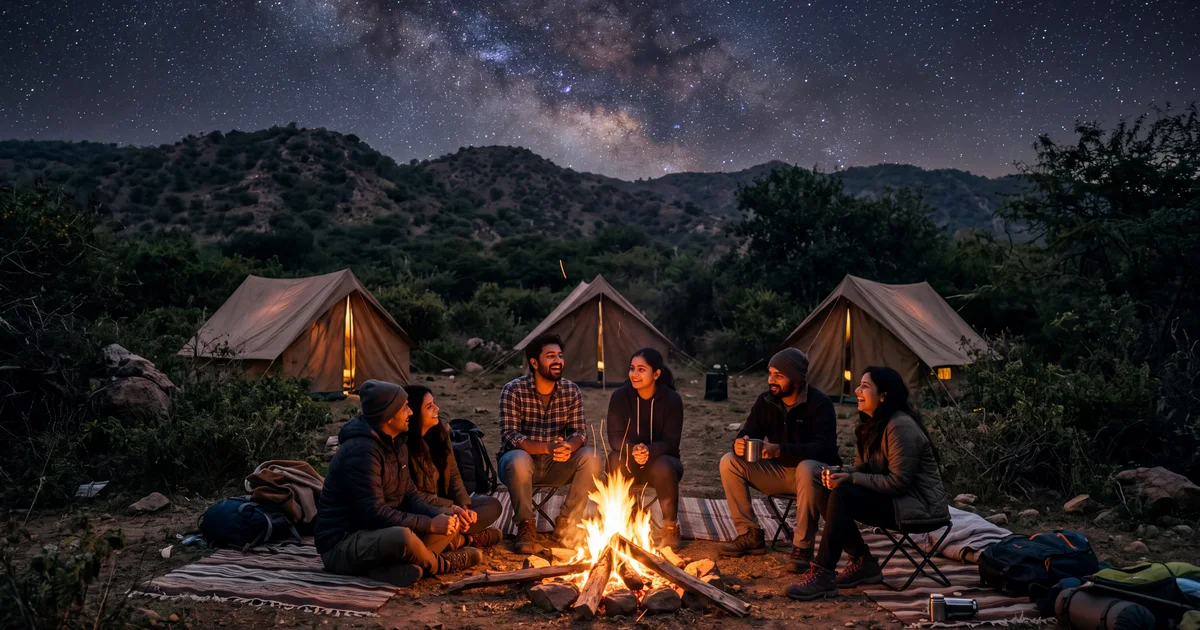
Delhi is flat, dusty, and 28 million people deep. None of that sounds like camping country. But drive 60 km in almost any direction and the terrain shifts: Aravalli ridges to the south, Shivalik forests to the north, and the Himalayan foothills within a half day. The camping options are more varied than you would expect from a city that barely has park benches.
The catch is sorting the real camps from the Instagram setups. Too many "camping experiences" near Delhi are a rented farmhouse with fairy lights, two tents on mowed grass, and a speaker blasting Bollywood at 11 PM. This guide skips those.
TL;DR
- Damdama Lake (60 km): closest option, lake and Aravalli setting, Friday night friendly
- Camp Wild Dhauj (45 km): rock face backdrop, good for beginners and families
- Rishikesh corridor (240 km): proper riverside camping on the Ganges, needs a full weekend
- Pangot and Nainital rim (300 km): forest camping at 2,000 metres, winter cold is real
- Budget: 1,200 to 3,000 rupees per person for managed camps, more with rafting or treks
What Are the Best Camping Places Near Delhi Within 100 km?
If your window is one night and you cannot take Friday off, you need something under two hours from South Delhi. Three spots consistently deliver.
Damdama Lake sits 60 km south via NH 48, just past Sohna in Gurgaon district. The lake itself is a modest rain fed reservoir surrounded by low Aravalli scrub hills. Camps line the western bank. You get a tent on flat ground, a bonfire pit, and kayaking on the lake if water levels cooperate (they usually do from September to March). Weekday camps here feel quiet. Long weekends in October and December turn it into a parking lot.
The honest caveat: Damdama is not wilderness. You can hear highway traffic from certain campsites when the wind shifts. If your idea of camping requires silence, keep reading.
Camp Wild at Dhauj is 45 km from Nehru Place via the Faridabad bypass. The setting is better than Damdama for people who want to feel enclosed by terrain: the camp sits at the base of a quartzite cliff face in the Aravallis. A seasonal stream runs through from July to November. Morning walks along the ridge take 30 to 40 minutes and give views over the Faridabad plains. It is well suited for families and first time campers.
Tikli Bottom, about 40 km from Gurgaon, is quieter than both but harder to find. The camp runs out of a restored farmstead in the Aravallis. Capacity is small (20 people max most weekends), which keeps the noise down. The trade off: fewer organized activities. You come here to sit by a fire and do nothing. That is the point.
I think Tikli Bottom is the most underrated option on this list. If you want a genuine break from Delhi sensory overload, 20 people in a valley beats 150 at a lake.
Is Rishikesh the Best Spot for Riverside Camping Near Delhi?
For proper riverside camping, yes. Nothing closer competes. The Ganges between Shivpuri and Kaudiyala (15 to 35 km upstream from Rishikesh town) runs through a forested gorge with sand and pebble beaches on both banks. Operators set up Swiss tents right on the riverbank from September to June.
The drive from Delhi is 240 km via Haridwar, typically 5 to 6 hours depending on how badly Roorkee traffic cooperates. Leave by noon on Saturday and you reach camp before dark. The standard package runs 2,500 to 4,500 rupees per person and includes a tent, meals, a 16 km rafting stretch in the morning, and a bonfire.
One thing nobody tells you: the Shivpuri stretch gets cold from December to February. Night temperatures along the river drop to 4 to 7 degrees Celsius. Sleeping bags provided by camps are often thin; bring your own blanket or a liner if you are going in January.
For something less crowded, look at camps upstream of Kaudiyala. The river section between Kaudiyala and Devprayag has fewer operators and bigger rapids (Grade III to IV), so it attracts experienced rafters rather than corporate team outings. Camps here are smaller, 30 to 40 people capacity versus 100+ at Shivpuri.
My opinion: Shivpuri camps work for a first timer who wants rafting plus camping in one package. But the place has become an outdoor theme park. If you have done it once, move upstream.
Where Can You Go Forest Camping Near Delhi?
The Aravalli scrub near Damdama and Dhauj does not count as forest camping. For actual tree cover, you need to go north.
Pangot, a village 15 km from Nainital at 1,960 metres elevation, sits inside dense oak and rhododendron forest. The birding here is exceptional: over 250 species recorded in a 5 km radius, including the koklass pheasant and rufous bellied woodpecker. Forest rest house bookings or private camps along the Pangot road run 1,500 to 2,500 rupees per night. The drive from Delhi is 300 km (6 to 7 hours), so plan for a full weekend.
The catch with Pangot: mobile signals are patchy once you leave the Nainital road. For some people that is the entire appeal. For others it is a deal breaker when they need to respond to a Monday morning email.
Jim Corbett National Park periphery offers jungle camping at Bijrani and Dhikala zones, but booking through the Uttarakhand forest department website requires planning 30 to 45 days in advance. Dhikala is inside the core zone (280 km from Delhi) and has a wild atmosphere: elephants cross the camp area at dawn, and you are not allowed outside your cabin after dark. Costs run 3,000 to 6,000 rupees per night depending on the accommodation type.
Rajaji National Park near Haridwar (210 km) has safari camping along the Ganges in the Chilla zone. Fewer tourists than Corbett, similar Shivalik forest setting. The mahseer fishing stretch near Chilla dam attracts anglers from September to November.
How Do You Plan a Camping Trip Near Delhi for a Group?
Groups of 8 or more get meaningfully better rates at most managed camps. A Damdama Lake operator charging 2,200 rupees per person for a couple will often drop to 1,500 to 1,800 for a group of 15. Always ask; the discount is rarely listed on the website.
Transport is the real planning variable. For spots under 100 km, cab pools work. For Rishikesh or Pangot, renting a Tempo Traveller (12 to 15 seater) from Delhi costs 8,000 to 12,000 rupees for a weekend round trip. Split across 12 people, that is under 1,000 per head for transport.
A few things to sort before booking:
Confirm tent capacity. "Two person tent" at many Delhi NCR camps means two thin mattresses on the ground touching each other. If you want space, book a four person tent for two.
Check washroom ratio. A camp advertising 50 tents but running 4 portable toilets is going to be unpleasant by Saturday morning. Anything below a 1:10 ratio is a red flag.
Ask about the sound policy. Group camps near Damdama and Dhauj often run music until midnight or later. If your group wants quiet, or if another group there does not, pick a smaller camp with limited capacity.
For group trips with fixed departures and verified operators, check options on TripzSearch. You can also browse Delhi departure trips specifically.
What Should You Pack for Camping Near Delhi?
Delhi campers consistently overpack or underpack. The gap between October nights (15 degrees, pleasant) and January nights (3 to 5 degrees, cold enough to wake you up) is large enough to change your entire gear list.
For October to November: a light jacket, mosquito repellent (non negotiable near any water body), a headlamp or torch, and closed shoes. Sandals work at the campsite but not on any trail, and Aravalli rock is sharp.
For December to February: thermal base layer, a down jacket or heavy fleece, woollen socks, and gloves if you are going above 1,500 metres. If the camp is in Rishikesh or Pangot, add a beanie. Sleeping bags provided by camps are usually rated to 10 degrees at best. Below that, you freeze.
Year round essentials: a power bank (2 to 3 full phone charges), toilet paper (even managed camps run out by night), a water bottle (tap water at camps is not always filtered), and sunscreen if you are camping in the Aravallis where tree cover is minimal.
One thing to skip: Bluetooth speakers. I know this is controversial, but if you want music in the forest, you can stay in Hauz Khas.
When Is Camping Near Delhi Not Worth It?
April to June. The plains around Delhi hit 42 to 46 degrees Celsius, and even evening temperatures in the Aravallis stay above 35 degrees. Tent interiors become unbearable by 7 AM. The only exception is high altitude spots like Chopta (2,700 metres) or the Nainital rim, where summer nights still drop to 12 to 15 degrees.
Monsoon (July to September) is mixed. The Aravallis turn surprisingly green and beautiful, but most camps near Damdama and Dhauj close because of waterlogging and unpredictable rain. Rishikesh camps stay open, but water levels rise and rafting operates on a shorter, safer stretch. Flash flood warnings are real along the Ganges corridor from mid July.
Long weekends in October and November (Dussehra, Diwali) bring massive crowds to every camp within 200 km of Delhi. If you cannot book three weeks in advance, do not bother. The alternative: go on a regular weekend in late November when crowds thin and temperatures are still comfortable.
Beyond the Tent: Combining Camping with Treks and Activities
The best camping trips near Delhi are not just about sitting by a fire. Pair the night stay with a morning activity and the trip feels twice as long.
At Dhauj, morning rock climbing sessions on the Aravalli cliff face run 800 to 1,200 rupees per person. Routes range from 20 to 40 feet, bolted and suitable for beginners. Instructors handle all gear.
At Rishikesh, the 16 km Shivpuri to Rishikesh rafting stretch is the standard morning add on. You break camp at 8 AM, raft through Grade II to III rapids for 2 to 3 hours, and finish in Rishikesh town in time for lunch at Chotiwala.
Near Pangot, the Kilbury bird trail starts at dawn and runs 4 km through oak forest. Even non birders find the walk worth it for the canopy cover and silence. In winter, the trail gets frost before 7 AM.
For multi day options, the Nag Tibba base camp (90 km from Mussoorie, accessible from Delhi via Dehradun) combines one night of camping at 2,400 metres with a summit push next morning to 3,022 metres. The Himalayan panorama from the top, Bandarpoonch, Swargarohini, Kedarnath range, is the best you can get within a weekend from Delhi.
Browse destination guides or check Delhi area trips for group departures that bundle camping with treks or rafting.
Practical Logistics from Delhi
By car: NH 48 south to Damdama and Dhauj (1 to 1.5 hours). NH 44 then NH 334 to Rishikesh (5 to 6 hours). NH 9 to Nainital and Pangot (6 to 7 hours via Haldwani).
By bus: ISBT Kashmere Gate runs Volvo and semi sleeper services to Rishikesh (4.5 hours, 500 to 900 rupees), Haridwar (4 hours, 400 to 700 rupees), and Nainital (7 hours, 600 to 1,000 rupees). The last mile from bus stand to campsite usually needs a local cab.
By train: Shatabdi to Haridwar (4.5 hours, arrives by noon) works well for Rishikesh camps. Kathgodam Shatabdi for Nainital side. Both run daily and book up 2 to 3 weeks ahead in peak season.
Group transport: Tempo Traveller (12 seater) for a weekend round trip to Rishikesh costs 10,000 to 12,000 rupees. To Nainital, expect 12,000 to 15,000 rupees. Always confirm toll charges are included in the quote.
For finding group trips with transport included, the simplest route is a fixed departure where the operator handles pickup from a Delhi meeting point.
Frequently asked questions
- What is the best time for camping near Delhi?
- October to February gives the best conditions. Night temperatures in the Aravalli foothills drop to 8 to 14 degrees Celsius, and skies stay clear enough for stargazing. March is still manageable, but April onwards the plains heat makes tent sleeping miserable unless you head above 1,500 metres. Monsoon camps (July to September) work only in Uttarakhand river corridors where operators are set up for rain.
- How much does camping near Delhi cost per person?
- Budget between 1,200 and 3,000 rupees per person for one night at managed sites like Damdama Lake or Tikli Bottom. This typically covers tent, dinner, breakfast and one activity such as a bonfire or short nature walk. Rishikesh and Chopta corridor camps run 2,500 to 5,000 rupees when rafting or trekking is included. Self camping with your own gear at forest rest houses or dam banks costs 200 to 500 rupees in fees.
- Which is the closest camping spot to Delhi?
- Damdama Lake in Gurgaon district is about 60 km from central Delhi, reachable in 90 minutes via NH 48. Camps there sit beside the lake with Aravalli scrub hills behind. You can leave after work on Friday and reach before dark. The downside: it gets crowded on long weekends.
- Is camping near Delhi safe for beginners and families?
- Yes. Most operator run camps near Delhi are beginner friendly with pre pitched tents, attached washrooms within 50 metres, camp coordinators, and flat cleared ground. Spots like Camp Wild Dhauj and Damdama lakeside operators cater specifically to families and first timers. Avoid solo wild camping near canals or highways.
- Can I do riverside camping near Delhi?
- Rishikesh (240 km, 5 to 6 hours) is the closest reliable option for proper riverside camping on the Ganges. Closer alternatives include the Yamuna banks near Paonta Sahib (about 280 km via Dehradun) and seasonal setups near Hathinikund barrage (150 km). For river adjacent camping within 2 hours, Camp Wild at Dhauj near the Aravalli foothills has a small seasonal stream.
- Do I need my own camping gear for trips near Delhi?
- Not for organized camps. Operators provide tents, sleeping bags, mats and basic pillows. Bring a torch, mosquito repellent (essential October to November), a warm layer for post midnight cold, and a power bank since most camps lack charging points. If you prefer BYO setups, confirm with the operator first because some sites charge differently.