Brahmatal Trek (2026): Snow, Frozen Lakes and Winter Departures from Delhi
Brahmatal trek guide covering route, best time, cost and group departures from Delhi. Frozen lakes, Tharali views and 12,250 ft summit.
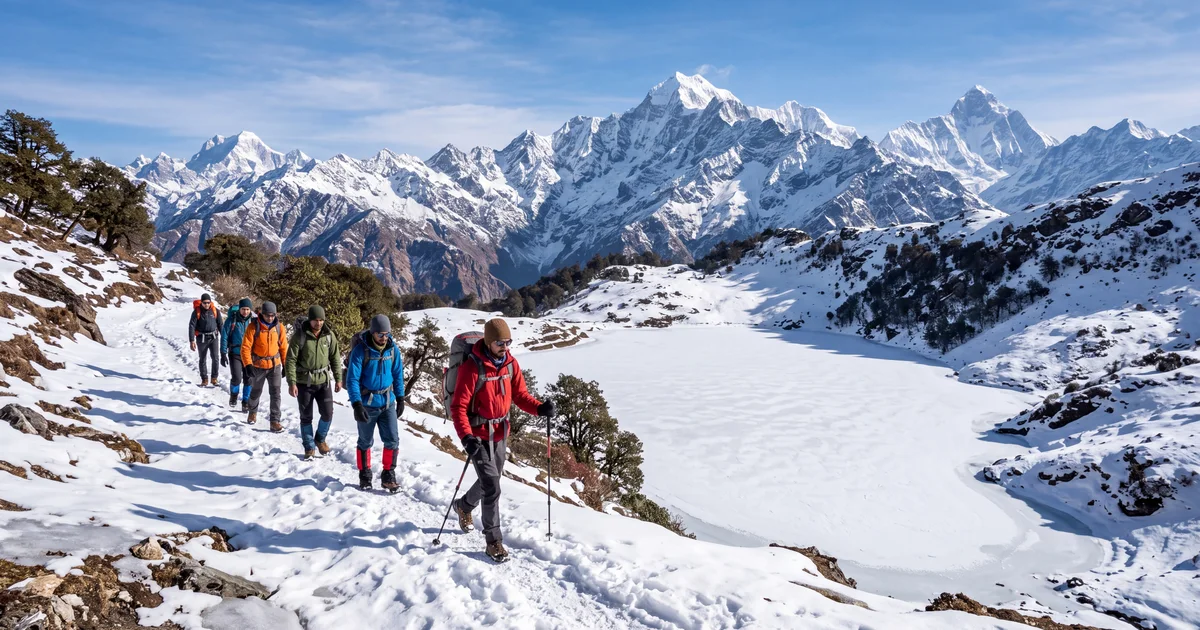
The Brahmatal trek puts you on a frozen lake at 11,200 ft with Trisul and Nanda Ghunti filling the horizon. That is not hyperbole. On a clear January morning, the view from the ridgeline above Brahmatal Lake is among the best you will get in Uttarakhand without technical climbing.
The trail starts from Lohajung, a 10 hour drive from Rishikesh, and takes 5 to 6 days round trip. It crosses oak and rhododendron forests, open alpine meadows, and two frozen lakes before reaching the summit at 12,250 ft. The route is not steep in the conventional sense, but snow makes every section slower, and altitude fatigue hits harder when your lungs are working in minus 10°C air.
TL;DR
- Best window: December to March. January and February for full snow and frozen lakes.
- Summit altitude: 12,250 ft (3,734 m). Rated moderate.
- Typical group cost from Delhi: 8,000 to 14,000 rupees for 6 days.
- Base village: Lohajung, Chamoli district, Uttarakhand.
- You see Trisul (7,120 m), Nanda Ghunti (6,309 m), and Hathi Ghoda peaks from the ridge.
What makes Brahmatal different from other winter treks?
Most winter Himalayan treks in Uttarakhand follow forested valleys and give you snow at the summit. Brahmatal does something else. By day 2 you are walking on open snowfields with 270 degree mountain views. The frozen lake appears on day 3, not as a final reward but as a midway campsite.
Compared to Kedarkantha (which is steeper but shorter), Brahmatal spreads the altitude gain over more days. You gain roughly 700 ft per day on average. That makes acclimatization easier for people who get headaches above 10,000 ft.
The trail is also quieter. Kedarkantha sees 30 to 40 trekkers per day at peak season. Brahmatal gets 10 to 15. If you want a winter trek that feels less like a highway, this is the one.
One caveat: Brahmatal has no tea houses or permanent shelters. You are fully dependent on your group's camping setup. A bad tent or a poorly insulated sleeping bag will ruin the experience when temperatures drop to minus 15°C after sunset.
Route and itinerary: what each day looks like
The standard 6 day itinerary breaks down like this:
Day 1: Delhi to Lohajung. Overnight bus or shared cab to Rishikesh, then a 10 hour drive via Karnaprayag and Dewal. Most groups depart Delhi at 6 PM and reach Lohajung by next afternoon. The road past Tharali is narrow and winding. Motion sickness tablets are not optional.
Day 2: Lohajung to Bekaltal (9,700 ft). A 4 to 5 hour walk through oak and rhododendron forest. The trail is well marked and gains about 2,000 ft. Bekaltal is a small frozen lake surrounded by trees. Camp here.
Day 3: Bekaltal to Brahmatal Lake campsite (11,200 ft). This is where the forest ends and the snowfields begin. You gain 1,500 ft over 5 hours. The last hour is exposed alpine terrain. Brahmatal Lake sits in a depression with Trisul visible to the northeast. Camp next to the frozen lake.
Day 4: Summit day. Brahmatal Top (12,250 ft) and descent to Tilandi (10,500 ft). Start at 5 AM. The climb to the summit takes 3 hours on snow. The ridge gives a panoramic view: Trisul, Nanda Ghunti, Hathi Parbat, and on clear days, the Chaukhamba massif far to the north. Descend to Tilandi for camp. Total walking: 7 to 8 hours.
Day 5: Tilandi to Lohajung. A simple 4 hour downhill walk. You reach Lohajung by noon and can catch afternoon transport toward Rishikesh.
Day 6: Lohajung to Delhi. The return drive takes 10 to 12 hours depending on road conditions and season.
Some operators compress this into 5 days by combining days 1 and 2. That works only if you are comfortable with a 6 AM start after an overnight drive.
How hard is the Brahmatal trek, really?
The difficulty is moderate by Indian Himalayan standards. Here is what that means in practical terms.
The steepest single section is the summit push on day 4: 1,050 ft of elevation gain in 3 hours, mostly on compacted snow. You will need gaiters and microspikes. Some groups carry crampons for icy patches, but microspikes suffice in most conditions.
The total trek distance is approximately 22 km one way. Daily walking ranges from 4 to 8 hours. The pace is slow on snow, about 2 km per hour including rest stops.
Fitness requirement: you should be able to walk 12 km on flat ground without stopping and climb 10 floors of stairs without gasping. If you ran even once last week, you are probably fine. If the last physical activity you did was in school, start training 6 weeks before.
The real challenge is cold, not terrain. Night temperatures at Brahmatal Lake camp reach minus 12 to minus 15°C in January. Your sleeping bag needs to be rated to minus 20°C. Renting a cheap bag from the operator is a gamble. Ask what brand and rating they provide before booking.
When should you go (and when should you skip it)?
The season runs December to March. Each month offers something different.
December: Snow begins building. Lower camps (Bekaltal) may have thin coverage. The lake starts freezing. Fewer groups operate in early December, so you might get a private campsite. Temperatures are cold but not brutal (minus 5 to minus 10°C at night).
January: Peak season. Deep snow from Bekaltal onward. The lake is fully frozen and walkable. Trekking groups are at their largest, 8 to 12 people per batch. This is the best month for photography. Expect minus 12 to minus 15°C at camp.
February: Similar to January but with slightly more consolidated snow. The trail is packed down by previous groups, making walking easier. Late February can bring unexpected snowfall that blocks the road to Lohajung for 2 to 3 days. Build buffer days into your plan.
March: The snow melts fast at lower altitudes. Bekaltal may be slushy. The summit still has snow but it is patchy by late March. If you want a less intense cold experience, early March is a compromise.
April onward: The snow is gone. Do not book a "Brahmatal winter trek" that departs after March 15. Some budget operators advertise April departures without disclosing that you will see green meadows instead of snowfields.
What does a group departure from Delhi cost?
Most operators price the Brahmatal trek between 8,000 and 14,000 rupees per person for the standard 6 day package. That spread depends on group size, equipment quality, and food.
The package typically includes: transport from Rishikesh to Lohajung and back, all meals on the trek (3 per day plus tea), camping equipment (tent, sleeping bag, mat), a guide, a cook, and forest permits.
Not included: travel from Delhi to Rishikesh (bus 500 to 800 rupees, train 300 to 600 rupees), personal gear (jacket, trekking poles, gaiters), and tips for the trek crew.
If you see a package under 7,000 rupees, check what they provide for sleeping bags. A bag rated to minus 5°C will not cut it at Brahmatal Lake in January. The cheapest operators save money on insulation, and you pay for it at 2 AM when you cannot feel your feet.
For current prices and available group departures, check /trips where you can compare operators side by side.
How to reach Lohajung from Delhi
Option 1 (most common): Delhi to Rishikesh, then shared cab to Lohajung. Delhi to Rishikesh: overnight Volvo bus (6 hours, 800 to 1,200 rupees) or train to Haridwar then local bus (7 hours total, 350 to 600 rupees). Rishikesh to Lohajung: shared Sumo or Bolero via Karnaprayag, Tharali, and Dewal. This stretch takes 10 hours and costs 1,500 to 2,000 rupees per seat. The road is narrow past Tharali with sharp turns and no guardrails for long stretches.
Option 2: Fly to Dehradun, cab to Lohajung. Faster by 3 hours but more expensive. Delhi to Dehradun flight (1 hour, 3,000 to 5,000 rupees). Then a private cab to Lohajung (12 hours, 8,000 to 10,000 rupees one way).
Most group departures include Rishikesh to Lohajung transport. Book a Delhi to Rishikesh bus yourself the night before the trek start date.
One thing to know: in January and February, the road between Dewal and Lohajung occasionally gets blocked by snowfall for 12 to 24 hours. Budget one extra day as a buffer when planning your return flight or train.
What to pack for the Brahmatal trek in winter
The gear list matters more here than on most Indian treks because the cold is the primary challenge.
Essentials: 4 layer upper body system (thermal base, fleece, down jacket, waterproof shell), 3 layer lower (thermal, trek pants, waterproof over pants), insulated gloves with liner gloves beneath, balaclava or neck gaiter that covers your nose, sunglasses with side shields (snow glare at 12,000 ft causes real eye pain), microspikes for snow, trekking poles with snow baskets, and a water bottle you can keep inside your jacket (bottles freeze solid overnight).
Skip the heavy DSLR unless you have a chest harness. Pulling a camera from your backpack with frozen fingers is slow and frustrating. A phone with a power bank inside your jacket pocket is faster for most people.
Your sleeping bag is the single most critical item. If the operator's bag is rated below minus 15°C, bring your own or rent from a gear shop in Rishikesh. Decathlon Rishikesh stocks minus 20°C bags for rent at 200 rupees per day.
Is Brahmatal right for you?
If you want snow and frozen lakes with moderate effort, yes. If you want a summit that feels earned without being technical, yes. If you want to see Trisul and Nanda Ghunti from a ridge that takes 3 hours to reach, yes.
If you dislike camping, no. If you cannot handle cold below minus 5°C, no. If you want hot showers and warm beds, look at Chopta or Auli instead.
The Brahmatal trek rewards people who are comfortable being uncomfortable for 4 days in exchange for a landscape most Indians never see outside photographs. It is not the hardest winter trek. It is not the easiest. It sits in that middle zone where first time winter trekkers and experienced ones both find something worthwhile.
Browse Himalayan group treks with fixed departures to compare dates and operators, or explore all group trips from Delhi if you are looking for something closer to home.
Frequently asked questions
- What is the best time to do the Brahmatal trek?
- December to March is the ideal window. January and February offer the thickest snow cover and frozen lakes. December works if you prefer lighter snow and fewer crowds at campsites.
- How difficult is the Brahmatal trek for beginners?
- Brahmatal is rated moderate. The summit day involves 6 to 7 hours of walking on snow at 12,250 ft. If you can climb stairs for 20 minutes without stopping and have one prior trek under your belt, you can handle it.
- How much does a Brahmatal trek package cost from Delhi?
- Group departures from Delhi typically cost between 8,000 and 14,000 rupees per person for 6 days. This includes transport from Rishikesh, meals, tents, permits and a guide. Flights or trains to Delhi are extra.
- Can I do the Brahmatal trek in summer?
- The trail is open May to June but you will miss the snow and frozen lakes entirely. The views of Trisul and Nanda Ghunti remain, but the trek loses its defining character without the winter landscape.
- Is the Brahmatal trek open in December?
- Yes. December marks the start of the season. Early December may have patchy snow at lower camps, but Brahmatal Lake and the summit ridge are reliably snow covered by mid December.
- What altitude does the Brahmatal trek reach?
- The highest point is Brahmatal Top at 12,250 ft (3,734 m). The frozen Brahmatal Lake sits at approximately 11,200 ft. Most of the trail between camps stays above 9,000 ft.