Best Treks in India (2026): 20 Trails Across the Himalayas, Sahyadris and Western Ghats
20 best treks in India for 2026 with routes, difficulty, costs and group departures across the Himalayas, Sahyadris and Western Ghats.
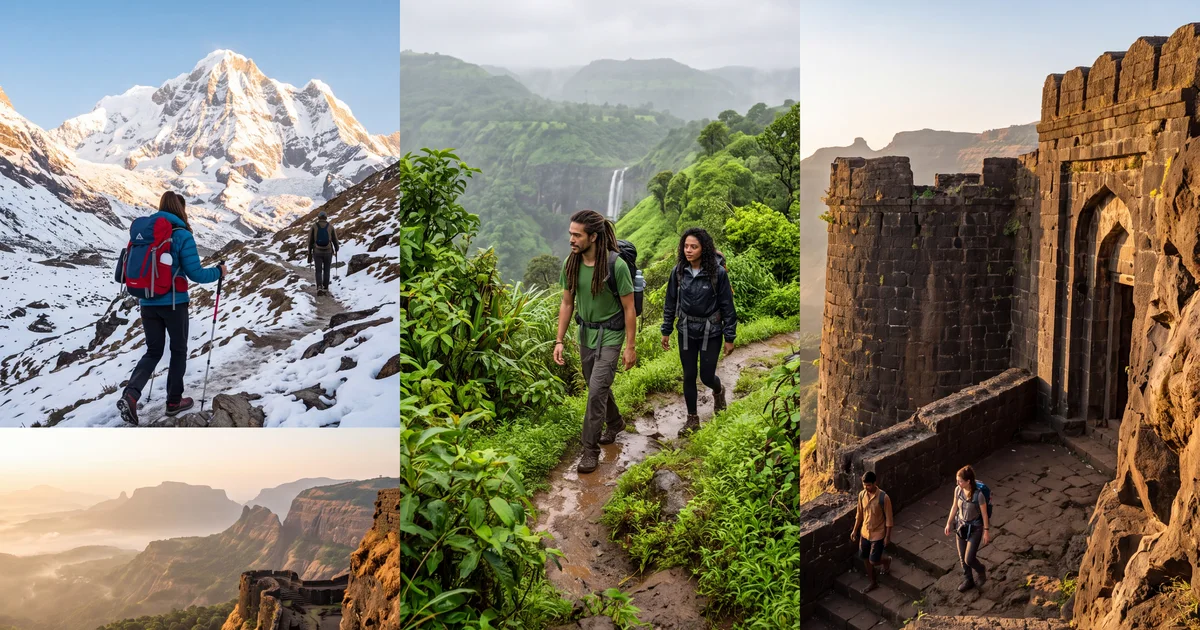
India has more trekking variety packed into one country than most people realize. You can walk on a frozen river in Ladakh in January, wade through knee high monsoon grass on a Sahyadri fort in August, and camp beside alpine flowers in Uttarakhand in September. Three different mountain systems, three different seasons, three completely different experiences.
This list covers 20 treks across the Himalayas, Sahyadris, and Western Ghats. Each one has been picked because it offers something specific: a route worth repeating, a view that justifies the sore legs, or access through organized group departures that take the logistics off your plate. No ranking by "best." The right trek depends on when you are going, how fit you are, and whether you want snow, jungle, or coastline.
TL;DR
- India has trekking across three mountain systems: Himalayas (north), Sahyadris (west), and Western Ghats (south).
- Himalayan treks run April to June and September to November. Sahyadri treks are best in monsoon (July to September).
- Beginner picks: Triund, Kedarkantha, Nag Tibba. Advanced: Chadar, Roopkund, Pin Parvati.
- Group departures with operators start from ₹3,000 for weekend Sahyadri treks to ₹20,000+ for multi day Himalayan expeditions.
- Browse fixed departure treks across India for upcoming dates.
What Makes a Trek Worth Doing in 2026?
Not every trail on a "top treks" list deserves to be there. Some get recommended because they have always been recommended. Here is how this list was filtered.
First, the trek must be accessible through organized departures. A trail that requires you to source your own porters and navigate unmarked routes is an expedition, not a trek. Every entry here has at least one operator running fixed departure groups, which matters if you are booking from a different city.
Second, the trail condition matters more than the Instagram photos. Roopkund looks spectacular in photos. It is also a difficult 53 km trek at altitude with a glacier crossing. The list includes both easy weekend options and serious multi day routes, but each entry notes the real difficulty so you can match it to your experience.
Third, permits and access in 2026. Some trails have seasonal closures or newly enforced permit requirements. The details below reflect the current status as of September 2026.
Himalayan Treks: The Big Mountains
The Himalayas run 2,500 km across northern India, from Ladakh in the west to Sikkim in the east. Most trekking happens in Uttarakhand, Himachal Pradesh, and Jammu & Kashmir, where the infrastructure of base camps, operators, and transport connects to the trail network.
1. Kedarkantha (3,810 m), Uttarakhand
Kedarkantha is the most popular winter trek in India for good reason. The trail starts from Sankri village (accessible from Dehradun, 7 hours by road) and takes 4 days. You walk through pine and oak forests, camp at treeline, and summit on day 3 with 360 degree views of Swargarohini, Bandarpoonch, and Black Peak.
Difficulty is moderate. No technical sections. Total distance is 20 km. Snow starts in December and stays through March. Group departures run ₹7,000 to ₹12,000 per person including food, camping, and guide.
The honest caveat: weekends in December and January get crowded at the summit camp. If you can go midweek, the experience improves significantly.
2. Valley of Flowers (3,658 m), Uttarakhand
A UNESCO World Heritage Site that opens only from June to October. The valley floor at 3,352 metres blooms with over 600 species of wildflowers, and the peak bloom window is late July to mid August. The trek starts from Govindghat (near Joshimath) and is 17 km one way to the valley.
Most groups combine Valley of Flowers with Hemkund Sahib, a Sikh shrine at 4,329 metres. The combination takes 5 to 6 days. Difficulty is moderate, though the altitude gain on the Hemkund day catches people off guard. Entry permit costs ₹150.
My honest take: go in the first two weeks of August. By late August the bloom fades and you are basically doing a rainy trek through green grass. Timing is everything here.
3. Hampta Pass (4,270 m), Himachal Pradesh
This one stands out because it crosses from the green Kullu valley to the barren Lahaul side in a single pass. The contrast is dramatic. You start in Manali, trek through forests and glacial moraines for 4 days, cross the pass on day 3, and get dropped at Chandratal lake before returning by road.
Total distance is about 26 km of trekking. Difficulty is moderate to hard, mostly because of the altitude gain at the pass and the river crossings that can be tricky during monsoon. Best months are June, September, and early October. Group departures cost ₹9,000 to ₹14,000.
The river crossing near Balu ka Ghera is the section to watch. In heavy rain it becomes waist deep. Operators sometimes reroute, so check conditions before booking a July departure.
4. Roopkund (5,029 m), Uttarakhand
Known as the "Mystery Lake" trek because of the 500+ human skeletons found at the glacial lake at 5,029 metres. The trek itself is a serious 53 km round trip from Lohajung over 7 to 8 days. You cross Junargali Pass at 4,750 metres and camp at Bhagwabasa (4,100 m) before the summit day push.
This is not a beginner trek. The altitude, distance, and unpredictable weather above 4,500 metres make it genuinely challenging. Prior high altitude experience is recommended. Best window is May to June and September to October.
Note: the Uttarakhand forest department has periodically restricted access to Roopkund to protect the archaeological site. Confirm current access status before booking.
5. Sandakphu (3,636 m), West Bengal
The only trek in India where you can see four of the world's five highest peaks in one panorama. Everest, Kangchenjunga, Lhotse, Makalu. All visible from a single ridge point on a clear morning. The trek starts from Manebhanjan (28 km from Darjeeling) and takes 4 to 5 days.
The Singalila Ridge route follows the India Nepal border through rhododendron forests that bloom spectacular red in April. Distance is about 51 km. Difficulty is moderate with long walking days (12 to 16 km). Permit for Singalila National Park costs ₹200.
October to mid November gives the clearest views. January and February are bitterly cold (minus 10°C at camp) but uncrowded if you can handle it.
6. Chadar Trek, Ladakh
Walking on a frozen river in minus 25°C. That is the Chadar. The Zanskar River freezes solid from January to February, creating a natural ice highway between towering canyon walls. The trek covers 62 km over 6 to 8 days.
This is the hardest mainstream trek on this list. The ice shifts, cracks, and occasionally gives way. You sleep in caves along the river. Temperatures regularly drop below minus 30°C at night. Group departures are the only practical way to do it, and they cost ₹25,000 to ₹40,000.
If you have done at least two multi day Himalayan treks and can handle extreme cold, the Chadar is unforgettable. If this is your first trek, pick literally anything else.
7. Brahmatal (3,425 m), Uttarakhand
A winter alternative to Kedarkantha that is less crowded and arguably more scenic. The trail passes two frozen alpine lakes (Bekaltal and Brahmatal) and offers clear views of Trishul and Nanda Ghunti. The trek starts from Lohajung (10 hours from Rishikesh) and takes 4 days.
Total distance is 22 km. Difficulty is moderate. Snow is reliable from December to March. Group costs run ₹8,000 to ₹12,000.
The best part of Brahmatal is the silence. Kedarkantha gets 40 to 50 trekkers at summit camp on weekends. Brahmatal gets 10 to 15.
8. Chopta Tungnath (3,680 m), Uttarakhand
The world's highest Shiva temple sits at 3,680 metres at Tungnath, and the summit of Chandrashila (4,000 metres) is just 1.5 km further. The trek from Chopta village is short (3.5 km to Tungnath) but steep. Most people do it as a 2 day trip.
This works well as a first Himalayan trek. The altitude is manageable, the trail is clear, and the views of Nanda Devi, Chaukhamba, and Kedarnath peak are outstanding. Best months: March to June and September to November. Avoid monsoon; the trail gets dangerously slippery.
9. Triund (2,828 m), Himachal Pradesh
The most accessible Himalayan trek in India. The trail from McLeodganj is 9 km one way, gains 1,100 metres, and takes 4 to 5 hours. You camp at the top with the Dhauladhar range filling the skyline. No permits needed. You can do it solo or with a group.
Triund's weakness is also its strength: accessibility means crowds. Friday evening to Sunday is packed during season. Go on a Tuesday in October and you will have the ridge almost to yourself.
10. Nag Tibba (3,022 m), Uttarakhand
The highest peak in the lower Himalayas of Garhwal, and a solid weekend trek from Delhi. The trail from Pantwari village (3 hours from Dehradun) takes 2 days. Summit views include Bandarpoonch, Swargarohini, and the Gangotri group on clear mornings.
Total distance is 16 km. Difficulty is easy to moderate. Group costs run ₹3,500 to ₹6,000 for a weekend departure including transport from Dehradun. A reliable choice when you want mountains without committing to a week long expedition.
Sahyadri Treks: Forts and Monsoon Green
The Sahyadris (Western Ghats in Maharashtra) are a different animal entirely. These are basalt plateaus and cliff forts, best trekked in the monsoon when waterfalls appear on every cliff face. The treks are shorter (typically 1 to 2 days) but steeper, and the history of Maratha forts adds a layer that pure nature treks lack.
11. Harishchandragad (via Kokan Kada), Maharashtra
The Kokan Kada cliff is a 500 metre vertical overhang. It is the single most dramatic cliff formation in the Sahyadris. The trek to the top starts from Khireshwar village (3 hours from Pune) and takes 5 to 6 hours. The route via Nalichi Vaat involves scrambling up a narrow, exposed rock chimney.
Nalichi Vaat is not for beginners. If scrambling unnerves you, take the Pachnai route instead (longer but no exposure). Best time is July to September when the monsoon turns the entire mountain into a waterfall amphitheatre. No permit required.
12. Rajmachi Fort, Maharashtra
Two fort bastions (Shrivardhan and Manaranjan) perched above a valley that fills with waterfalls in monsoon. The trek from Lonavala is 15 km one way. Most people camp at Udhewadi village between the forts. The trail is well marked and suitable for beginners.
What makes Rajmachi worth the drive from Mumbai (90 minutes to Lonavala) is the monsoon transformation. In October it is a dry brown hike. In August the same valley has 30+ waterfalls visible from camp. Time it right.
13. Torna Fort, Maharashtra
Torna was the first fort captured by Shivaji Maharaj in 1643. The trek from Velhe village (50 km from Pune) takes 2 to 3 hours on a steep trail with rock cut steps. Elevation gain is about 500 metres. Difficulty is easy to moderate.
The fort ruins at the top are extensive. You can spend an hour exploring the bastions, water cisterns, and the Zunjar Machi viewpoint. Monsoon weekends get busy. Start early (6 AM) to beat the crowds and the afternoon rain.
14. Bhira Dam and Andharban, Maharashtra
Andharban means "dark forest," and the name fits. The trail descends 13 km through dense tree cover in the Tamhini Ghat, ending at Bhira dam. The route is one way (you need transport at both ends) and drops about 700 metres. It is one of the most atmospheric monsoon treks near Pune.
The best approach: start at the Andharban trailhead (near Pimpri village), trek downhill through the forest, and finish at Bhira dam for lunch. In peak monsoon the trail has stream crossings that go knee deep. Leeches are guaranteed between July and September. Bring salt.
Western Ghats: South India's Green Lungs
South of the Sahyadris, the Western Ghats become the mountain backbone of Karnataka, Kerala, and Tamil Nadu. The treks here are shorter and lower in altitude, but the shola grasslands, coffee estates, and biodiversity make them distinct.
15. Kudremukh (1,894 m), Karnataka
Kudremukh peak sits inside a national park, and the 10 km trail from the park entrance crosses rolling grasslands with views that stretch to the Arabian Sea on clear days. Monsoon (July to September) is the prime season, when the entire landscape turns emerald green and waterfalls appear on every slope.
You need a forest department permit (book online, ₹350 for Indians). The trail is well marked but long, so start by 6 AM to finish before afternoon rain builds. Group treks from Bangalore cost ₹3,000 to ₹5,000 for a weekend.
The catch: leech socks are not optional in monsoon. The last 2 km to the summit gets steep and slippery when wet.
16. Tadiandamol (1,748 m), Karnataka
The highest peak in Coorg (Kodagu district), and the easiest summit trek on this list. The trail from Nalaknad Palace is 8 km round trip and takes 4 to 5 hours. You walk through shola forest and open grassland with views of the Brahmagiri range.
This trek works year round but September to February is the sweet spot. The post monsoon months have clear skies and still green hills. It pairs well with a Coorg coffee estate stay.
17. Kumara Parvatha (1,712 m), Karnataka
The toughest trek in Karnataka. The trail from Kukke Subramanya is 22 km round trip with 1,300 metres of elevation gain and multiple false summits. The full route takes 2 days with camping at Bhattra Mane (a ranger station midway).
This trek filters out casual hikers fast. The first 6 km is a relentless staircase. If you have done Tadiandamol and Kudremukh and want something that will actually tire your legs, Kumara Parvatha is the answer. Best season is October to February. Monsoon is possible but slippery.
18. Chembra Peak (2,100 m), Kerala
Chembra in Wayanad is known for the heart shaped lake near the summit. The trek is 9 km round trip from the entry gate and takes about 5 hours. You need a permit from the forest office in Meppadi (₹500 per group).
The lake is real and genuinely shaped like a heart. That said, the forest department restricts access beyond the lake to protect the fragile shola ecosystem. The views from the lake viewpoint cover the entire Wayanad plateau. Best visited between September and March.
19. Meesapulimala (2,640 m), Tamil Nadu
The second highest peak in South India, inside the Eravikulam buffer zone. The trek from the village of Suryanelli is 15 km round trip and requires a guide mandated by the forest department. The trail crosses high altitude grassland with panoramic views of the Kerala plains.
Permits are strictly limited and must be arranged through the Tamil Nadu forest department. Group departures are rare but some Kerala based operators run guided trips. November to March is the season. This one requires planning, but the payoff is standing at 2,640 metres on a grassy summit with no one else in sight.
20. Mullayanagiri (1,930 m), Karnataka
The highest point in Karnataka, and ironically one of the easiest to reach. A motorable road goes most of the way. The actual trek from the Sarpadhari steps is 3 km one way. For anyone looking at a quick sunrise trek paired with a Chikmagalur coffee weekend, this is the move.
Start at 4:30 AM from the base to catch sunrise at the summit temple. The steps are steep but short. Clear mornings give views across the Baba Budan range. Pair it with a visit to the coffee estates for a full weekend from Bangalore.
How to Pick the Right Trek for Your Level
If you have never trekked before, start with Triund, Nag Tibba, or Tadiandamol. These trails are forgiving, well marked, and short enough to complete in a weekend. You get mountain views without committing to altitude, multi day logistics, or extreme weather.
If you have done 2 to 3 treks and want to step up, look at Kedarkantha, Sandakphu, or Kudremukh. These involve multiple days, moderate altitude, and enough physical challenge to feel earned. Group departures handle the logistics so you can focus on fitness.
If you are experienced and want a real test, Roopkund, Chadar, and Kumara Parvatha deliver. These require genuine preparation, prior high altitude experience (for the Himalayan options), and comfort with uncertainty.
How Much Do Treks in India Cost in 2026?
Cost varies wildly by region, duration, and operator.
Sahyadri weekend treks near Pune or Mumbai run ₹1,500 to ₹3,000 per person with a group, or nearly free if you go independently and carry your own food. Western Ghats treks in Karnataka range ₹3,000 to ₹6,000 for a weekend departure from Bangalore.
Himalayan treks cost more. A 4 to 5 day trek like Kedarkantha or Brahmatal runs ₹7,000 to ₹14,000. Longer treks (Valley of Flowers, Roopkund) go ₹12,000 to ₹20,000. The Chadar trek, which requires specialized cold weather gear and cave camping logistics, tops out at ₹25,000 to ₹40,000.
These prices typically include meals, camping or teahouse accommodation, a guide, and permits. Airfare or train tickets to the base town are almost always extra. Check group trek departures for current prices and dates.
What to Pack for a Trek in India
Skip the 47 item packing lists. Here is what actually matters.
For Sahyadri monsoon treks: waterproof bag, leech socks, a rain jacket (not a poncho, the wind rips them), and shoes with grip. Cotton kills. Wear synthetic or merino.
For Himalayan treks: layers are the system. A base layer, a fleece, and a waterproof shell handle most conditions from June to October. Add a proper down jacket for anything above 4,000 metres or in winter. Trekking poles save your knees on descent.
For Western Ghats treks: similar to Sahyadri gear for monsoon. Post monsoon, it is warm enough for a t shirt and light trousers. Bring sun protection; the grasslands above treeline offer zero shade.
One thing most packing lists skip: broken in shoes. Do not wear new boots on trek day. Walk at least 30 km in them before showing up at base camp.
Where to Find Group Trek Departures
If you are trekking from Bangalore, Delhi, Pune, or Mumbai, the number of operators running fixed departure groups has grown significantly. The advantage of a group departure over self organized treks is straightforward: permits, transport from the nearest city, meals, camping gear, and a guide are handled. You show up at the meeting point with a backpack.
Browse upcoming trek departures across the Himalayas and Western Ghats to find dates that work for your schedule.
Frequently asked questions
- What is the best trek in India for beginners?
- Triund in Himachal Pradesh is the most recommended beginner trek. The trail from McLeodganj is 9 km one way, gains 1,100 metres, and takes 4 to 5 hours. There are no technical sections. Kedarkantha in Uttarakhand is another strong option for first timers, with a well marked trail and organized group departures.
- Which is the hardest trek in India?
- The Chadar trek in Ladakh is widely considered the toughest mainstream trek in India. You walk on a frozen river at temperatures below minus 25°C for 6 to 8 days. Stok Kangri (6,153 metres) and Pin Parvati Pass are other high difficulty options that require prior alpine experience.
- What is the cheapest trek in India?
- Sahyadri fort treks near Pune and Mumbai cost almost nothing if you go independently. Torna, Rajmachi, and Harishchandragad have no entry fees. Add ₹500 to ₹1,000 for transport and food and you have a full weekend trek. In the Himalayas, Triund and Nag Tibba run ₹3,000 to ₹5,000 with a group operator.
- When is the best time for trekking in India?
- It depends on the mountain range. Himalayan treks are best from April to June and September to November. Sahyadri and Western Ghats treks peak during the monsoon from July to September, when waterfalls and green valleys are at their best. Winter (December to February) is ideal for snow treks like Kedarkantha and Brahmatal.
- Can I do Himalayan treks from Bangalore?
- Yes. You fly to Delhi, Dehradun, or Kullu and join a group departure from the trek base. Most operators include transport from the nearest airport or railhead. Kedarkantha, Hampta Pass, and Valley of Flowers are popular choices for trekkers flying from Bangalore. Browse fixed departure dates on TripzSearch.
- Do I need a permit for trekking in India?
- Some treks require permits. Singalila National Park (Sandakphu) charges ₹200 for Indians. Valley of Flowers charges ₹150. Roopkund and parts of Ladakh need inner line permits. Most group operators handle permit procurement. Sahyadri treks in Maharashtra generally do not require any permits.